Movie review
November 9, 2022 · 162 min · PG-13 · Sci-Fi · Action · Adventure
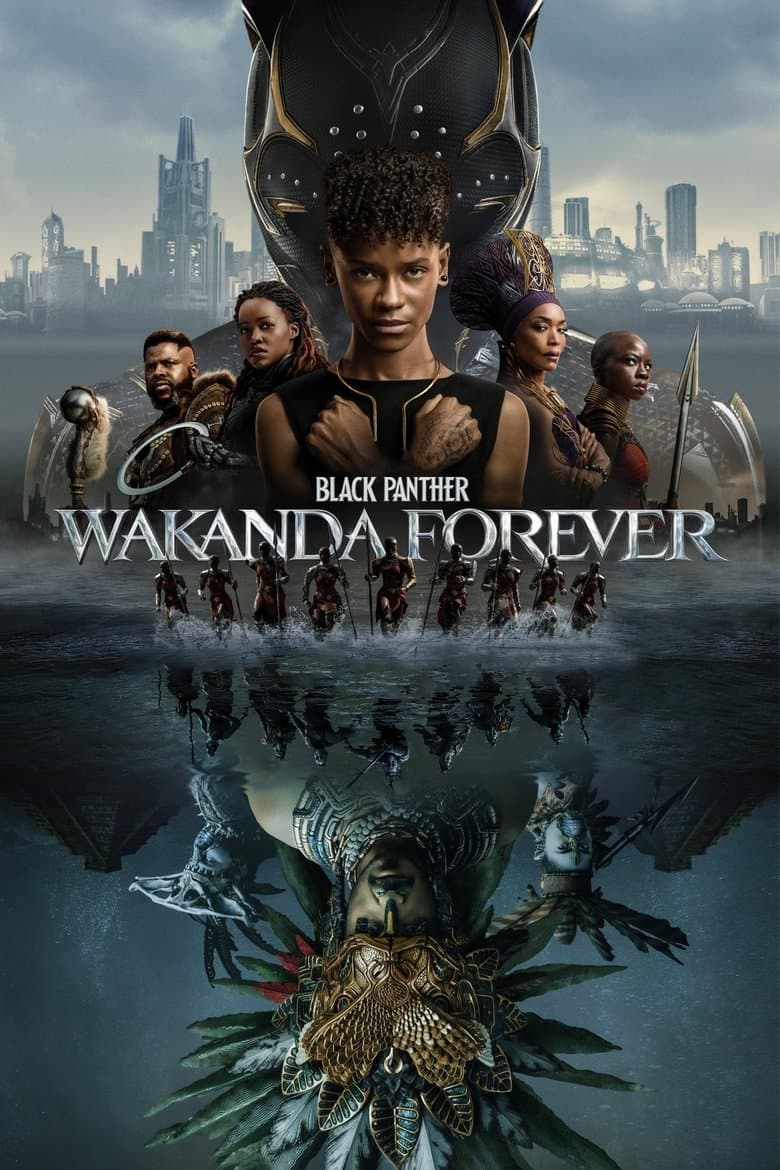
Black Panther: Wakanda Forever is a superhero movie about the leaders of Wakanda trying to protect their nation after the death of King T'Challa. They must face a new threat from an underwater kingdom while defending their resources from global powers. The film strongly emphasizes girl power, with women occupying every key leadership, defense, and scientific role. It also features clear anti-colonial themes and includes a confirmed queer romance between two female warriors.
Community feedback
Was our 94% Woke rating accurate?
Breakdown
These are the editorial factors and ratings behind our score for Black Panther: Wakanda Forever.
Woke representation / casting
The film features an almost entirely female power structure ruling Wakanda. It introduces Riri Williams as a brilliant teenage black female scientist who easily replicates Iron Man's advanced technology. It also includes an openly queer romance between two female warriors, Ayo and Aneka. This confirmed LGBTQ+ representation adds a major score increase.
80%
Woke political dialogue
The dialogue frequently targets Western nations, portraying them as greedy and corrupt entities looking to exploit African resources. Key dialogue frames Western leaders as predatory colonial powers. Characters use politically loaded terms like "colonizer" to mock white allies, and the script heavily emphasizes themes of historical European oppression and systemic injustice.
55%
Identity-driven story themes
The story's main plot revolves around marginalized, non-Western societies protecting themselves from the predatory gaze of Western institutions. It relies heavily on female empowerment themes, showing women leading every technological and political breakthrough. The inclusion of a queer romance subplot further emphasizes modern identity politics as a core storytelling element, boosting the score.
70%
Western institutional / cultural critique
The film presents a strong systemic critique of Western institutions. The United States government, France, and the CIA are depicted as imperialistic and untrustworthy, actively seeking to undermine and exploit non-white nations. Additionally, Namor's entire villain motivation is framed through historical anti-colonial rage against Spanish conquistadors, reinforcing modern academic concepts of colonial guilt.
75%
Woke character or canon changes
The character of Namor undergoes a major cultural and racial reimagining, shifting from a classic Atlantean to a Mesoamerican/Mayan ruler to center the character's backstory around anti-colonial struggle. Additionally, the film elevates a comic-book queer romance between Ayo and Aneka to the screen, adapting legacy characters to align with modern representation priorities.
65%
Anti-woke backlash and complaints
The movie faced significant backlash from anti-woke critics and online audiences. Common complaints focused on the "M-MCU" trend, criticizing the decision to replace King T'Challa with a female lead rather than recasting him. Critics also targeted the introduction of Riri Williams as an unrealistic "girlboss" tech prodigy and expressed frustration with the film's heavy-handed anti-colonial themes.
75%
Creator track record context
The creative team has a strong track record of promoting diversity and representation. Producer Nate Moore and former executive Victoria Alonso have been vocal advocates for expanding LGBTQ+ and racial representation in the MCU. Director Autumn Durald Arkapaw and casting director Sarah Halley Finn have both publicly championed the goal of reshaping Hollywood production to favor marginalized voices.
54%
Production
Movie · 2018
As the Avengers and their allies have continued to protect the world from threats too large for any one hero to handle, a new danger has emerged from the cosmic shadows: Thanos.
Movie · 2021
Peter Parker is unmasked and no longer able to separate his normal life from the high-stakes of being a super-hero.
Movie · 2017
The Guardians must fight to keep their newfound family together as they unravel the mysteries of Peter Quill's true parentage.
Movie · 2024
Following their explosive showdown, Godzilla and Kong must reunite against a colossal undiscovered threat hidden within our world, challenging their very existence – and our own.
Movie · 2017
Fuelled by his restored faith in humanity and inspired by Superman's selfless act, Bruce Wayne and Diana Prince assemble a team of metahumans consisting of Barry Allen, Arthur…
Movie · 2017
Humans and Transformers are at war. Optimus Prime is gone. The key to saving our future lies buried in the secrets of the past, in the hidden history of Transformers on Earth.
Movie · 2023
When his attempt to save his family inadvertently alters the future, Barry Allen becomes trapped in a reality in which General Zod has returned and there are no Super Heroes to…
Movie · 2019
When Alita awakens with no memory of who she is in a future world she does not recognize, she is taken in by Ido, a compassionate doctor who realizes that somewhere in this…
