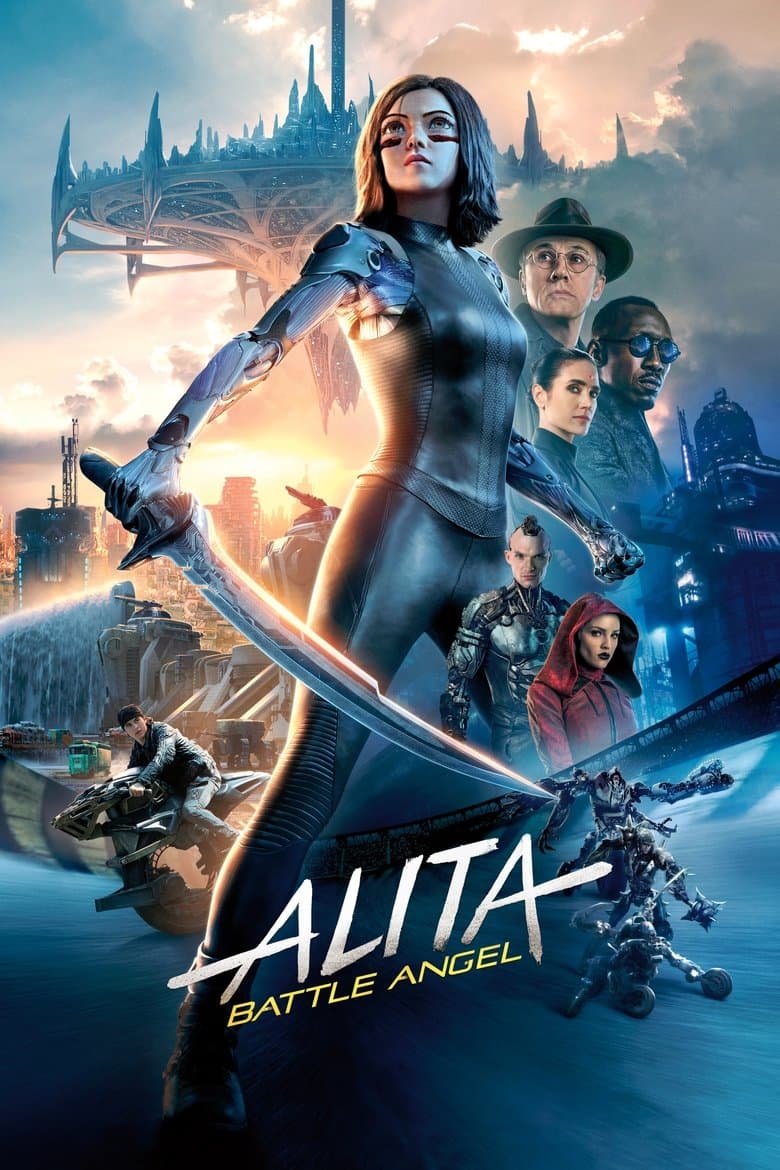
Alita wakes up in a junkyard body with no memory of who she is. Kind doctor Ido rebuilds her and names her after his lost daughter. The story is set in Iron City, a rough scrapyard world far below a rich sky city called Zalem. Alita learns she is a super-skilled fighter, falls for a boy named Hugo, and fights deadly cyborgs while chasing the truth about her past. The tone is big, loud sci-fi action with romance and cyberpunk grit.
The movie is mostly a manga-based action adventure about memory, love, and fighting power, not a modern social-justice lecture. Viewers see a young woman hero who is extremely good in battle because she was built as a warrior. Iron City looks like a mixed future city of people from many places, and some casting and press talk pushed Latino representation with star Rosa Salazar. The big story conflict is poor ground people versus rich sky rulers and crooks, in classic sci-fi style. Creators like James Cameron bring some mid-level activist history from other work, but this film stays focused on action, found family, and Alita’s personal journey.
Community feedback
Was our 20% Woke rating accurate?
Breakdown
These are the editorial factors and ratings behind our score for Alita: Battle Angel.
Woke representation / casting
Iron City is written as a mixed future scrapyard of refugees, so a multi-ethnic cast fits the world. Casting looked for an “ethnically ambiguous” Hugo. Press and star Rosa Salazar framed the lead as a win for Latino representation. On screen, viewers mainly see ordinary ensemble diversity, not a heavy identity lesson.
24%
Woke political dialogue
Not present in this title.
0%
Identity-driven story themes
Not present in this title.
0%
Western institutional / cultural critique
Not present in this title.
0%
Woke character or canon changes
Not present in this title.
0%
Anti-woke backlash and complaints
Not present in this title.
0%
Creator track record context
James Cameron’s other films carry climate and colonial themes. Laeta Kalogridis has spoken for diverse writers’ rooms. Robert Rodriguez has lighter Latino-empowerment themes. Manga creator Yukito Kishiro is low on politics. The team’s overall record is mixed, not extreme.
40%
Production
Movie · 2010
Cobb, a skilled thief who commits corporate espionage by infiltrating the subconscious of his targets is offered a chance to regain his old life as payment for a task considered…
Movie · 2017
Fuelled by his restored faith in humanity and inspired by Superman's selfless act, Bruce Wayne and Diana Prince assemble a team of metahumans consisting of Barry Allen, Arthur…
Movie · 2023
65 million years ago, the only 2 survivors of a spaceship from Somaris that crash-landed on Earth, must fend off dinosaurs to reach the escape vessel in time before an imminent…
Movie · 2016
16-year-old Cassie Sullivan tries to survive in a world devastated by the waves of an alien invasion that has already decimated the population and knocked mankind back to the…
Movie · 2020
After an earthquake destroys their underwater station, six researchers must navigate two miles along the dangerous, unknown depths of the ocean floor to make it to safety in a…
Movie · 2026
The evil Empire has fallen, and Imperial warlords remain scattered throughout the galaxy. As the fledgling New Republic works to protect everything the Rebellion fought for, they…
Movie · 2022
A mysterious force knocks the moon from its orbit around Earth and sends it hurtling on a collision course with life as we know it.
Movie · 2016
Through a technology that unlocks the genetic memories of his ancestor in 15th century Spain, Callum Lynch discovers he is a descendant of an ancient line of Assassins and amasses…
