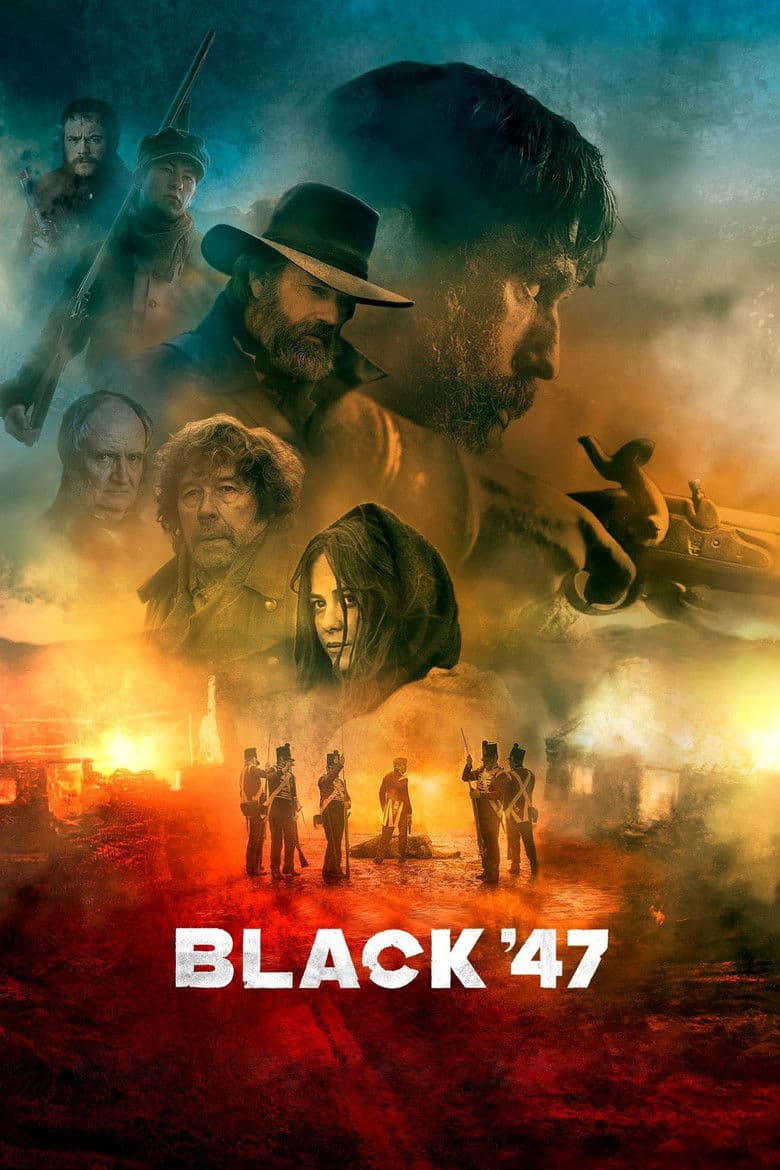
Black '47 follows Martin Feeney, an Irish soldier who deserts the British Army and returns to Connemara in 1847. He finds that famine, fever, evictions, and hanging have destroyed his family and village. Feeney turns his army skills against landlords, police, soldiers, and local helpers whom he blames for the deaths. Inspector Hannah, a former army comrade, leads the hunt for him with a young British officer and an Irish guide. The film has a bleak, cold, and very violent western tone.
The story shows starving families, burned homes, food leaving the country under guard, and poor Catholics being pressed to take soup after hearing Protestant teaching. It presents British rule, landlords, tax law, and local law enforcement as forces that protect land and power while ordinary people die. Feeney answers this abuse with private revenge, while the film shows that his violence cannot repair the wider disaster. Irish language, family loyalty, grief, and survival give the story a strong national and historical feeling, but the main drama stays with one man's revenge.
Community feedback
Was our 2% Woke rating accurate?
Breakdown
These are the editorial factors and ratings behind our score for Black '47.
Woke representation / casting
Not present. The cast shows mostly white Irish and British characters in a 1847 Irish setting. The film does not use race, gender, or sexuality as a diversity message.
0%
Woke political dialogue
Not present. The film has political talk about the Great Famine, British rule, landlords, and forced religious conversion. Those lines explain the period's conflict rather than a present-day activist message.
0%
Identity-driven story themes
Not present. The film centers on an Irish man's grief, family, language, and revenge during a historical disaster. It does not build its story around modern race, gender, sexuality, or representation politics.
0%
Western institutional / cultural critique
Not present. British officers, landlords, police, and Protestant missionaries act cruelly in the famine story. The film does not turn that period conflict into a modern attack on Western family life, Christianity, or social roles.
0%
Woke character or canon changes
Not relevant. The film follows fictional characters during a real historical crisis and expands the short film An Ranger. It does not change a known character or real figure to make an identity point.
0%
Anti-woke backlash and complaints
Not present. The supplied X pass found no anti-woke reaction or specific complaints. Web reviews discussed historical bias, violence, and tone, not woke, DEI, or identity propaganda.
0%
Creator track record context
Lance Daly has a mild record of stories about people harmed by poverty and past injustice. Daly describes Black '47 as a cathartic expression of Irish anger, but he also says he avoided dogma and calls himself apolitical. Pierce Ryan, P.J. Dillon, and Eugene O'Brien show public work centered on Irish history, craft, and ordinary people rather than DEI activism. The cached producer profiles show mostly business work with only mild links to social or identity themes.
10%
Production

Movie · 2025
Diagnosed with Tourette Syndrome at 15, John Davidson navigates his way against the odds through troubled teenage years and into adulthood, finding inspiration in the kindness of…

Movie · 2023
The true story of the inseparable Von Erich brothers, who made history in the intensely competitive world of professional wrestling in the early 1980s.
Movie · 2017
Members of the Granite Mountain Hotshots battle deadly wildfires to save an Arizona town.

Movie · 2016
After his older brother passes away, Lee Chandler is forced to return home to care for his 16-year-old nephew.
Movie · 2023
The story of J. Robert Oppenheimer's role in the development of the atomic bomb during World War II.
Movie · 2026
While people across 1990s Iraq struggle to survive the war and food shortages, Saddam Hussein requires each school in the country to prepare a cake to celebrate his birthday.
Movie · 2022
London, 1953. Mr. Williams, a veteran civil servant, is an important cog within the city's bureaucracy as it struggles to rebuild in the aftermath of World War II.
Movie · 2022
Based on a true tragedy, the emotionally triggering film sheds light on the plight of Kashmiri Pandits (Hindus), a religious minority in the 1990s Kashmir valley, who were…
