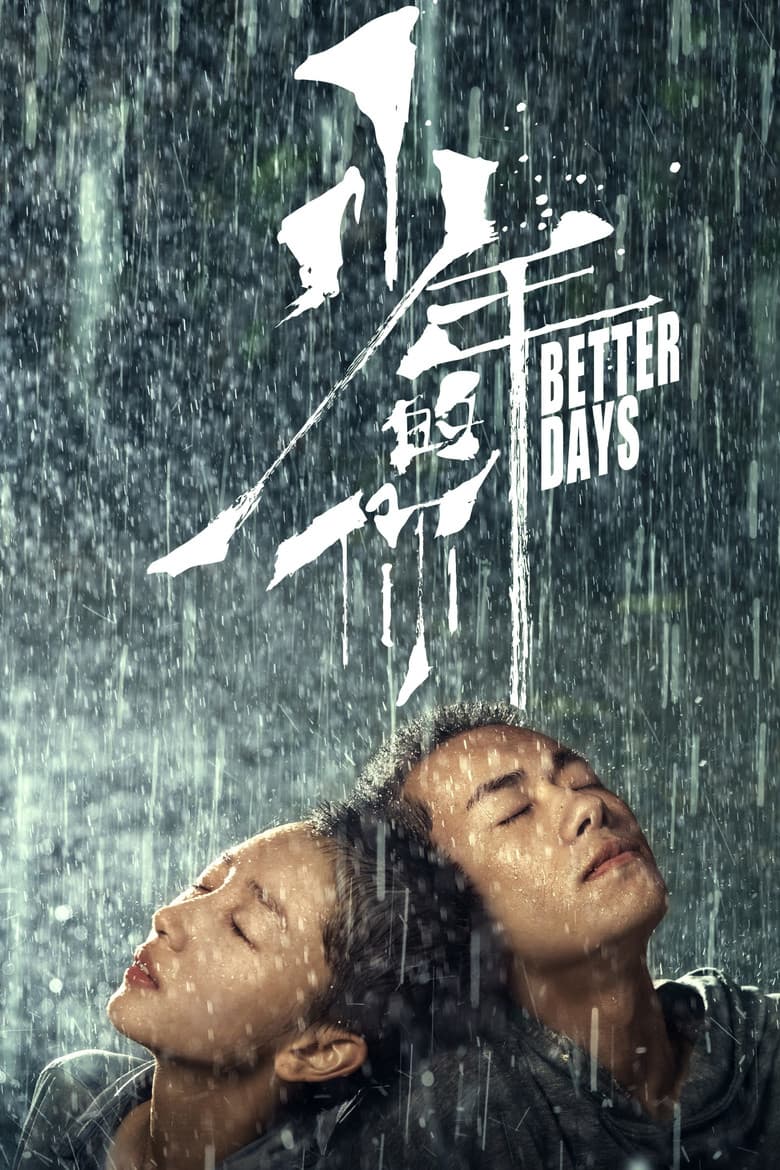
Chen Nian is a quiet high school student in a Chinese city who prepares for the gaokao, the national college entrance exam. Her mother is often away, and debt collectors threaten the family. Chen believes the exam is her only path to a safer life. After a classmate dies following severe bullying, a popular group of girls targets Chen. She turns to Xiao Bei, a poor school dropout and street fighter, and their fragile friendship grows into love while a violent crime draws them into a police case.
Better Days makes bullying the main subject of its story. The film shows insults, beatings, sexual humiliation, online abuse, suicide, and the damage caused by classmates and adults who ignore the harm. The story connects this violence to exam pressure, family debt, poverty, and failures by schools and police to protect children. Chen and Xiao Bei protect each other, and Chen later helps another bullied child. The ending asks adults and students to speak up and presents protection, honesty, responsibility, and government action as ways toward a better future.
Community feedback
Was our 13% Woke rating accurate?
Breakdown
These are the editorial factors and ratings behind our score for Better Days.
Woke representation / casting
Not present. Representation is not present. The main cast is Chinese, which matches the film’s Chinese setting. The female lead, male protector, and school bullies serve story roles rather than a diversity statement.
0%
Woke political dialogue
The final segment uses spoken language that urges people to act against school bullying and protect young people. The film also presents new government policies as an answer to the problem. The message is brief and supports the story’s lesson about bullying. The film contains no repeated discussion of race, gender, sexuality, or DEI.
12%
Identity-driven story themes
The story repeatedly focuses on a girl’s sexual humiliation, online abuse, and loss of safety. The film asks classmates and adults to protect children who are being harmed. Chen later continues that duty by helping another bullied child. These themes involve social and gendered harm, but they grow from the bullying plot instead of a modern identity-politics message.
16%
Western institutional / cultural critique
Not present. Western institutional or cultural critique is not present. The film criticizes failures by Chinese schools, police, parents, and other adults. The film does not attack Western institutions, Christianity, conservative family life, or traditional gender roles.
0%
Woke character or canon changes
Not relevant. Character or canon changes are not relevant. The film adapts a modern Chinese novel and keeps its central girl and boy. The film shows no change involving race, gender, sexuality, or a real person.
0%
Anti-woke backlash and complaints
Not present. Anti-woke backlash is not present. The reviewed coverage and supplied X research show no sustained anti-woke complaints. The reported disputes concern censorship and plagiarism claims about the source novel, not DEI or identity politics.
0%
Creator track record context
The director’s known social focus includes bullying and youth pressure, which gives a mild activist context. The writers and producers have no clear record of sustained DEI advocacy or identity politics. Their work is mainly youth drama, romance, and commercial filmmaking. The creator context adds only a weak signal.
8%
Production
Movie · 2016
James, down on his luck and desperate for some quick cash, agrees to drive a small truck across country. He soon realizes that he's made a huge mistake and has inadvertently…
Movie · 2018
German artist Kurt Barnert has escaped East Germany and now lives in West Germany, but is tormented by his childhood under the Nazis and the GDR regime.

Movie · 2020
A teenager lives out the hilarious and often tragic consequences of being lethally attractive, until he meets a girl with a congenital defect.

Movie · 2020
Young musician Zach Sobiech discovers his cancer has spread, leaving him just a few months to live. With limited time, he follows his dream and makes an album, unaware that it…

Movie · 2016
Meeting by chance when they return to their tiny California hometown, two former high-school sweethearts reflect on their shared past.

Movie · 2017
Nothing is as it seems in this riveting World War 2 thriller as a wary soldier goes to investigate a mysterious German monarch at his secluded mansion, leading him into a web of…

Movie · 2018
A man and a woman meet in the ruins of post-war Poland. With vastly different backgrounds and temperaments, they are fatally mismatched and yet drawn to each other.

Movie · 2024
Remi and Barnes, two very different teenagers, meet by chance in the winter of their senior year, then spend four days together over the course of a year that will change their…
