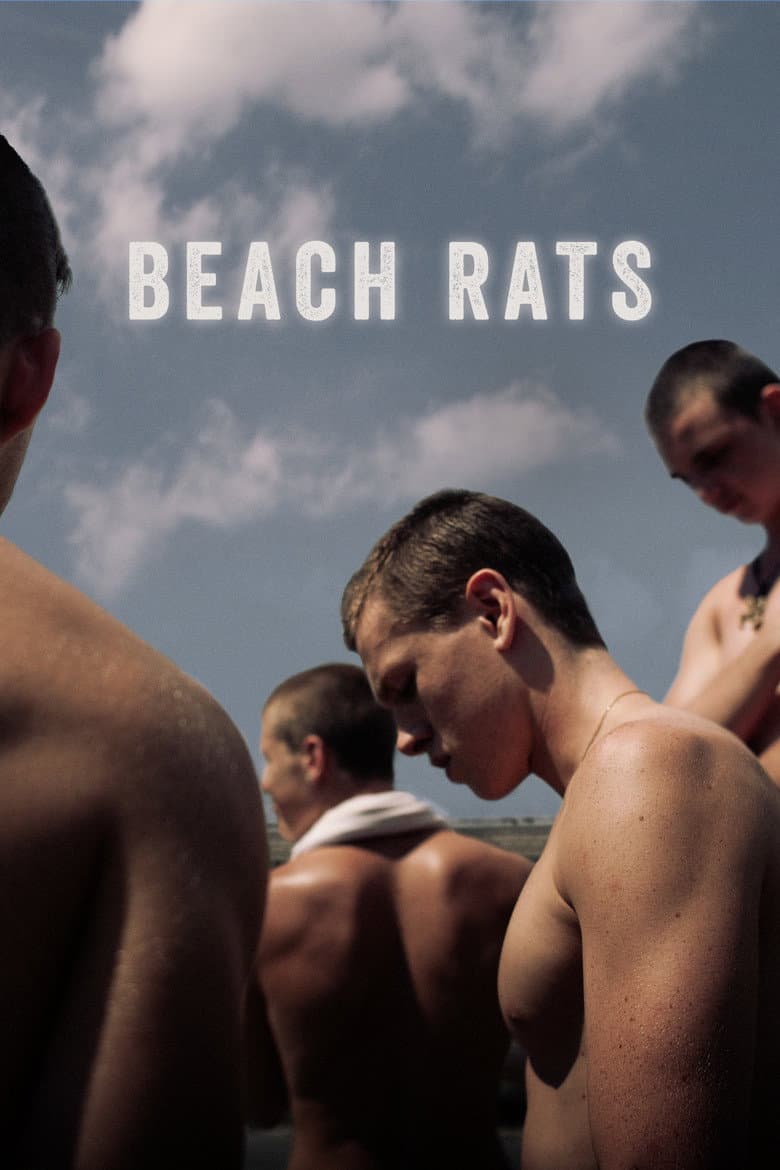
Beach Rats follows Frankie, a 19-year-old who spends a hot summer in South Brooklyn with his dying father, worried mother, younger sister, and rough friends. He smokes, steals, hangs around the boardwalk, and starts dating Simone while secretly using online chat sites to meet older men. Frankie wants the safety of his usual macho life, but he also wants sexual experiences that he cannot admit to himself or others. The film is quiet, tense, bleak, and often dreamlike as his lies grow harder to control.
Queer identity is the main subject, not a side plot. Frankie hides his attraction to men, avoids a clear label, and treats his relationship with Simone as part of a false public life. The story presents macho friendship rules, homophobic fear, and pressure to act like a straight young man as forces that trap him. The film gives no simple lesson or happy ending, but its sympathy stays with the pain of hiding desire and the damage caused by shame, fear, and violence.
Community feedback
Was our 73% Woke rating accurate?
Breakdown
These are the editorial factors and ratings behind our score for Beach Rats.
Woke representation / casting
The film gives repeated attention to male bodies and male sexual vulnerability through a female director’s viewpoint. Coverage frames this choice as a female or feminist gaze. The main roles do not show a clear diversity-first pattern or an engineered identity mix. The identity signal is weak and concerns viewpoint more than casting.
14%
Woke political dialogue
Not present. Frankie and his friends talk about sex, fear, and fitting in, but the film has no clear activist, DEI, or modern identity speech. Homophobic talk appears as part of the setting and is not presented as a woke message.
0%
Identity-driven story themes
Frankie spends the film hiding his attraction to men while trying to date Simone and fit in with macho friends. The story makes this double life the center of his fear, shame, lies, and choices. Secret hookups and the attack on one of the men he meets show how deeply the conflict shapes the plot. The movie does not give Frankie a simple label or a happy answer, but queer identity under social pressure is its main subject.
90%
Western institutional / cultural critique
Frankie’s friends mock gay men and police what a young man should be. His mother pushes him toward a girlfriend, while his friends expect him to act like a straight young man. The story links these rules to his secrecy, fear, and worsening choices. It criticizes macho social pressure and homophobia, but it does not attack government, churches, or broad Western institutions.
55%
Woke character or canon changes
Not relevant. The film is an original story and does not change a known character, book, historical person, or event.
0%
Anti-woke backlash and complaints
Not present. Reviews and audience posts mostly debate the slow pace, bleak ending, and treatment of queer violence. The supplied X pass found no anti-woke posts, boycott calls, or claims that the film pushed DEI or identity politics. No reliable report found a right-leaning backlash.
0%
Creator track record context
Eliza Hittman’s prior work centers queer sexuality, internalized homophobia, feminism, and reproductive autonomy. The producers also have a record of backing socially focused and representation-conscious independent films. Several producers have little public activist profile, so the signal is not uniform across the whole team. The current film strongly matches Hittman’s established queer and social themes.
58%
Production

Movie · 2017
A brilliant but impulsive young surgeon spirals into self-destruction after a painful breakup, struggling to cope with love, loss, and the consequences of his own temper.

Movie · 2018
Seasoned musician Jackson Maine discovers — and falls in love with — struggling artist Ally. She has just about given up on her dream to make it big as a singer — until Jack…

Movie · 2019
An extraordinary look at the lives of a middle-aged couple in the midst of the wife's breast cancer diagnosis.

Movie · 2018
A man and a woman meet in the ruins of post-war Poland. With vastly different backgrounds and temperaments, they are fatally mismatched and yet drawn to each other.
Movie · 2017
Recently deceased, a white-sheeted ghost returns to his suburban home to console his bereft wife, only to find that in his spectral state he has become unstuck in time, forced to…
Movie · 2017
Nothing is as it seems in this riveting World War 2 thriller as a wary soldier goes to investigate a mysterious German monarch at his secluded mansion, leading him into a web of…

Movie · 2023
College freshman Abby tries to distance herself from her dark past while resisting her attraction to bad boy Travis.

Movie · 2016
Set during the last days of the Ottoman Empire, a love triangle develops between Mikael, a brilliant medical student, the beautiful and sophisticated artist Ana, and Chris, a…
