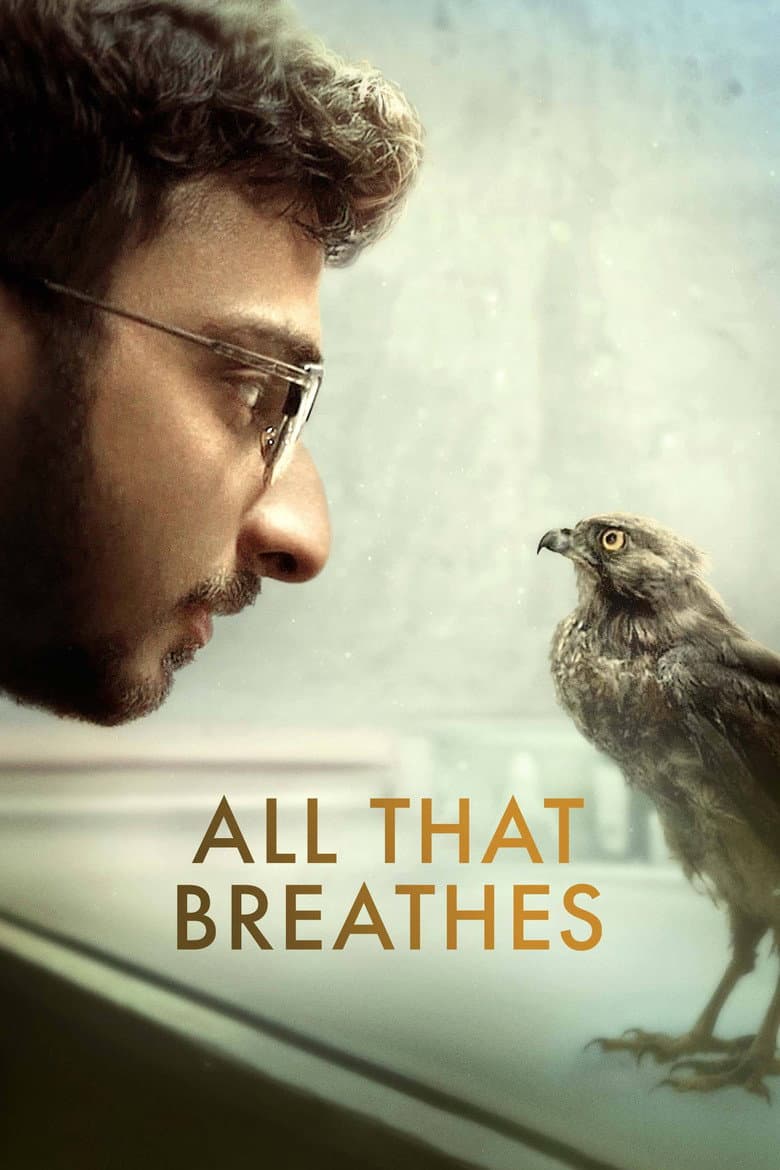
All That Breathes follows brothers Nadeem Shehzad and Mohammad Saud as they rescue black kites that fall from the polluted skies of New Delhi. They work with their cousin Salik in a cramped basement clinic while also trying to keep their bird rescue work and small business alive. The brothers argue, joke, and care for injured birds as the city fills with trash, smoke, rats, and unrest. The film moves slowly and quietly, with close attention to animals, family life, and the hard work of survival.
The film shows the brothers' Muslim family background and connects their bird care to lessons from their late mother about respecting every living thing. News clips, protest sounds, damaged homes, and talk around the Citizenship Amendment Act place communal tension around the bird story. The film also links polluted air, damaged wildlife, and human violence, but it keeps political material brief and indirect. Its main message is that people, birds, and other animals share one fragile world, not that a party or movement should be followed.
Community feedback
Was our 21% Woke rating accurate?
Breakdown
These are the editorial factors and ratings behind our score for All That Breathes.
Woke representation / casting
Not present. The documentary follows real brothers and their real cousin in New Delhi. Their Muslim identity is part of their actual lives, not a fictional casting choice or a diversity message.
0%
Woke political dialogue
News clips and brief talk refer to the Citizenship Amendment Act, communal unrest, and violence against Muslims. The brothers do not deliver political speeches or argue for a party. The bird rescue remains the central subject.
15%
Identity-driven story themes
The film follows Muslim brothers whose faith and family teaching shape why they care for birds. It places their work beside references to the Citizenship Amendment Act, communal unrest, and anti-Muslim violence. The identity and shared-community message recur as background, but they do not replace the main story about birds, pollution, and family.
28%
Western institutional / cultural critique
Not present. The documentary shows Delhi’s pollution, garbage, poverty, and unrest. It does not target Western institutions, capitalism, Christianity, patriarchy, traditional gender roles, or conservative culture.
0%
Woke character or canon changes
Not relevant. The film records real people and current events. It does not rewrite established characters, source material, or historical figures.
0%
Anti-woke backlash and complaints
Not present. Mainstream reviews and audience posts largely praise the film’s environmental and human themes. No notable anti-woke complaints about DEI, identity politics, or activist messaging are reported.
0%
Creator track record context
Shaunak Sen’s earlier documentary Cities of Sleep examined homelessness in Delhi, and this film uses ecological and coexistence themes as mild social-issue signals. The cinematographers have no documented activist or identity-driven records. Teddy Leifer’s past work includes sexual assault and institutional accountability, but the team has no clear DEI or queer focus.
15%
Production
Movie · 2017
A celebration of the universe, displaying the whole of time, from its start to its final collapse. This film examines all that occurred to prepare the world that stands before us…

Movie · 2025
Those who knew iconic funnyman John Candy best share his story, in their own words, through never-before-seen archival footage, imagery, and interviews.
Movie · 2025
An engine fire leaves 4,000 passengers stranded at sea without power and plumbing in this wild documentary about the infamous "poop cruise" of 2013.

Movie · 2018
A documentary about World War I with never-before-seen footage to commemorate the centennial of Armistice Day, and the end of the war.
Movie · 2023
As the Russian invasion begins, a team of Ukrainian journalists trapped in the besieged city of Mariupol struggle to continue their work documenting the war's atrocities.
Movie · 2023
A courageous pastor uses his underground network to rescue and aid North Korean families as they risk their lives to embrace freedom.
Movie · 2025
OceanGate's Titan tourist submersible imploded in 2023 on a deep-sea dive to the Titanic. This documentary details how a bold vision ended in tragedy.
Movie · 2019
In this documentary, Alex trusts his twin, Marcus, to tell him about his past after he loses his memory. But Marcus is hiding a dark family secret.
