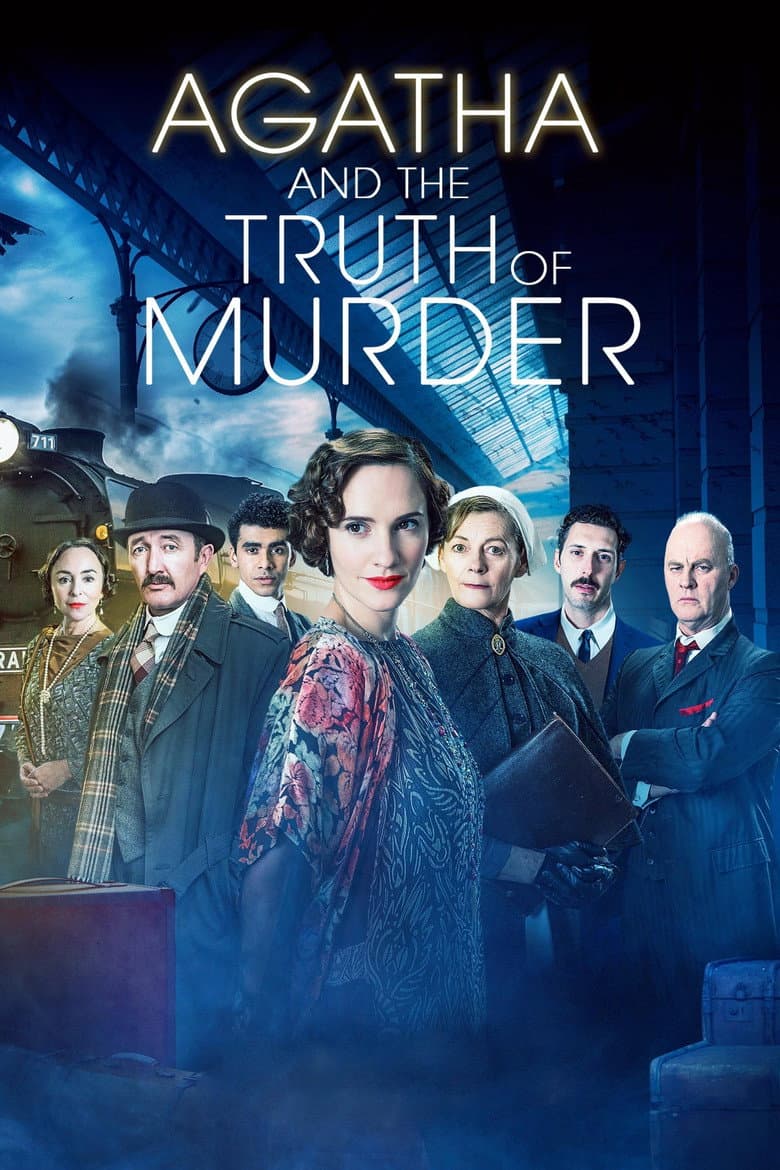
In December 1926, Agatha Christie is stuck in a bad marriage and cannot find a new mystery to write. She disappears and takes the name Mary Westmacott while she joins Mabel Rogers at a country house. Mabel wants Agatha to solve the six-year-old murder of Florence Nightingale Shore, her partner, who was beaten on a train. The suspects gather under a false inheritance plan, and a second murder makes the case more dangerous. The film uses a quiet, old-fashioned mystery tone with dry jokes and sad moments.
Two woke elements stand out in the story. Mabel and Florence are shown as a long-term female couple, and Mabel's grief starts the investigation, so the queer relationship is more than background detail. Agatha also faces a man who says women cannot design a golf course, and she answers him with a sharp joke. The film presents women's skill and same-sex love in a sympathetic way, but these ideas stay inside a period murder plot rather than becoming a broad political campaign. Agatha remains the main solver, while the love story and the short sexism scene add meaning to her search.
Community feedback
Was our 33% Woke rating accurate?
Breakdown
These are the editorial factors and ratings behind our score for Agatha and the Truth of Murder.
Woke representation / casting
Not present. The main cast is largely white British and Irish, which fits the English period setting. Zaki Hannachi is a French man from Constantine, and his background is explained in the story rather than used as a diversity message.
0%
Woke political dialogue
Sir Arthur Conan Doyle tells Agatha that a golf club would not hire a woman to design a course. He says the task is beyond a woman's ability, even if she is capable. Agatha answers with a mocking joke, and the film treats his view as foolish. This is one short exchange and it does not control the main mystery.
28%
Identity-driven story themes
Mabel and Florence are shown as a female couple who spent 26 years together. Mabel's love and grief cause her to seek Agatha's help, so the relationship starts the main murder story. The film treats their bond with sympathy, and the family reaction adds a short thread about same-sex relationships in the 1920s. Agatha also leads the case and proves that a woman can outthink the men around her. The movie remains mainly a mystery rather than a queer or feminist campaign.
48%
Western institutional / cultural critique
Not present. The film shows a bad marriage, family abuse, war trauma, and police mistakes as parts of its plot. It does not turn those events into a repeated modern attack on Western culture, Christianity, family life, or social institutions.
0%
Woke character or canon changes
Not relevant. The film invents Agatha's role in a real murder during her disappearance, but the change affects the mystery only. It does not change a character's race, gender, sexuality, or identity role.
0%
Anti-woke backlash and complaints
Not present. No clear anti-woke complaints were found. The recorded X pass had no reaction, and forum and review posts mainly discussed the invented history, mystery quality, or casting. No strong news controversy linked the film to DEI or identity politics.
0%
Creator track record context
Terry Loane and Tom Dalton have very low stored scores and no clear record of activist or DEI work. Most of the other listed crew also have low or modest stored scores. Chamoun Issa has a human-rights science-fiction short and professional ties to an LGBTQ rights group. The wider record does not show a sustained identity-first pattern that strongly raises this movie's score.
8%
Production

Movie · 2017
Barcelona, Spain. Adrián Doria, a young and successful businessman accused of murder, meets one night with Virginia Goodman, an expert interrogation lawyer, in order to devise a…

Movie · 2026
Through unlikely bonds formed during night shifts at a local aquarium, Tova, an elderly widow, learns of a life-changing discovery that may bring her joy and wonder once again.
Movie · 2023
In this office satire, Orson, a straight-laced employee, retreats to a blissfully empty corner office to get away from his lackluster colleagues.

Movie · 2018
After David Kim's 16-year-old daughter goes missing, a local investigation is opened and a detective is assigned to the case.
Movie · 2022
Craig, a young boy living in a small town befriends an older, reclusive billionaire, Mr. Harrigan. The two form a bond over books and an iPhone, but when the man passes away the…

Movie · 2018
An up-and-coming journalist finds his world and faith increasingly challenged when he's granted the interview of a lifetime – with someone who claims to be God.

Movie · 2018
A filmmaker discovers a box of video tapes depicting two students' disturbing film project featuring a local horror legend, The Peeping Tom.
Movie · 2022
7 years after the case related to Vijay Salgaonkar and his family was closed, a series of unexpected events bring truth to light that threatens to change everything for the…
