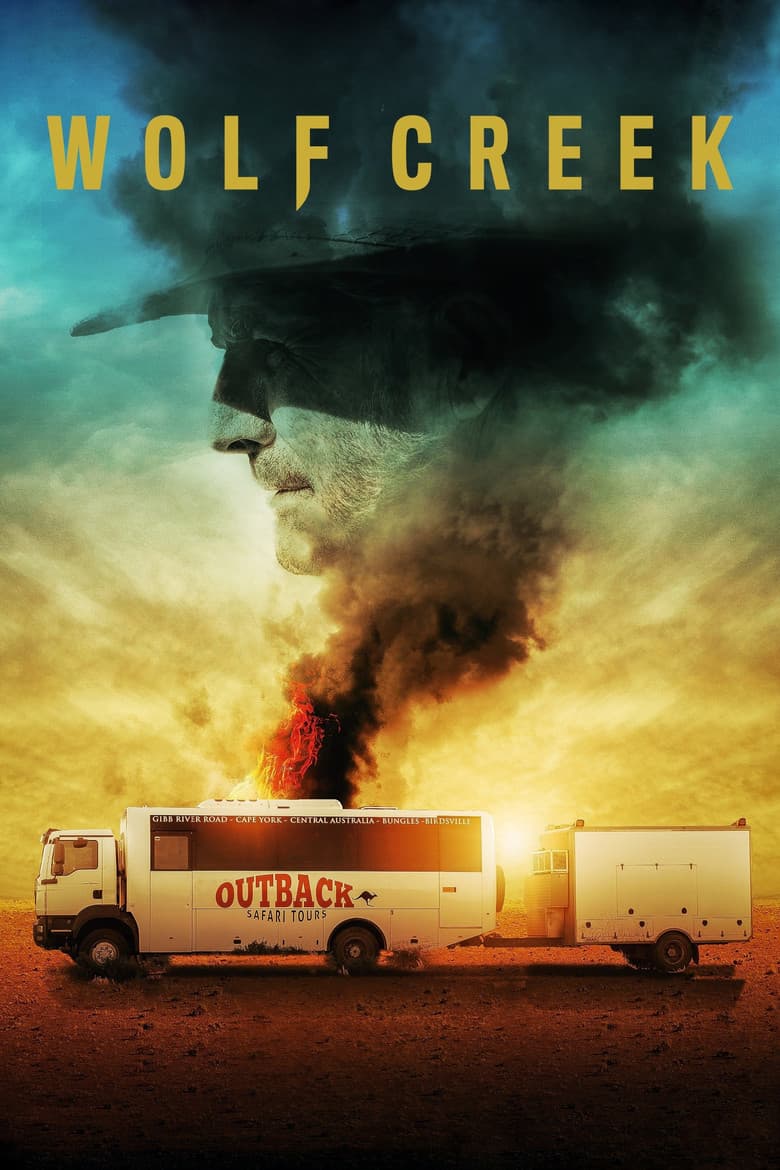
Started May 12, 2016 · Ended · Based on 2 seasons, 12 episodes through December 15, 2017 · TV-MA · 60 min
Wolf Creek follows Mick Taylor, a violent serial killer who hunts travelers in the Australian outback. Season 1 follows Eve Thorogood, a young American whose parents and brother are killed during a holiday. Eve crosses remote towns and bush roads while she searches for Mick and seeks revenge. Season 2 follows an international tour group after Mick takes over their bus and strands them far from help. The show is grim, bloody, tense, and sometimes darkly funny.
The clearest woke element is the strong female revenge lead in Season 1. Eve changes from a girl addicted to painkillers into a hunter who tracks Mick, learns outback skills from an Indigenous man, and helps defeat him. Season 2 includes a gay Australian couple and a group of tourists from several countries, but identity does not control the main plot. These choices add a mild representation signal, while the series remains mainly a violent revenge and survival story.
Community feedback
Was our 26% Woke rating accurate?
Breakdown
These are the editorial factors and ratings behind our score for Wolf Creek.
Woke representation / casting
Season 1 makes Eve a young American woman who hunts and defeats Mick. Interviews present her as a strong female lead who flips the usual slasher victim role. Season 2 places a gay Australian couple inside a group promoted as diverse tourists from around the world. The international tour setup explains much of the mix, so the casting gives a mild representation signal rather than a strong quota feel.
28%
Woke political dialogue
Not present. Characters discuss murder, addiction, family strain, travel, and survival. The show has no repeated modern activist speeches or identity-politics debate.
0%
Identity-driven story themes
Season 1 gives Eve a continuing arc from a girl addicted to painkillers to a hunter who takes revenge on Mick. Creator and lead-actor interviews describe this as a strong female lead and a deliberate turn from the usual female victim in slashers. Season 2 includes a gay couple whose relationship appears in group conversations and danger scenes. The show remains mainly about revenge and survival, so these themes are visible but not central across all twelve episodes.
28%
Western institutional / cultural critique
Not present. The police sometimes slow Eve down, and Mick attacks families, tourists, and local communities. The story treats these events as obstacles and horror plot points, not as a modern attack on Western institutions, gender roles, or family life.
0%
Woke character or canon changes
Not relevant. The series adds original TV characters and changes the format into two anthology seasons. Mick remains the established killer, and the new identities belong to new characters rather than rewritten movie characters.
0%
Anti-woke backlash and complaints
Not present. The supplied X pass found no anti-woke reaction or specific complaint. Web reviews and audience posts mainly discuss gore, Mick, Eve, pacing, and the change from Season 1 to Season 2.
0%
Creator track record context
Nick Parsons has a record of Aboriginal-rights drama and LGBTIQ-focused projects, including Dead Heart and Queer for Short. That record gives the show some identity-related background, but it does not prove that the series carries those themes. Greg McLean and Tony Tilse are mainly linked to horror, action, and crime work with low supplied scores. Rob Gibson has one gender-identity drama in his background but no strong activist record.
24%
Production
TV Show · 2016
The story of Mac Conway, a Marine who returns home to Memphis from Vietnam in 1972 and finds himself shunned by those he loves and demonized by the public.
TV Show · 2021
A happily married man's life is turned upside down when his wife is killed in a mysterious hit-and-run accident in Tel Aviv.
TV Show · 2022
With the aid of unexpected friends, a gifted but introverted student confronts bullies and violent foes — unaware of how dangerous his world will become.
TV Show · 2022
Navy SEAL Commander James Reece turns to vengeance as he investigates the mysterious forces behind the murder of his entire platoon.
TV Show · 2017
Action drama series inspired by the real missions of Navy SEAL Team Six.
TV Show · 2016
In 18th-century North America, ruthless trappers and entrepreneurs fight to wrest control of the fur trade from the mighty Hudson's Bay Company.
TV Show · 2021
Takemichi Hanagaki is a freelancer that’s reached the absolute pits of despair in his life. He finds out that the only girlfriend he ever had, in middle school, Hinata Tachibana…
TV Show · 2018
When CIA analyst Jack Ryan stumbles upon a suspicious series of bank transfers his search for answers pulls him from the safety of his desk job and catapults him into a deadly…
