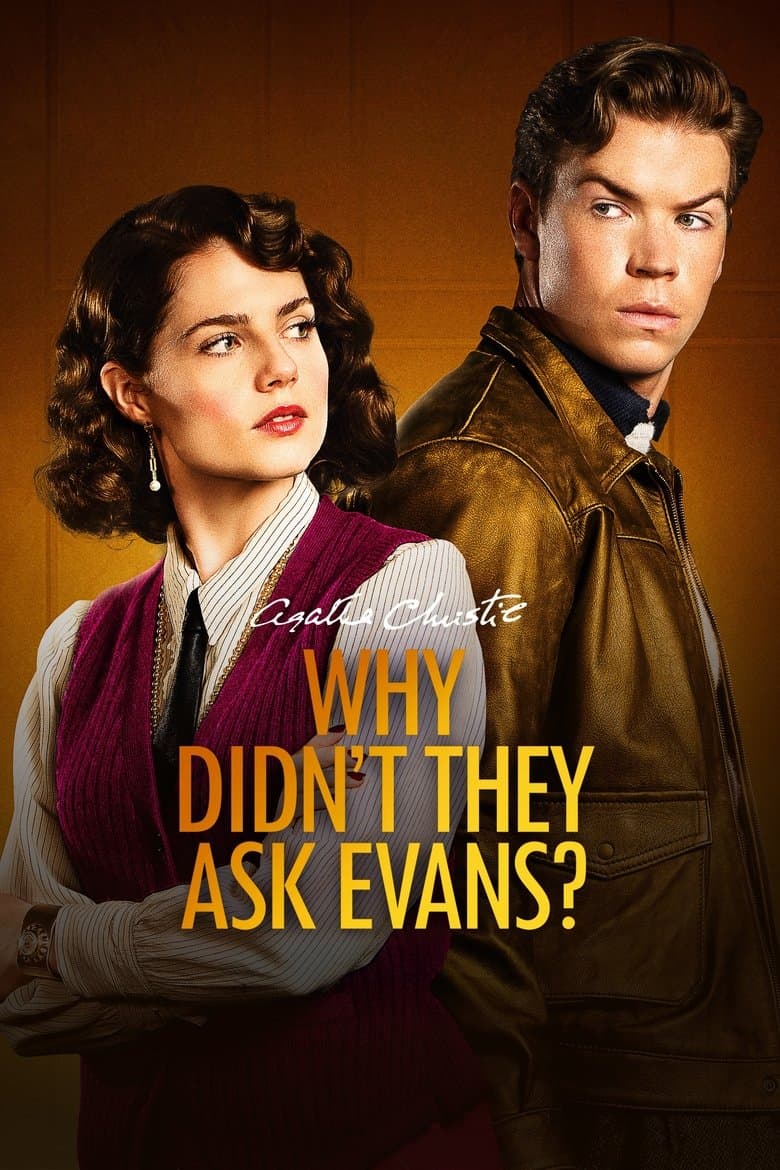
Started April 12, 2022 · Ended · Based on 1 season, 3 episodes through April 12, 2022 · TV-14 · 60 min
Why Didn't They Ask Evans? is a three-part mystery set in 1930s Wales and England. Bobby Jones is a vicar's son and former naval officer who finds a dying man below a cliff. The man's last words send Bobby and his bold old friend Lady Frankie Derwent after the meaning of a strange question. Their search leads through country houses, doctors, servants, false names, poison, and murder, while the tone stays playful, tense, and sometimes dark.
The show makes Frankie the sharper and more daring half of the detective pair. She pushes Bobby into action and solves several key parts of the case, while Bobby is more careful and unsure of his future. The adaptation also changes Christie's Badger Beadon into Ralph Knocker Beadon and casts him as a black former shipmate who runs a garage with Bobby. That visible identity change is the main representation issue, but the mystery does not build its story around race, gender politics, sexuality, or modern activist ideas.
Community feedback
Was our 29% Woke rating accurate?
Breakdown
These are the editorial factors and ratings behind our score for Why Didn't They Ask Evans?.
Woke representation / casting
The show gives Jonathan Jules a recurring role as Ralph “Knocker” Beadon, a black former shipmate and garage partner in a 1930s British setting. The book used the name Badger Beadon, so the new identity is easy for viewers to notice. Knocker is a useful and heroic helper, but he is not the lead, the savior, or part of a large diversity-focused group. The show does not present the casting as a diversity message.
24%
Woke political dialogue
Not present. The dialogue focuses on clues, murder, money, medicine, and personal secrets. The show does not use repeated modern activist or identity-political speeches.
0%
Identity-driven story themes
Frankie is repeatedly the sharper and more daring investigator. She pushes Bobby to act and makes several key deductions, while Bobby is more cautious and unsure of his future. The show presents them as a playful partnership instead of attacking men or praising a political cause. The strong female-lead pattern is visible across the miniseries, but it remains mild.
25%
Western institutional / cultural critique
Not present. The show has a corrupt wealthy family, a private mental health clinic, and a weak police response. Those parts move the murder plot forward and do not become a modern attack on Western institutions, Christianity, family life, or traditional gender roles.
0%
Woke character or canon changes
The adaptation changes Christie's Badger Beadon into Ralph “Knocker” Beadon and makes him Black. That is an audience-visible identity change to a known Christie character. Knocker becomes a recurring garage owner and former shipmate who helps solve the case. The show gives no political explanation, so the change remains limited rather than becoming a major rewrite.
25%
Anti-woke backlash and complaints
A few small X accounts called Knocker's Black casting a woke or DEI change. Some described the role as out of place beside the book and period. The posts had single-digit or roughly 12 likes and no large campaign followed. No broad boycott, review-bombing, or major anti-woke media campaign was found.
15%
Creator track record context
Hugh Laurie is mainly known for acting, comedy, and mainstream drama. The cached context gives him a low woke score and shows no strong activist record. Agatha Christie and the listed producers and casting directors also have low cached scores and no high-confidence identity-focused record. This gives the show only a weak creator-context signal.
8%
Production
TV Show · 2016
Satoru Fujinuma is a struggling manga artist who has the ability to turn back time and prevent deaths. When his mother is killed he turns back time to solve the mystery, but ends…
TV Show · 2022
A prisoner on death row in the US, a vicar in a quiet English town, and a maths teacher trapped in a cellar cross paths in the most unexpected way.

TV Show · 2017
Kiyotaka Ayanokouji enrolls at the prestigious Tokyo Koudo Ikusei Academy, but is assigned to Class 1-D, where students with behavioral problems are housed.
TV Show · 2020
Hiding a twisted past, a man maintains his facade as the perfect husband to his detective wife — until she begins investigating a series of murders.
TV Show · 2020
A family's lives are irreparably disrupted when the 14-year-old son is accused of murdering a fellow classmate.
TV Show · 2026
Ben Reilly, an aging and down on his luck private investigator in 1930s New York, is forced to grapple with his past life as the city's one and only superhero.

TV Show · 2024
Kirie tries to escape from her town Kurouzu-cho, where the residents get obsessed with spirals due to an unexplained curse.
TV Show · 2019
A Philadelphia couple are in mourning after an unspeakable tragedy creates a rift in their marriage and opens the door for a mysterious force to enter their home.
