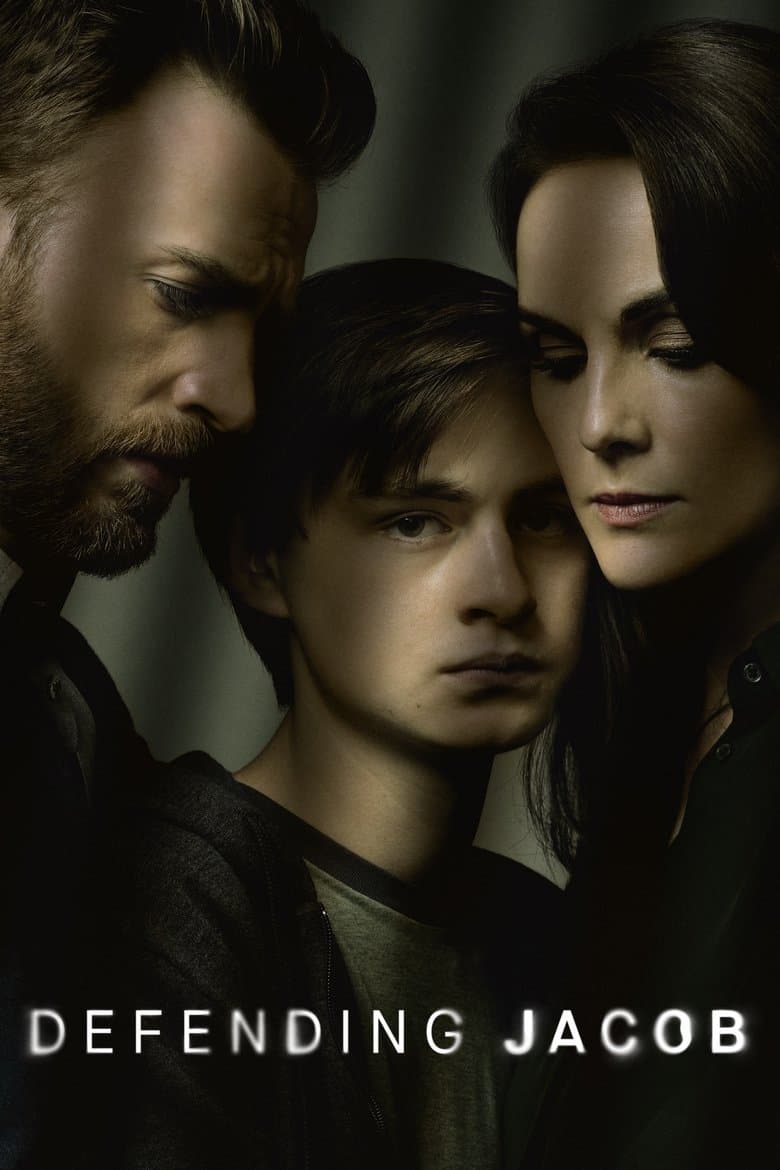
Started April 24, 2020 · Ended · Based on 1 season, 8 episodes through May 29, 2020 · TV-MA
Defending Jacob follows Andy Barber, an assistant district attorney in Newton, Massachusetts. His quiet family life breaks apart when his 14-year-old son, Jacob, is accused of stabbing a classmate. Andy leaves the case but keeps trying to protect Jacob, while his wife Laurie starts to doubt their son. The eight episodes use a dark, slow crime-drama tone and keep asking whether Jacob is guilty.
The show has very little woke content that viewers can see. Joanna Klein, the defense lawyer, briefly mentions her wife, which confirms a lesbian relationship but does not affect the case or the family’s choices. The supporting cast includes several people of color, and the series changes two male roles from the novel into female roles, but the story does not present those choices as a political message. Most of the drama concerns family loyalty, the pressure of a murder case, social media rumors, hidden family history, and the hard question of whether parents should protect a child they may not trust.
Community feedback
Was our 20% Woke rating accurate?
Breakdown
These are the editorial factors and ratings behind our score for Defending Jacob.
Woke representation / casting
Joanna Klein, the defense lawyer, mentions her wife. That makes a lesbian relationship visible in a major supporting role. The series also changes two male secondary roles from the novel to female roles. Those changes are brief and are not presented as a diversity message.
20%
Woke political dialogue
Not present. Dialogue stays grounded in family tension, legal procedure, personal suspicion, and moral questions with zero activist language or social-justice framing.
0%
Identity-driven story themes
Joanna Klein briefly says that she has a wife. The line confirms a lesbian relationship in the story. The relationship does not drive the murder case, the family conflict, or the ending.
12%
Western institutional / cultural critique
Not present in this title.
0%
Woke character or canon changes
Two supporting professional roles were recast female compared with the novel; these are peripheral, logically consistent, and never highlighted or criticized as ideological.
18%
Anti-woke backlash and complaints
One fringe review mocked the show’s diversity choices. The review complained that characters who are not white stayed in supporting roles and called the Jewish mourning scene forced and “woke enough.” No major news outlet reported a boycott or broad anti-woke campaign. The available complaint evidence is weak and isolated.
8%
Creator track record context
The stored creator scores are 8/100 for Morten Tyldum, 10/100 for Mark Bomback, and 6/100 for William Landay. Their summaries describe mainstream thriller, legal, science-fiction, and historical work with no clear activist or identity-focused pattern. This gives the title only a low creator track record context score.
8%
Production

TV Show · 2024
A young boy growing up in the suburbs of 1980s Brisbane faces the harsh realities of life — and the looming dangers that threaten his family.
TV Show · 2022
Lucy wakes every night at exactly 3:33am. Nothing in her life has made sense for a long time. But the answers are out there, somewhere, at the end of a trail of brutal murders.

TV Show · 2026
The dynamic between the two contrasting personalities, a seasoned cop who prefers old-school methods and a tech-savvy cop who relies on modern technology for investigations, as…
TV Show · 2025
A brash but brilliant cop becomes head of a new police department, where he leads an unlikely team of misfits in solving Edinburgh's cold cases.

TV Show · 2026
Ben Reilly, an aging and down on his luck private investigator in 1930s New York, is forced to grapple with his past life as the city's one and only superhero.
TV Show · 2019
A Philadelphia couple are in mourning after an unspeakable tragedy creates a rift in their marriage and opens the door for a mysterious force to enter their home.

TV Show · 2020
Hiding a twisted past, a man maintains his facade as the perfect husband to his detective wife — until she begins investigating a series of murders.
TV Show · 2026
Wrongfully imprisoned for murdering his own son, a father sets out on a desperate rescue mission after learning the boy may still be alive.
