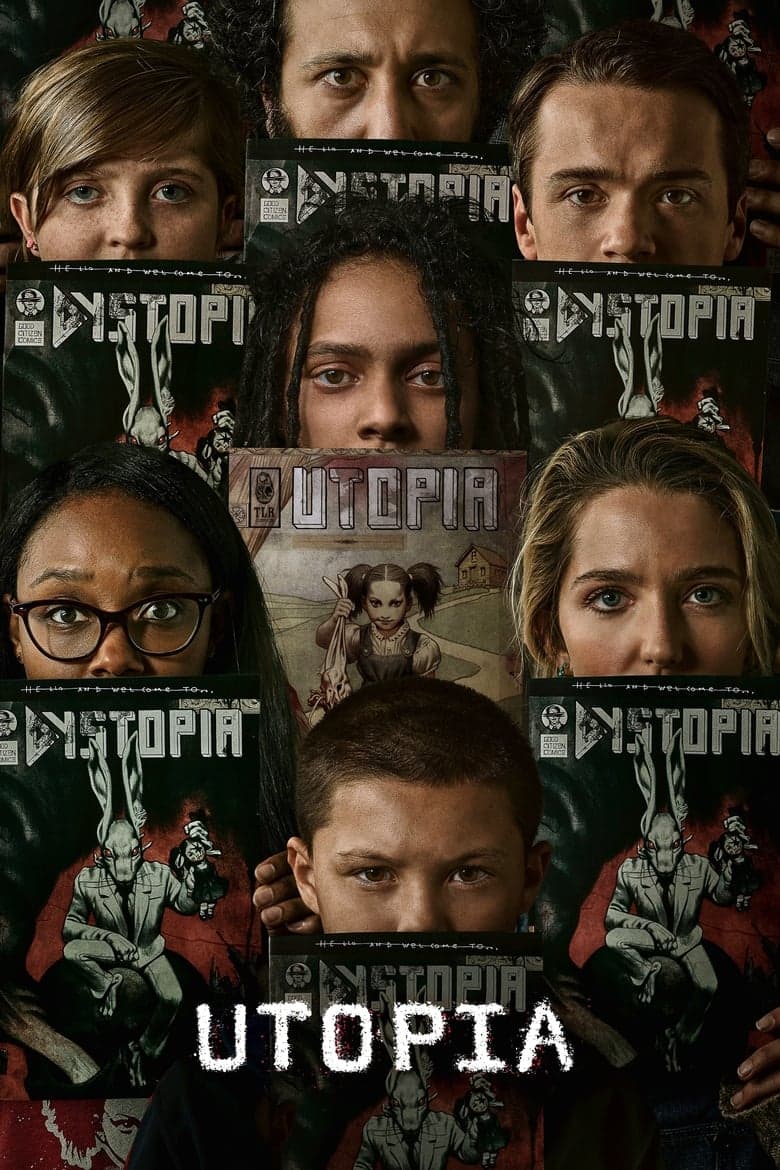
Started September 25, 2020 · Canceled · Based on 1 season, 8 episodes through September 25, 2020 · TV-MA
Utopia follows Jessica Hyde, a violent young woman who says she escaped from the world of a graphic novel. She joins four online comic fans in Chicago after they find a missing sequel that seems to predict deadly outbreaks. A biotech boss, a secret group, and hired killers chase them while a flu spreads among children. The season uses dark jokes, harsh violence, and a bleak mystery to tell a story about fear, control, and survival.
Jessica is the main fighter and the group’s strongest force, while Samantha openly works to save the planet and Becky is a smart black woman whose illness drives her search for a cure. The show also presents a black woman, Milner, as a senior power inside the hidden plan. Its biggest political idea is that a rich science leader may use a fake pandemic and a vaccine to cut human births for the sake of the planet. The other characters fight that plan, but the show repeatedly talks about climate damage, overpopulation, corporate power, and the danger of trusting experts or online theories.
Community feedback
Was our 44% Woke rating accurate?
Breakdown
These are the editorial factors and ratings behind our score for Utopia.
Woke representation / casting
Jessica Hyde is played by black actress Sasha Lane, while the British original used white Irish actress Fiona O’Shaughnessy. Jessica is the lead fighter, survivor, and main guide through the plot. Becky is a black graduate student whose illness and search for a cure drive a continuing subplot, and Milner is a black woman with high power in the secret group. Publicity calls Becky a “Black girl nerd,” so the pattern carries a clear identity signal beyond background casting.
43%
Woke political dialogue
Samantha rejects climate rallies and says people only act after Africa starves, water runs out, and the world burns. The show returns to climate damage, overpopulation, pandemics, vaccines, and drug-company power across the season. Christie uses the phrase “crowded world” and presents population control as a duty. The dialogue is political, but it is mostly part of a conspiracy thriller and rarely discusses race, gender, or party politics.
29%
Identity-driven story themes
Jessica is a violent female lead who takes charge, survives abuse, and often decides what the group will do. Samantha is an outspoken climate activist, and Becky’s illness makes control of her body and the search for a cure central to her story. The finale makes population control and forced sterilization the key moral choice. The season does not center race, sexuality, or modern identity politics, so these themes stay below the main conspiracy plot.
32%
Western institutional / cultural critique
Christie’s biotech company and public agencies hide facts and put people at risk, but the story treats this mainly as thriller corruption. Samantha says climate rallies only make people feel useful while leaders wait until Africa starves, water runs out, and the world burns. Male comic fans dismiss Samantha’s ideas, and she pushes back. The show does not build a repeated case against men, family, Christianity, or normal social roles.
17%
Woke character or canon changes
Not relevant. The American series moves the story from London to Chicago and changes some plot details, but no clear woke or identity-driven rewrite of an established character or source idea is confirmed.
0%
Anti-woke backlash and complaints
X research found no anti-woke complaints about the show. A Reddit post called the remake “superficially inclusive” and “super woke,” while another said it made all women seem smart and most men seem stupid or evil. These were isolated posts, and most public complaints focused on writing, violence, pacing, or the British original, so the backlash is weak.
10%
Creator track record context
Gillian Flynn’s supplied creator score is 35/100 because of Democratic support and complex female characters, while her work is mainly dark and morally mixed. J.D. Dillard’s supplied score is 31/100, and Dennis Kelly and several producers have mild scores linked to power, women’s visibility, or inclusive talent work. The other supplied writers and producers have little or no activist record. The group gives the title mild supporting context, not a main theme.
30%
Production
TV Show · 2020
A tight-knit group of teens unearths a long-buried secret, setting off a chain of illicit events that takes them on an adventure they'll never forget.
TV Show · 2025
Before The Terminal List, Navy SEAL Ben Edwards finds himself entangled in the black operations side of the CIA.

TV Show · 2025
In the early Meiji era, Shujiro, once known as an undefeated samurai, decides to participate in a deadly survival game to save his family and villagers.
TV Show · 2018
When CIA analyst Jack Ryan stumbles upon a suspicious series of bank transfers his search for answers pulls him from the safety of his desk job and catapults him into a deadly…
TV Show · 2022
Dan Chase absconded from the CIA decades ago and now lives off the grid. When an assassin arrives and tries to take Chase out, the old operative learns that to ensure his future…
TV Show · 2016
In 18th-century North America, ruthless trappers and entrepreneurs fight to wrest control of the fur trade from the mighty Hudson's Bay Company.

TV Show · 2016
The story of Mac Conway, a Marine who returns home to Memphis from Vietnam in 1972 and finds himself shunned by those he loves and demonized by the public.
TV Show · 2022
Navy SEAL Commander James Reece turns to vengeance as he investigates the mysterious forces behind the murder of his entire platoon.
