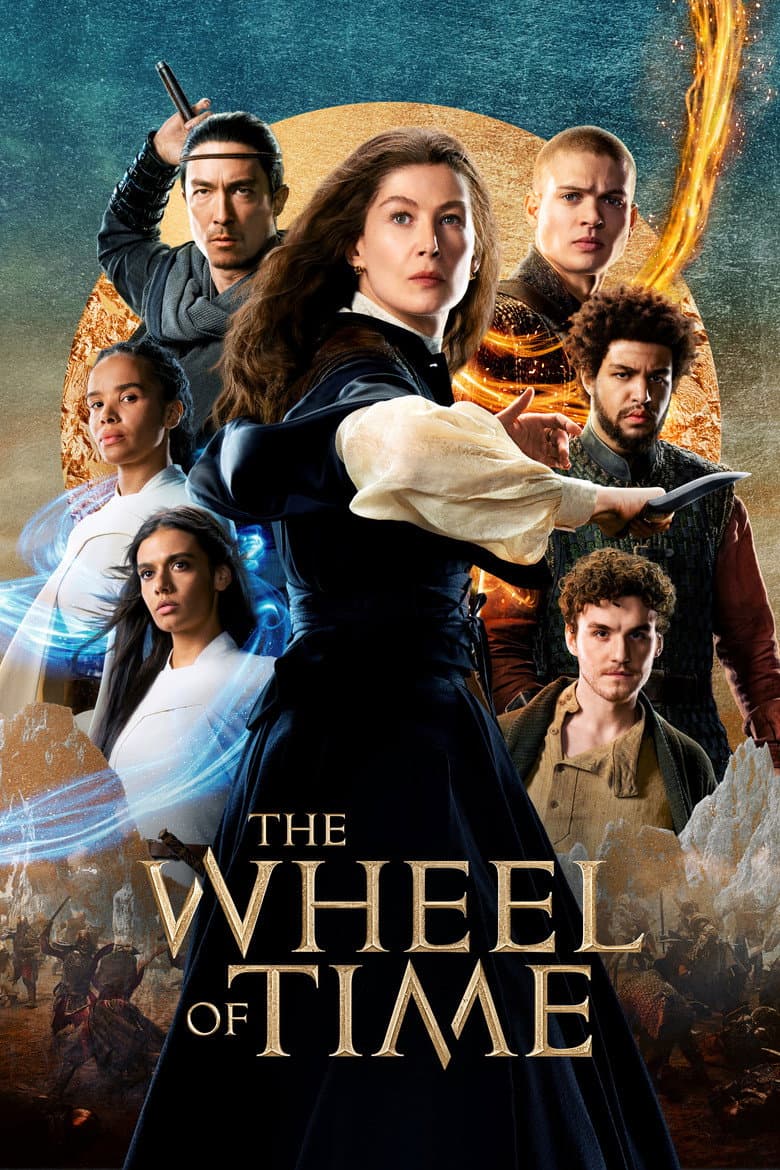
Started November 18, 2021 · Canceled · Based on 3 seasons, 24 episodes through April 17, 2025 · TV-14
The Wheel of Time is an epic fantasy television show based on a popular series of books. The story is set in a magical world where only certain women can use a special power. A powerful guide named Moiraine finds five young villagers, believing that one of them is the reincarnation of a legendary hero called the Dragon Reborn. This hero is prophesied to either save the world from an ancient evil or destroy it completely. The show features strong progressive themes that are hard to miss. The creators changed the lore so that a woman could be the legendary Dragon, which ignores the core rules of the books. They also added many explicit LGBTQ relationships, such as a romance between Moiraine and another female leader. Male characters are often pushed to the side or shown as weak. Meanwhile, the female characters get unearned power and take over major victories that belonged to men in the books.
Community feedback
Was our 95% Woke rating accurate?
Breakdown
These are the editorial factors and ratings behind our score for The Wheel of Time.
Woke representation / casting
The casting of the series heavily prioritizes modern diversity over the logic of the fantasy setting. In the source material, the village of Emond's Field is an isolated community where people have looked the same for generations. However, the show casts a highly diverse, multicultural group of actors for these roles, destroying the visual logic of an isolated town. The casting choices for major characters like Egwene, Nynaeve, Perrin, and Min clearly signal modern representation goals rather than story necessity. The casting director has openly stated a commitment to prioritizing diverse representation in major television roles.
75%
Woke political dialogue
While the show mostly avoids using modern political jargon, the dialogue frequently leans into progressive ideas about gender and power. Female characters often deliver lectures about the flaws, arrogance, and danger of men, especially male channelers. The scripts also place a heavy emphasis on validating diverse sexual identities and lifestyles through dialogue. The language is framed to fit a modern feminist perspective, with women constantly asserting their superiority and moral authority over men.
42%
Identity-driven story themes
The narrative is deeply driven by modern feminist and queer themes. The central power structure, the Aes Sedai, is framed as an ideal female matriarchy that is superior to any male authority. Multiple explicit LGBTQ+ romances are woven into the main plot, including a central romance between Moiraine and Siuan. The showrunner has openly admitted to centering the narrative around a queer lead. The series also highlights polyamorous relationships among the Warders, emphasizing identity politics and modern sexual dynamics over the original story's epic fantasy themes.
88%
Western institutional / cultural critique
The series contains a strong critique of traditional gender roles and male authority. The narrative frames male power as inherently corrupt, dangerous, and toxic, while presenting female power as orderly and benevolent. Traditional family structures are downplayed, and the show paints conventional male protective roles as outdated or harmful. The plot actively subverts traditional heroism, suggesting that a centralized male savior is a threat rather than a hope, which aligns with modern progressive critiques of patriarchy and male authority.
65%
Woke character or canon changes
The show features massive, identity-driven changes to the source material. The foundational prophecy of the Dragon Reborn was altered to be gender-neutral, allowing a woman to potentially be the savior. The primary male hero, Rand, is frequently sidelined, and his major victories from the books are given to female characters to highlight their strength. Additionally, minor platonic relationships are turned into explicit queer romances, and positive male figures from the books, like Mat's father, are rewritten as abusive deadbeats to fit a negative stereotype of men.
92%
Anti-woke backlash and complaints
The series faced severe and sustained backlash from fans who accused the creators of running a woke agenda. Viewers heavily criticized the gender-neutral prophecy, the race-swapping of the isolated village of Emond's Field, and the perceived emasculation of the male characters. Online forums and pop-culture channels are filled with complaints that the showrunner cared more about modern political correctness, queer representation, and feminist messaging than respecting Robert Jordan's books, leading to a massive drop in viewership.
85%
Creator track record context
The show's creators have a notable track record of promoting progressive themes. Showrunner Rafe Judkins has a history of defending changes to the source material to increase representation and has been very open about centering queer storylines. Casting director Kelly Valentine Hendry has a score of 67 for advocating diversity in prominent roles. Other key directors and writers involved in the project also have a background in activist, feminist, or diverse projects, creating a highly progressive environment behind the camera.
52%
Production
TV Show · 2018
After 250 years on ice, a prisoner returns to life in a new body with one chance to win his freedom: by solving a mind-bending murder.
TV Show · 2016
A disgraced, 75-year-old ex-sheriff, whose life ends at the hands of corrupt cops, is brought back to life and given a second chance by a pair of young tech scientists, as a…
TV Show · 2021
On a perilous adventure across a post-apocalyptic world, a lovable boy who's half-human and half-deer searches for a new beginning with a gruff protector.
TV Show · 2017
An MIT grad student and a tech superstar bring a low-level Pentagon official a staggering discovery that an asteroid is just six months away from colliding with Earth.
TV Show · 2021
Two federal agents from two different continents, and two different mindsets, must work together to investigate when wreckage from a destroyed alien spacecraft has mysterious…
TV Show · 2016
In the near future a family must make difficult decisions as they balance staying together with trying to survive.
TV Show · 2018
The war is over, and Violet Evergarden needs a job. Scarred and emotionless, she takes a job as a letter writer to understand herself and her past.
TV Show · 2016
Detective Raimy Sullivan is stunned when a voice suddenly crackles through her father’s old, long-broken ham radio – it’s Frank Sullivan, somehow transmitting over the airwaves…
