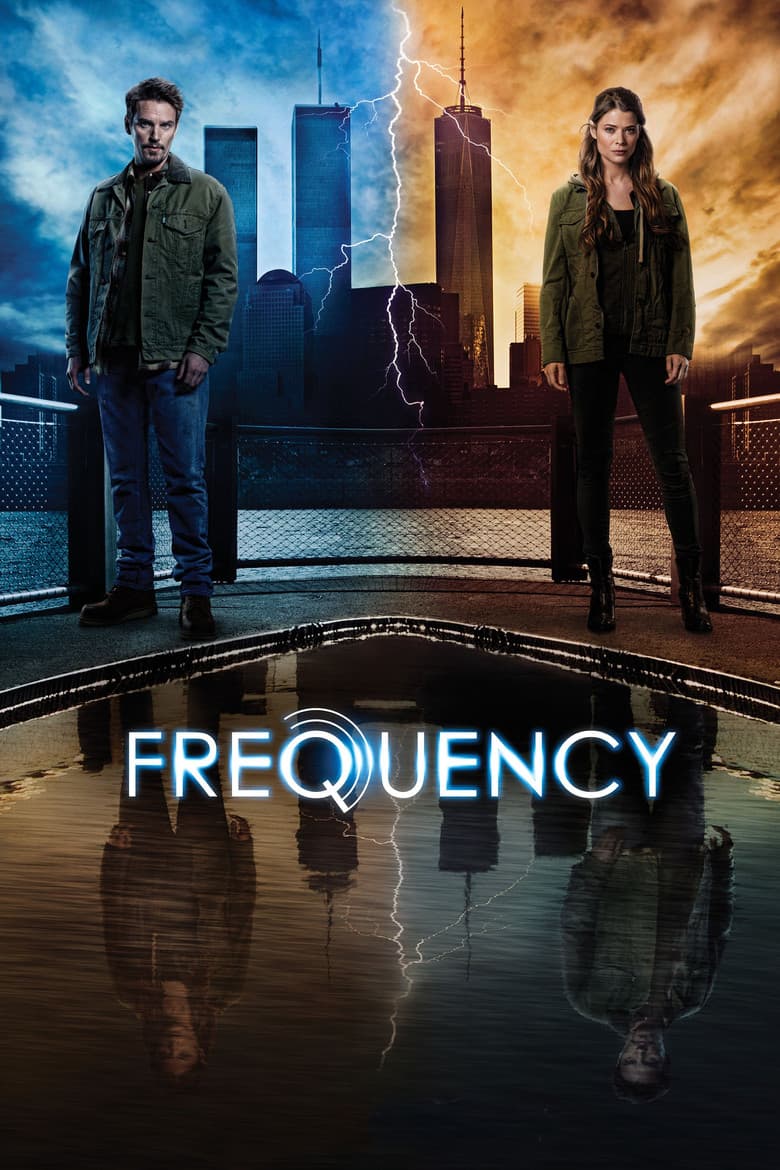
Started October 5, 2016 · Based on 1 season, 13 episodes · TV-14 · 42 min
Frequency is a one-season science fiction crime drama set between New York in 2016 and 1996. New York police detective Raimy Sullivan hears her dead father Frank through his old ham radio, even though he is still alive twenty years earlier. Raimy warns Frank that he will be killed, but saving him changes her life and lets a serial killer target her mother instead. The pair work across time to stop the killer while repairing a damaged family bond, and the show mixes tense police work with emotional family scenes.
The clearest gender-related choice is that the series changes the movie's son into Raimy, a daughter, and makes the father-daughter bond the heart of the story. Raimy is a capable detective who often leads the investigation, while Frank is a flawed father learning how to relate to his grown child. The showrunner described the change as a way to create a more dynamic relationship and move beyond the idea of a “daddy's little girl.” That idea appears in the family drama, but the season mainly tells a time-travel mystery about regret, loyalty, crime, and the cost of changing the past.
Community feedback
Was our 25% Woke rating accurate?
Breakdown
These are the editorial factors and ratings behind our score for Frequency.
Woke representation / casting
The series places Raimy, a female New York police detective, at the center of the story. The show also casts black actor Mekhi Phifer as Raimy's boss, Detective Satch Reyna. That mix fits a modern New York setting and is not treated as a message about race. The deliberate choice to turn the film's son into a daughter adds a mild gender signal to the lead role.
20%
Woke political dialogue
Not present. The dialogue deals with police cases, family wounds, time travel, loyalty, and moral choices. It does not turn those subjects into speeches about current political or social causes.
0%
Identity-driven story themes
The series makes the father-daughter relationship its main emotional thread. Raimy is a capable detective who often drives the investigation, while Frank is a flawed father learning to relate to his grown daughter. The showrunner described the gender change as a way to move past the “daddy's little girl” idea. The season uses that choice for family tension and character growth, not for a broad lesson about identity.
15%
Western institutional / cultural critique
Not present. The show includes police corruption, broken trust, and criminal violence as parts of its mystery. It does not frame police work, family life, or Western culture through a modern activist critique.
0%
Woke character or canon changes
The series changes the movie's child from a son into a daughter named Raimy. The change makes the central bond a father-daughter relationship instead of a father-son relationship. The showrunner said the new bond felt more dynamic and could move past the “daddy's little girl” idea. This deliberate gender change is one of the show's clearest audience-visible adaptation choices.
35%
Anti-woke backlash and complaints
Not present. No clear anti-woke complaints were found. Public coverage focused on the time-travel story, reviews, ratings, and cancellation. No anti-woke campaign or specific complaint about the series appeared in the available X evidence.
0%
Creator track record context
The creative team is mainly known for commercial genre and television work. Jeremy Carver's Frequency interviews focus on time-travel rules, family drama, and mystery. Dan Lin has later supported BIPOC creators, and Oz Scott has links to Black theater and civil-rights events. Frequency does not show a strong activist pattern from this team.
20%
Production
TV Show · 2021
Two federal agents from two different continents, and two different mindsets, must work together to investigate when wreckage from a destroyed alien spacecraft has mysterious…
TV Show · 2016
In the near future a family must make difficult decisions as they balance staying together with trying to survive.
TV Show · 2017
Holden wakes up from a coma after 12 years and discovers new abilities that propel him into the middle of a dangerous conspiracy.
TV Show · 2016
A disgraced, 75-year-old ex-sheriff, whose life ends at the hands of corrupt cops, is brought back to life and given a second chance by a pair of young tech scientists, as a…
TV Show · 2024
When a fatal accident occurs on board the International Space Station, a lone astronaut makes the heroic journey back to Earth, only to discover key pieces of her life—including…
TV Show · 2020
A unique story told over two distinct halves, "Summer" follows Sam, a man drawn to a mysterious island off the British coast where he encounters a group of islanders set on…
TV Show · 2020
In an isolated and inaccessible Antarctic research station in which winter has fallen on the South Pole and the sun will soon disappear for the next six months, a small team…

TV Show · 2022
Irene and Franklin York, a retired couple, have a secret: a Chamber buried in their backyard that miraculously leads to a strange, deserted planet.
