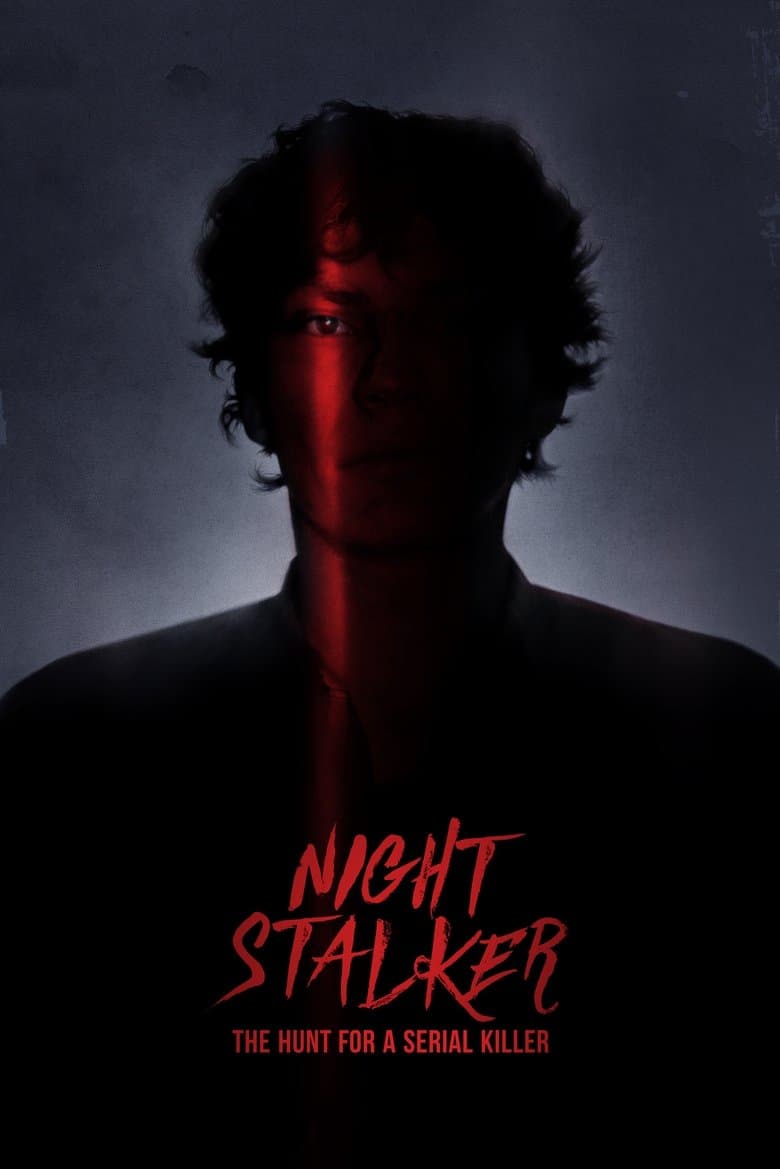
Started January 13, 2021 · Ended · Based on 1 season, 4 episodes through January 13, 2021 · TV-MA · 48 min
Night Stalker: The Hunt for a Serial Killer follows Los Angeles County detectives Gil Carrillo and Frank Salerno as they hunt Richard Ramirez, a killer who attacked people across Southern California in 1984 and 1985. The four-part documentary moves through hot summer streets, frightened homes, police offices, newsrooms, and courtrooms. Survivors, relatives, reporters, and other officers help show how the crimes spread fear through many communities. The tone is grim, tense, and often graphic, with crime photos, old news clips, interviews, and dark reenactments.
The series makes the investigation its main story instead of building a full portrait of Ramirez. Carrillo and Salerno follow shoe prints, witness reports, police records, and clues that cross several law enforcement areas. Their work is slowed by poor sharing between departments, pressure from the news media, and a lack of modern tools such as DNA databases. The final episode brings Ramirez into clearer view, follows the citywide manhunt, shows his arrest and trial, and closes with the lasting pain carried by survivors, families, and the detectives.
Community feedback
Was our 3% Woke rating accurate?
Breakdown
These are the editorial factors and ratings behind our score for Night Stalker: The Hunt for a Serial Killer.
Woke representation / casting
Not present. The series uses real detectives, reporters, victims, and survivors rather than invented identity casting. Gil Carrillo’s Latino background is part of his real life, and the show does not present it as a diversity goal.
0%
Woke political dialogue
Not present. The interviews discuss police mistakes, department rivalry, media pressure, and the lack of shared information. The show does not turn those 1985 problems into a modern identity, DEI, or activist message.
0%
Identity-driven story themes
Not present. The story includes men, women, children, and people from different neighborhoods and backgrounds. It uses that range to show the killer’s random reach and the city’s fear, not to promote identity politics or group-based activism.
0%
Western institutional / cultural critique
Not present. The series shows that police departments failed to share information and that news coverage sometimes hurt the investigation. It treats those failures as case problems and does not attack Western institutions or traditional family life.
0%
Woke character or canon changes
Not relevant. The show tells a real criminal case through interviews, old footage, records, photos, and reenactments. It does not change a known character or historical event to push identity or DEI messaging.
0%
Anti-woke backlash and complaints
Not present. The supplied X research found no anti-woke complaints or boycott activity. Other web discussion focused on graphic images, pacing, victim focus, and police conduct, not on woke, DEI, or identity politics.
0%
Creator track record context
Tiller Russell and James Carroll are mainly crime and nonfiction filmmakers, not activist storytellers. Tim Walsh, Paul-Michel Pierre-Benoist, David Holthouse, and Greg Tillman have no strong pattern of identity-driven work in the supplied creator records. Eli Holzman and Aaron Saidman have a higher supporting signal because their company produced documentaries about undocumented immigrants and LGBTQ+ performers. This gives the title mild creator track record context, but the title itself stays focused on crime.
14%
Production
TV Show · 2022
This harrowing docuseries explores, a cruel conman masquerading as a British spy manipulates and steals from his victims, leaving ruined families in his wake.
TV Show · 2025
What happened in the final days of Gabby Petito's life? In this gripping true-crime series, her loved ones reveal the untold story of her tragic murder.
TV Show · 2017
Inspired by actual events, this true crime anthology series takes a deep dive into the dark, twisted minds of terrorists and follows the brave souls who hunt them down.
TV Show · 2021
The Son of Sam case grew into a lifelong obsession for journalist Maury Terry, who became convinced that the murders were linked to a Satanic cult.
TV Show · 2020
New York City in the 1970s was ruled with a bloody fist by five mafia families, until a group of federal agents tried the unthinkable: taking them down.
TV Show · 2025
A brash but brilliant cop becomes head of a new police department, where he leads an unlikely team of misfits in solving Edinburgh's cold cases.
TV Show · 2020
A 10-part documentary chronicling the untold story of Michael Jordan and the Chicago Bulls dynasty with rare, never-before-seen footage and sound from the 1997-98 championship…
TV Show · 2024
A young boy growing up in the suburbs of 1980s Brisbane faces the harsh realities of life — and the looming dangers that threaten his family.
