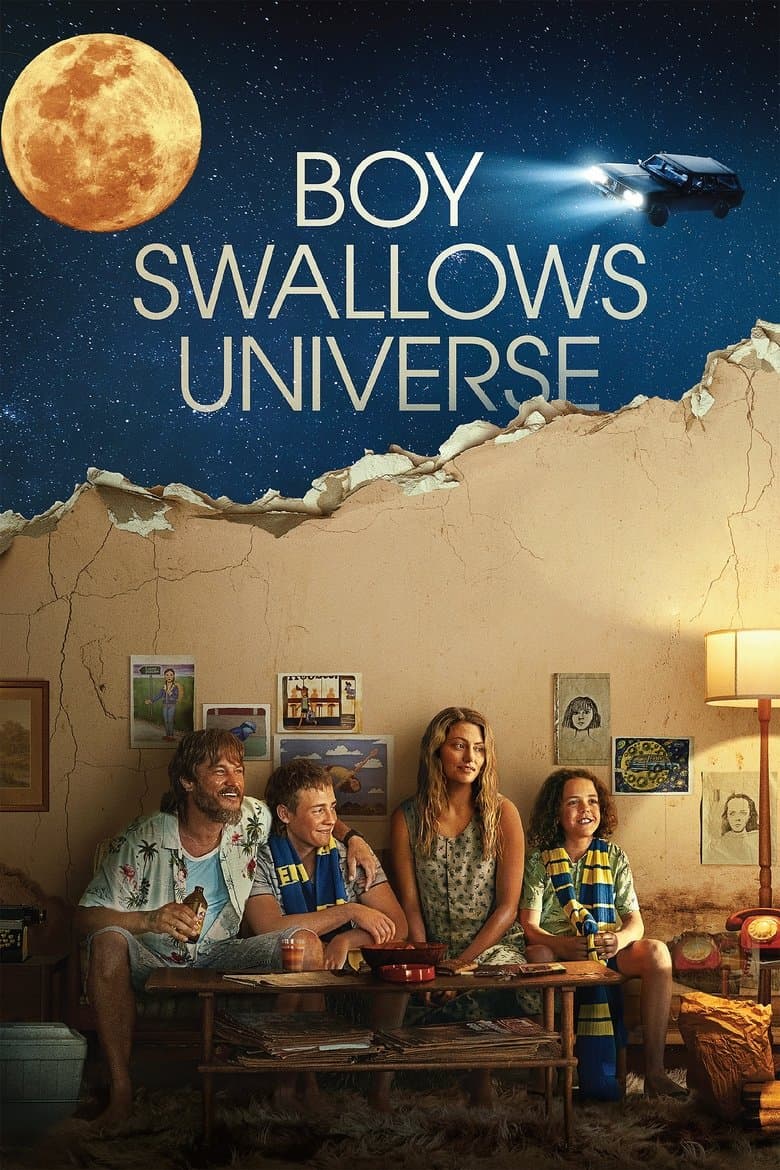
Started January 11, 2024 · Ended · Based on 1 season, 7 episodes through January 11, 2024 · TV-MA
Boy Swallows Universe follows Eli Bell, a bright thirteen-year-old boy living in the working-class suburb of Darra in Brisbane in 1985. Eli shares a troubled home with his mostly silent older brother Gus, his recovering mother Frankie, and his stepfather Lyle, who sells heroin. When Lyle is taken by a dangerous drug gang and Frankie goes to prison, Eli must protect his family while trying to learn what happened. The show mixes crime, family drama, dark humor, and magical images with a warm but often brutal tone.
The story follows Eli as he grows up around addiction, violence, poverty, broken homes, corrupt police, and people who still choose loyalty and kindness. It treats the Bell family as damaged but loving, and it gives much of its weight to the brothers' bond and to Eli's wish to become a crime reporter. Gus's silence is a major part of his character, but the show treats it as a personal condition tied to fear and trauma. The series also asks what makes a good man, while showing that adults can fail children and still try to change. Its main message is about family, healing, hope, and telling the truth after painful events.
Community feedback
Was our 5% Woke rating accurate?
Breakdown
These are the editorial factors and ratings behind our score for Boy Swallows Universe.
Woke representation / casting
Not present. The main roles are mostly white Australian characters, with Vietnamese and Indigenous supporting characters that fit the Brisbane setting and plot. The show does not frame the casting as a diversity or identity campaign.
0%
Woke political dialogue
Not present. The show includes crime, police corruption, and poverty in its plot. The characters do not use modern activist language about identity, DEI, or current political groups.
0%
Identity-driven story themes
Not present. The story centers on family trauma, addiction, crime, healing, brotherhood, and growing up. Gus's selective mutism and the family's violence are treated as character and plot problems, not as an identity campaign. The show does not make race, gender, or sexuality politics its main message.
0%
Western institutional / cultural critique
Not present. The show depicts a corrupt police officer, a violent crime world, and harmful family behavior in 1980s Brisbane. Those events serve the crime and family plot. The story does not turn them into a broad modern attack on Western institutions, men, family life, or religion.
0%
Woke character or canon changes
Not relevant. The series adapts the novel's characters and events without a reported identity-driven race, gender, or sexuality change. The largest changes are ordinary screen adaptation choices.
0%
Anti-woke backlash and complaints
Not present. No anti-woke complaints were identified in the reviewed news, audience discussion, or supplied X pass. Online criticism focused on the ending, pacing, casting transition, and an age-gap romance concern.
0%
Creator track record context
The key creators have mixed records. Jocelyn Moorhouse has a public record of support for feminism and equal rights. Livia Hanich has supported gender and racial diversity in hiring, and Kerry Kohansky-Roberts produced an LGBTQ-focused drama. John Collee, Trent Dalton, Bharat Nalluri, Kim Mordaunt, and most producers have low or mild public political profiles.
24%
Production
TV Show · 2025
A brash but brilliant cop becomes head of a new police department, where he leads an unlikely team of misfits in solving Edinburgh's cold cases.
TV Show · 2026
Ben Reilly, an aging and down on his luck private investigator in 1930s New York, is forced to grapple with his past life as the city's one and only superhero.
TV Show · 2022
Lucy wakes every night at exactly 3:33am. Nothing in her life has made sense for a long time. But the answers are out there, somewhere, at the end of a trail of brutal murders.
TV Show · 2026
Wrongfully imprisoned for murdering his own son, a father sets out on a desperate rescue mission after learning the boy may still be alive.
TV Show · 2022
A prisoner on death row in the US, a vicar in a quiet English town, and a maths teacher trapped in a cellar cross paths in the most unexpected way.
TV Show · 2026
The dynamic between the two contrasting personalities, a seasoned cop who prefers old-school methods and a tech-savvy cop who relies on modern technology for investigations, as…
TV Show · 2020
Hiding a twisted past, a man maintains his facade as the perfect husband to his detective wife — until she begins investigating a series of murders.
TV Show · 2018
In 1994, a toddler disappeared from a small Welsh village, never to be seen again. 23 years later, in London, the mother of rising cello star Matilda Gray commits suicide, without…
