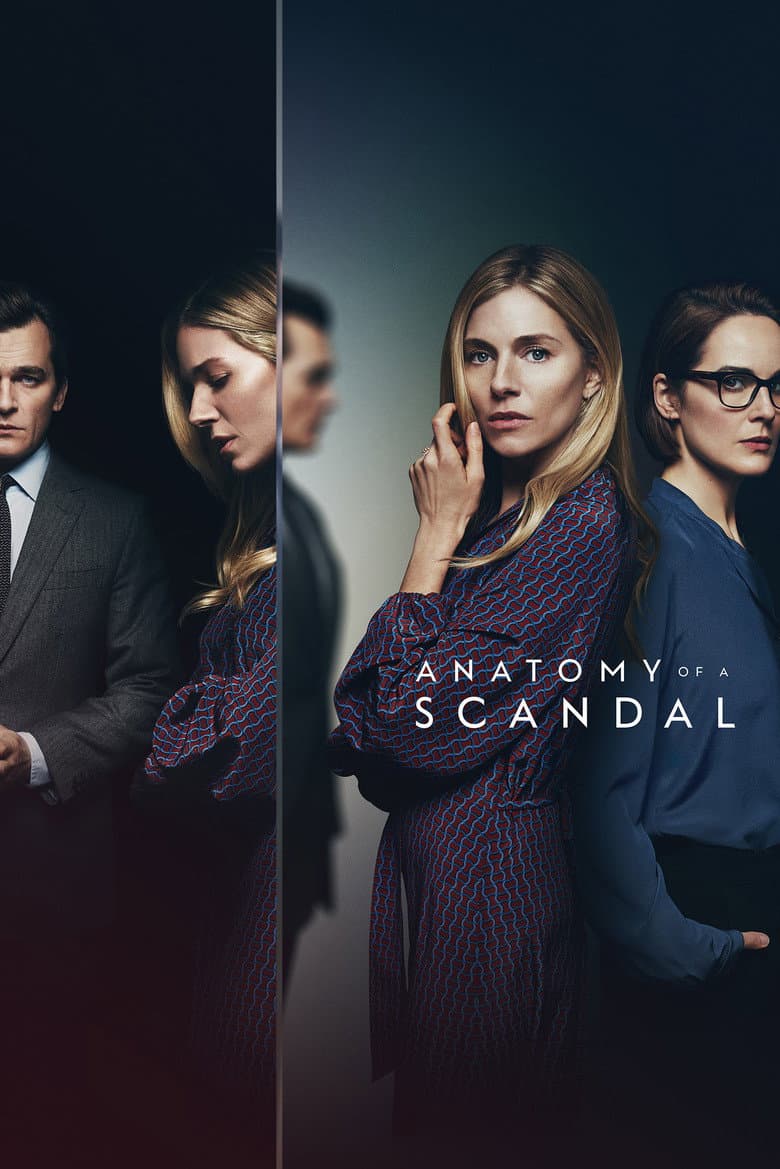
Started April 15, 2022 · Ended · Based on 1 season, 6 episodes through April 15, 2022 · TV-MA · 45 min
Anatomy of a Scandal follows Sophie Whitehouse, the polished wife of James, a powerful Conservative politician in London. James admits that he slept with Olivia Lytton, a younger aide, and then faces her accusation of rape. Sophie must decide whether to stand by her husband or question the life they built at Oxford and in Westminster. The six episodes mix courtroom drama, family secrets, flashbacks, and a dark mystery tone.
The show makes consent, male entitlement, and the protection of powerful men its main social message. Kate Woodcroft prosecutes James, but the story later reveals that she is Holly, a student James sexually assaulted at Oxford. Sophie also learns that her loyalty helped hide his behavior and finally leaves him and exposes his old secret. These gender and privilege themes run through the whole season, while race, sexuality, religion, and economic systems remain outside the main story.
Community feedback
Was our 61% Woke rating accurate?
Breakdown
These are the editorial factors and ratings behind our score for Anatomy of a Scandal.
Woke representation / casting
The main cast places Naomi Scott, a British Indian actor, in the key role of Olivia, the aide whose case starts the trial. Black actors Josette Simon and Kudzai Sitima play a senior defense lawyer and a young legal worker. Those choices give the show a visible pattern of minority women in capable legal roles. The series does not make their identities a theme, and modern London makes the mix plausible.
19%
Woke political dialogue
The prosecutor and other characters repeatedly discuss consent, male entitlement, sexual assault, and the special treatment of powerful politicians. Court speeches and private arguments ask whether silence, fear, or hesitation can count as consent. The show contrasts younger ideas about boundaries with the older Oxford culture around James. The dialogue supports a modern MeToo-style view of accountability, but it stays tied to this case.
42%
Identity-driven story themes
The six episodes center on women facing sexual assault, silence, and the power of a well-connected man. Kate turns her own hidden assault into a reason to seek justice, while Sophie moves from protecting her family image to leaving James. Olivia’s accusation starts the case, even though the show later gives her less screen time than the other women. The story favors women speaking up and making powerful men answer for their actions.
62%
Western institutional / cultural critique
The show presents Westminster, Oxford, and the rich political circle as places where connected men protect one another. James treats his status, money, and charm as proof that he deserves trust. Sophie’s role as a loyal politician’s wife is shown as part of the system that keeps his image safe. The season criticizes male entitlement and old-school power, but it does not attack Christianity or Western society as a whole.
55%
Woke character or canon changes
Not relevant. The show adapts Sarah Vaughan’s recent novel, and no identity-driven change to established characters, canon, or real historical figures drives the story.
0%
Anti-woke backlash and complaints
A few small X accounts called the series “woke garbage” or “woke bollocks.” One post complained that parts felt written to please woke viewers and mentioned a claimed lesbian-best-friend cliché, but that claim does not establish that the show contains one. The posts had little or no engagement, and no organized boycott, review-bombing, or large right-leaning campaign appeared. The anti-woke reaction is fringe.
12%
Creator track record context
David E. Kelley, Melissa James Gibson, and Sarah Vaughan have little public record of strong activist work. S.J. Clarkson is linked to strong female leads, while Lucy Bevan and Emily Brockmann add diversity-focused casting context. Bruna Papandrea often backs complex stories about women. Title-related interviews frame this show around consent, privilege, and male entitlement. The key team is a moderate supporting signal, not a dominant activist track record.
30%
Production
TV Show · 2023
The story of Bass Reeves, the legendary lawman of the wild West, is brought to life. Reeves worked in the post-Reconstruction era as a federal peace officer in the Indian…
TV Show · 2019
The true story of one of the worst man-made catastrophes in history: the catastrophic nuclear accident at Chernobyl.
TV Show · 2024
The true story of one Jewish family separated at the start of World War II, determined to survive—and to reunite.
TV Show · 2019
In the 1960s, Israeli clerk-turned-secret agent Eli Cohen goes deep undercover inside Syria on a perilous, years-long mission to spy for Mossad.

TV Show · 2024
In Japan in the year 1600, at the dawn of a century-defining civil war, Lord Yoshii Toranaga is fighting for his life as his enemies on the Council of Regents unite against him…

TV Show · 2026
The Clyburns uproot their comfortable New York City lives to the wild, untamed beauty of Montana's Madison River Valley on a search for connection.
TV Show · 2022
Oscar-winning producer Al Ruddy’s never before revealed experiences of making the iconic 1972 film The Godfather that Francis Ford Coppola directed and adapted with Mario Puzo.
TV Show · 2025
Tells the story of the ascent of the biblical figure, David, who becomes the most celebrated king of Israel. The series follows the once-mighty King Saul as he falls victim to his…
