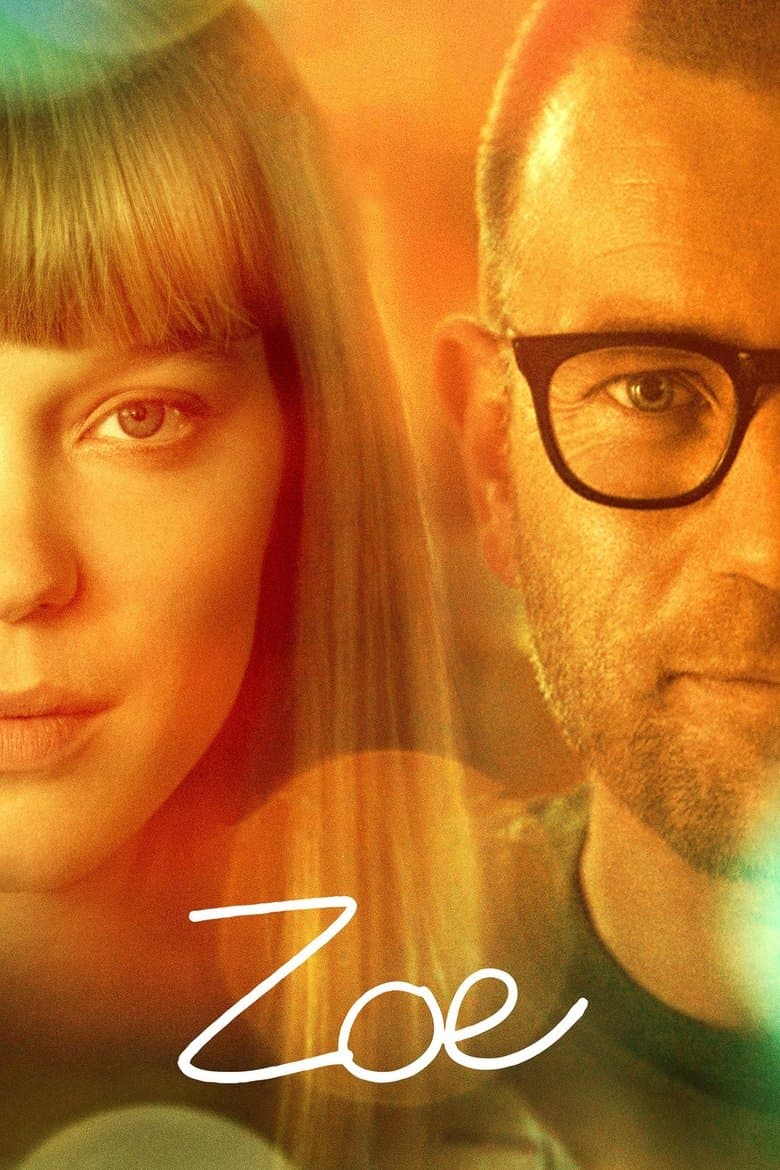
Zoe takes place in a near future where a company sells tools that promise better love. Zoe and Cole work at the company, where they build lifelike synthetic people and test matches with a computer. Zoe thinks she is human until Cole tells her that she is a new kind of synthetic made by the lab. Their romance becomes strained when a car accident exposes her artificial body and Cole pulls away. The movie has a quiet, sad, and adult tone.
The film asks whether a machine can feel love and whether a created person can choose her own life. It shows female-looking synthetics sold as companions and used in a brothel, where older models are treated as replaceable products. One brothel scene says that some men want the feeling a woman gives them rather than the woman herself. Zoe’s search for real feelings gives the story a clear gender and objectification angle, but the movie keeps returning to her romance with Cole instead of making a wider activist case. The strongest social message warns that technology and business can turn love and bodies into products.
Community feedback
Was our 34% Woke rating accurate?
Breakdown
These are the editorial factors and ratings behind our score for Zoe.
Woke representation / casting
Not present. The main cast does not show a clear diversity-first identity pattern. The film also does not frame its female science workers or mixed supporting cast as a political message.
0%
Woke political dialogue
Jewels tells Zoe that some men want the way a woman makes them feel rather than the woman herself. Jewels also says the lab values the synthetics only when they are real enough to make money. The scene links male desire with the sale and disposal of female-looking synthetics. The idea appears in one short brothel sequence rather than throughout the movie.
28%
Identity-driven story themes
The film centers on whether a created person can count as real and choose her own life. Zoe’s female-looking body is designed by a man, sold as a product, and threatened with replacement. The brothel adds a clear concern about the use and disposal of female-looking synthetics. The story makes love and personhood its main questions, so the identity message is present but not dominant.
34%
Western institutional / cultural critique
The film shows a company that sells matching scores, love pills, and synthetic companions. The brothel treats worn-out models as disposable. Jewels says the designer cares about money more than their humanity. Zoe’s creator also holds power over her body and choices. The critique stays focused on technology, business, and male desire rather than attacking Western religion, family, or society as a whole.
32%
Woke character or canon changes
Not relevant. The film tells an original science-fiction story about fictional characters. It does not change a known character, historical figure, or source story.
0%
Anti-woke backlash and complaints
Not present. The supplied X research found no anti-woke posts or named complaints. Other visible reactions focused on slow pacing, weak writing, and the film’s science-fiction premise. No clear anti-woke or anti-DEI backlash was found in the reviewed coverage.
0%
Creator track record context
Doremus has no strong public activist profile and is mainly known for romance and science-fiction stories. Greenberg has identity-centered work such as Take Me Out, but his career is not mainly activist. Bender has progressive political and environmental ties, and Zhou often highlights women and cross-cultural stories. Most of the other listed producers and casting directors have little public activist record.
24%
Production

Movie · 2025
Two highly trained operatives grow close from a distance after being sent to guard opposite sides of a mysterious gorge.
Movie · 2021
Tom and Janet have been happily married for years. But a visit from a mysterious stranger leads to a dead body, a lot of questions, and a tense couples' trip with friends who may…

Movie · 2017
Jimmy is a committed child psychologist who uses his own playbook, but when he is brought in to work with Ellie, he is completely unprepared for his subject—a 9-year-old…
Movie · 2017
In the near future, due to a breakthrough scientific discovery by Dr. Thomas Harbor, there is now definitive proof of an afterlife.

Movie · 2020
When carefree Nyles and reluctant maid of honor Sarah have a chance encounter at a Palm Springs wedding, things get complicated when they find themselves unable to escape the…
Movie · 2024
An elite trio of astronauts aboard a years-long, possibly compromised mission to Saturn's moon, Titan, gears up for a highly dangerous slingshot manoeuvre that will either…
Movie · 2021
A couple fights to hold their relationship together as a memory loss virus spreads and threatens to erase the history of their love and courtship.
Movie · 2017
This in-world short film takes place in the year 2036 and revolves around Jared Leto’s character, Niander Wallace.
