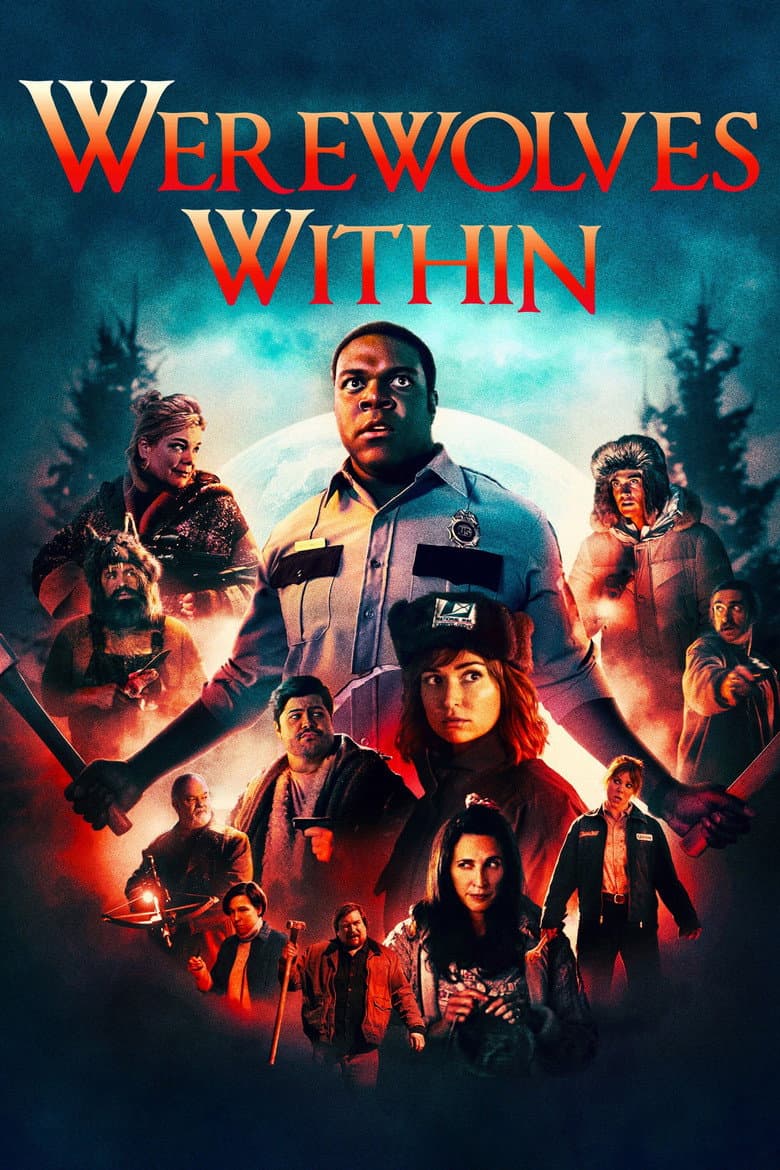
Werewolves Within follows Finn Wheeler, a very kind forest ranger who arrives in Beaverfield, Vermont, for a new job. A snowstorm traps him with a group of neighbors who are already fighting over a gas pipeline. After animals and people are attacked, Finn must keep the group alive while trying to find the hidden werewolf. The movie mixes bloody danger with fast jokes, awkward people, and a locked-room mystery.
The film makes the town’s political split easy to see. It jokes about liberal snowflakes, Antifa, gun rights, corporate money, environmental protection, and men who tell Finn to “man up.” A Black ranger leads the mostly white town, a gay couple has a strong supporting role, and several women are skilled or forceful while Finn is the gentle one. These choices shape the jokes and the town’s arguments, but the main story still centers on fear, greed, friendship, and the danger of neighbors turning on one another.
Community feedback
Was our 60% Woke rating accurate?
Breakdown
These are the editorial factors and ratings behind our score for Werewolves Within.
Woke representation / casting
The film places a black forest ranger at the center of a mostly white Vermont town. The film also gives major roles to a gay couple and to several women who run businesses, work as a scientist or mechanic, or handle dangerous action. Director Josh Ruben said he did not want another white hero and tied Finn’s casting to the story’s outsider idea. The casting therefore carries a clear representation message, even though the modern setting can support a varied town.
52%
Woke political dialogue
Characters repeatedly argue about the gas pipeline and use current political labels such as “Antifa” and “liberal snowflakes.” Cecily talks about men touching women while Finn is told to “man up,” and another line makes a joke about white men. The film also uses lines about heteronormativity, social media, gun rights, and environmental damage. These remarks appear throughout the town’s banter, but they remain short jokes inside a horror mystery.
47%
Identity-driven story themes
The story makes social identity and political labels part of the central mystery. The town splits into conservative locals, liberal newcomers, a gay couple, an environmental scientist, and workers who want pipeline money. The movie repeatedly shows men as creepy, weak, or foolish while Cecily, Jane, and Gwen are capable and forceful. Finn’s journey rejects the demand that a kind man must become loud or aggressive, and the ending treats kindness as a strength. These themes matter across the movie, but the werewolf hunt remains the main plot.
50%
Western institutional / cultural critique
The film presents the pipeline company as a rich business that uses money and division to get its way. The story treats environmental protection as the better side of that fight, while it mocks gun culture, conspiracy talk, and fear of “Antifa.” The film also makes male entitlement and “man up” ideas look foolish. The criticism is spread through jokes and a monster plot, so it is clear but not the whole movie.
44%
Woke character or canon changes
Not relevant. The film is a loose adaptation of a social-deduction game with generic roles. It does not change an established character’s race, sex, sexuality, or history.
0%
Anti-woke backlash and complaints
A few public comments and one home-video review called parts of the film “woke” or complained about “woke humor,” mainly because of the gay couple and political jokes. The remarks were isolated and did not produce a major boycott, review-bombing campaign, or news controversy. The supplied X research found no anti-woke reaction or specific complaints.
8%
Creator track record context
Cached context gives Josh Ruben a moderate score because he supports #MeToo and made a film about male privilege and sexism. Mishna Wolff’s work often discusses race, class, and belonging, while Sam Richardson has spoken about race and police violence. Producer Margaret Boykin has backed a women’s writing fellowship, and Natalie Metzger has worked on LGBTQ inclusion. The wider producer group has little public activist history, so the overall creator signal is moderate rather than dominant.
43%
Production
Movie · 2024
A family's vacation to a remote getaway takes an unexpected turn when they discover the present-day implications of the island's cannibalistic past.
Movie · 2025
A father and daughter accidentally hit and kill a unicorn while en route to a weekend retreat, where his billionaire boss seeks to exploit the creature’s miraculous curative…
Movie · 2017
Gary, who has just married Samantha, the woman of his dreams, discovers that her six-year-old son may be the Antichrist.
Movie · 2017
Ten years ago, over forty people were brutally torn to pieces in Louisiana’s Honey Island Swamp. Over the past decade, lone survivor Andrew’s claims that local legend Victor…
Movie · 2026
After breaking the mysterious "One Wish Willow" to win his crush's heart, a hopeless romantic finds himself getting exactly what he asked for but soon discovers that some desires…
Movie · 2019
A driving instructor must use her other-worldly gifts to save a lonely man’s daughter from a rock star looking to use her for Satanic purposes.
Movie · 2026
Moments after surviving an all-out attack from the Le Domas family, Grace discovers she’s reached the next level of the nightmarish game — and this time with her estranged sister…
Movie · 2024
A live broadcast of a late-night talk show in 1977 goes horribly wrong, unleashing evil into the nation's living rooms.
