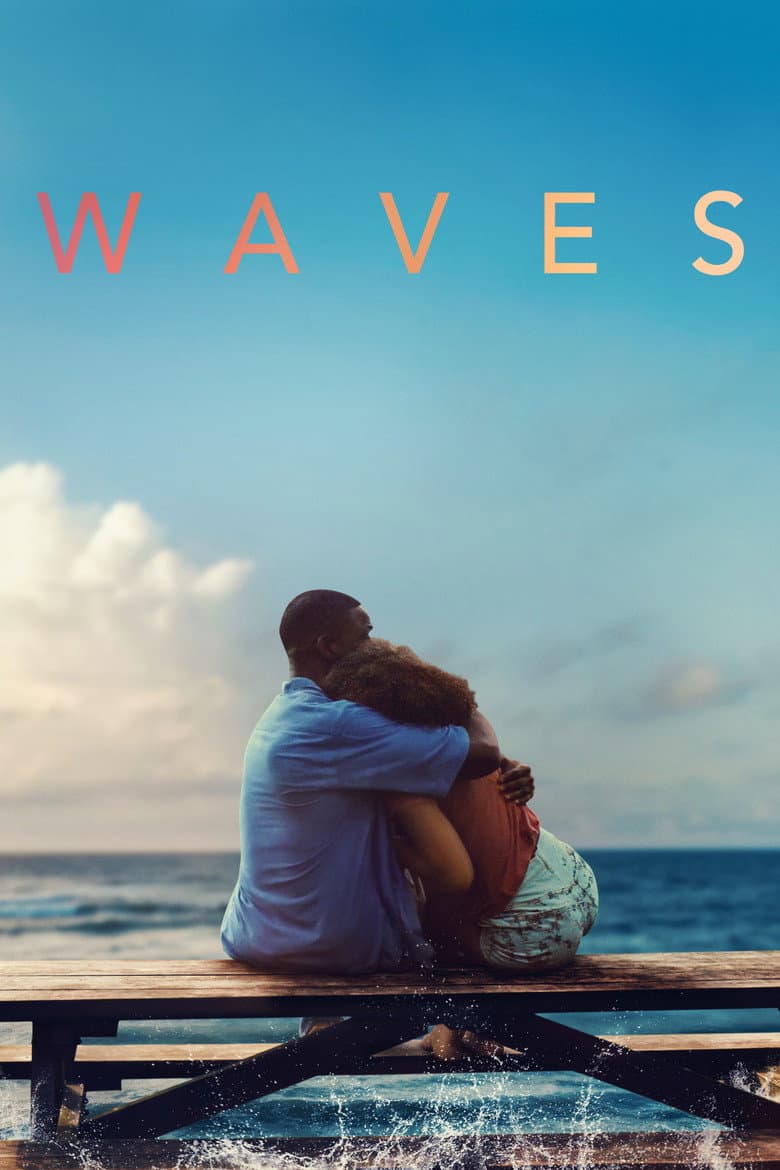
Waves follows Tyler Williams, a talented high school wrestler in a comfortable South Florida family. His father, Ronald, pushes him to win, hide pain, and secure a bright future. After a bad shoulder injury, drug use, and a bitter fight with his girlfriend, Tyler’s life breaks apart and a terrible act changes the family. The story then follows his quieter sister Emily as she deals with grief and finds a careful new love. The tone moves from loud, colorful teenage energy to slow sadness, guilt, and hope.
The film gives clear weight to the pressure placed on young black people to be excellent and avoid failure. Ronald says that black people are not given the freedom to be average, and the family connects that fear to hard rules about manhood. The story treats anger, control, and emotional silence in men as harmful, while Emily and the women around her carry much of the pain and healing. These identity-driven themes are important to the family conflict, but the film remains mainly a story about addiction, violence, loss, forgiveness, and love.
Community feedback
Was our 46% Woke rating accurate?
Breakdown
These are the editorial factors and ratings behind our score for Waves.
Woke representation / casting
The film centers its main family on black actors, while Tyler dates a Latina girl and Emily dates a white boy. The film also briefly identifies Tyler’s friend Franky as gay. The official synopsis and interviews present the cast as a way to show a middle-class black family and Black life. South Florida makes the mix believable, so the identity emphasis is clear but not extreme.
35%
Woke political dialogue
Ronald tells Tyler that black people are not given the freedom to be average and must work much harder to succeed. A later racist insult makes that pressure more direct. These lines connect the family conflict to race and unequal treatment. The dialogue appears in a few key moments, while most scenes focus on injury, addiction, violence, grief, and forgiveness.
32%
Identity-driven story themes
The story links Tyler’s drive to be perfect with pressure on young black men to prove themselves. The film treats rigid manhood, anger, and emotional silence as forces that damage Tyler and Ronald. Emily and the women around her face the results and become central to the film’s path toward healing. These ideas shape both halves, but the movie remains a family tragedy rather than a full identity-politics story.
48%
Western institutional / cultural critique
The film presents strict male control and the demand to stay tough as harmful family habits. Ronald belittles Catherine’s work, overlooks Emily, and pushes Tyler toward a narrow idea of success. The story also ties this pressure to the fear that black boys must outperform others. The criticism stays focused on family and gender roles instead of attacking Christianity, capitalism, or Western institutions.
33%
Woke character or canon changes
Not relevant. Waves is an original family drama with no established characters, source canon, or historical figures.
0%
Anti-woke backlash and complaints
Not present. The searched coverage shows praise, mixed reactions to the two-part structure, and some criticism about a white director telling a black family story. No clear anti-woke or right-leaning complaint says that the film pushes DEI or identity politics.
0%
Creator track record context
Shults is mainly known for personal family dramas and has no clear record of strong identity-politics activism. Kaufman has worked on projects with major LGBTQ themes, but Waves is not a queer-centered story. Jacob Jaffke and Kevin Turen have little known activist history, while James Wilson has made public comments about equal concern for civilians in Gaza and Yemen. This gives mild supporting context, not a strong title-specific signal.
23%
Production

Movie · 2018
A man and a woman meet in the ruins of post-war Poland. With vastly different backgrounds and temperaments, they are fatally mismatched and yet drawn to each other.
Movie · 2018
Seasoned musician Jackson Maine discovers — and falls in love with — struggling artist Ally. She has just about given up on her dream to make it big as a singer — until Jack…
Movie · 2025
Laura and Simon have been best friends since college. Over the years, they've realized their bond is more than platonic.
Movie · 2018
As a young New York couple goes from college romance to marriage and the birth of their first child, the unexpected twists of their journey create reverberations that echo over…
Movie · 2025
Based on a true story, two down-on-their-luck musicians form a joyous Neil Diamond tribute band, proving it's never too late to find love and follow your dreams.
Movie · 2018
The coming-of-age tale of 16-year-old Lina Vilkas who is deported to Siberia amid Stalin's reign of terror in the Baltic region during WWII.

Movie · 2025
Two artistic souls find harmony through music despite their contrasting worlds. As feelings deepen, age and circumstances challenge their undeniable bond.
Movie · 2016
Lou Clark, a directionless 26-year-old from the English countryside, takes a job at the local castle as a caregiver and companion to a wealthy young banker, Will Traynor.
