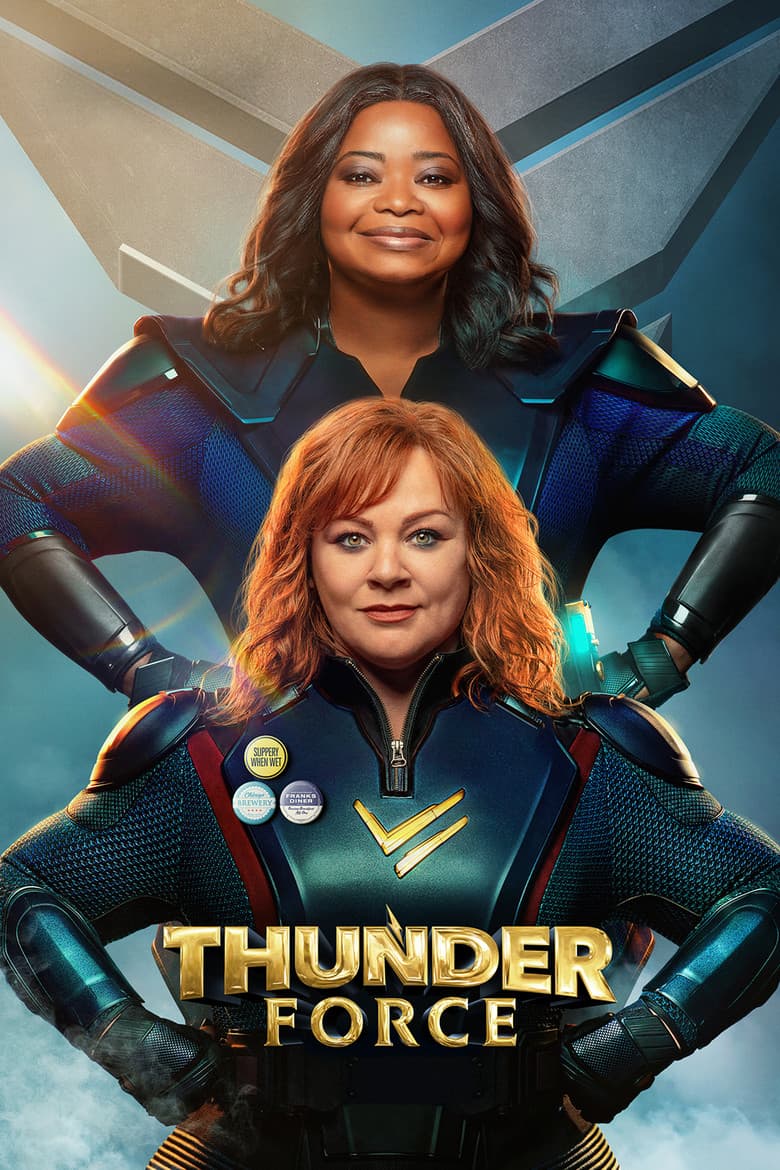
Thunder Force takes place in present-day Chicago, where supervillains have become common since a strange event in 1983 gave powers to people with violent or selfish minds. Lydia Berman is a funny but aimless forklift worker who wants to repair her friendship with Emily Stanton. Emily is a rich and brilliant scientist who has spent years making a treatment that can give normal people powers. The two women become the Thunder Force team and face a criminal mayoral candidate and his powered helpers in a broad, silly superhero comedy.
The movie makes female empowerment a major part of its story. It places two middle-aged, plus-size women in the main hero roles, gives Emily the lead science role, and lets her teenage daughter Tracy join the final battle. The film also presents a black woman scientist, a black teen genius, a woman mayor, and a family with two fathers as normal parts of its world. The message is that women and people with different bodies can be brave heroes, but the movie does not build its plot around a wider political movement or a queer story.
Community feedback
Was our 57% Woke rating accurate?
Breakdown
These are the editorial factors and ratings behind our score for Thunder Force.
Woke representation / casting
The film puts two middle-aged women at the center of the hero team. Emily is a brilliant black scientist, and Tracy is her Black teenage daughter who becomes a young hero. Lydia is a plus-size woman who becomes the team's strongest fighter, and a woman serves as Chicago's mayor. The film's promotion also calls these choices female empowerment and highlights smart women in leading roles.
75%
Woke political dialogue
Not present. The film has a mayoral election and a villain who uses fear, but it does not include recurring activist or identity-politics speeches. The political material works as a simple superhero plot about a dishonest candidate.
0%
Identity-driven story themes
The story makes female empowerment a central message. Lydia and Emily become heroes even though they are middle-aged and plus-size, and the movie treats their bodies as no bar to hero work. Emily's Black teenage daughter Tracy uses her intelligence and new speed to help save the city. A brief scene with a child and two fathers adds LGBTQ representation, but queer identity is not the main subject.
52%
Western institutional / cultural critique
Not present. The film shows a corrupt mayoral candidate, but it does not attack Western institutions, Christianity, family life, or men as a group. The story treats the election as a simple crime plot rather than a wider social critique.
0%
Woke character or canon changes
Not relevant. The film is an original superhero story, so it does not alter an established character, canon, historical figure, or real event.
0%
Anti-woke backlash and complaints
Small X accounts called the film “woke trash” and mocked body-positive vibes around its plus-size female heroes. Other posts complained that the heroes were fat, non-conventional women while the villains were mostly white men or a conservative-coded politician. The Quartering framed the movie's poor reception as another woke Netflix disaster, but the shared clips had little engagement. The available reaction showed no sustained boycott, review-bomb campaign, or large anti-woke movement.
20%
Creator track record context
The cached creator summaries give Ben Falcone and Melissa McCarthy low scores and find no record of political activism in their main film work. The listed producers and casting directors also have low cached scores and no noted focus on identity politics. Title interviews describe friendship, comedy, ordinary people becoming heroes, and female empowerment. This gives the film weak creator-context support, while its stronger identity signals come from the movie itself.
12%
Production
Movie · 2024
A listless Wade Wilson toils away in civilian life with his days as the morally flexible mercenary, Deadpool, behind him.
Movie · 2026
A 'Man from the Future' arrives at an LA diner where he must recruit the precise combination of disgruntled patrons to join him on a one-night quest to save the world from the…
Movie · 2024
After crash-landing on an alien planet, an asteroid miner must contend with the challenges of his new surroundings, while making his way across the harsh terrain to the only other…
Movie · 2019
Stranded at a summer camp when aliens attack the planet, four teens with nothing in common embark on a perilous mission to save the world.
Movie · 2016
Four losers are thrust into the position of saving the world when they stumble upon a UFO crash site and become genetically equipped to the battle suit on board.

Movie · 2019
The Men in Black have always protected the Earth from the scum of the universe. In this new adventure, they tackle their biggest, most global threat to date: a mole in the Men in…
Movie · 2024
Returning to her home planet, an infamous bounty hunter forms an unexpected alliance with a team of unlikely heroes.
Movie · 2017
In the near future, Major is the first of her kind: a human saved from a terrible crash, then cyber-enhanced to be a perfect soldier devoted to stopping the world's most dangerous…
