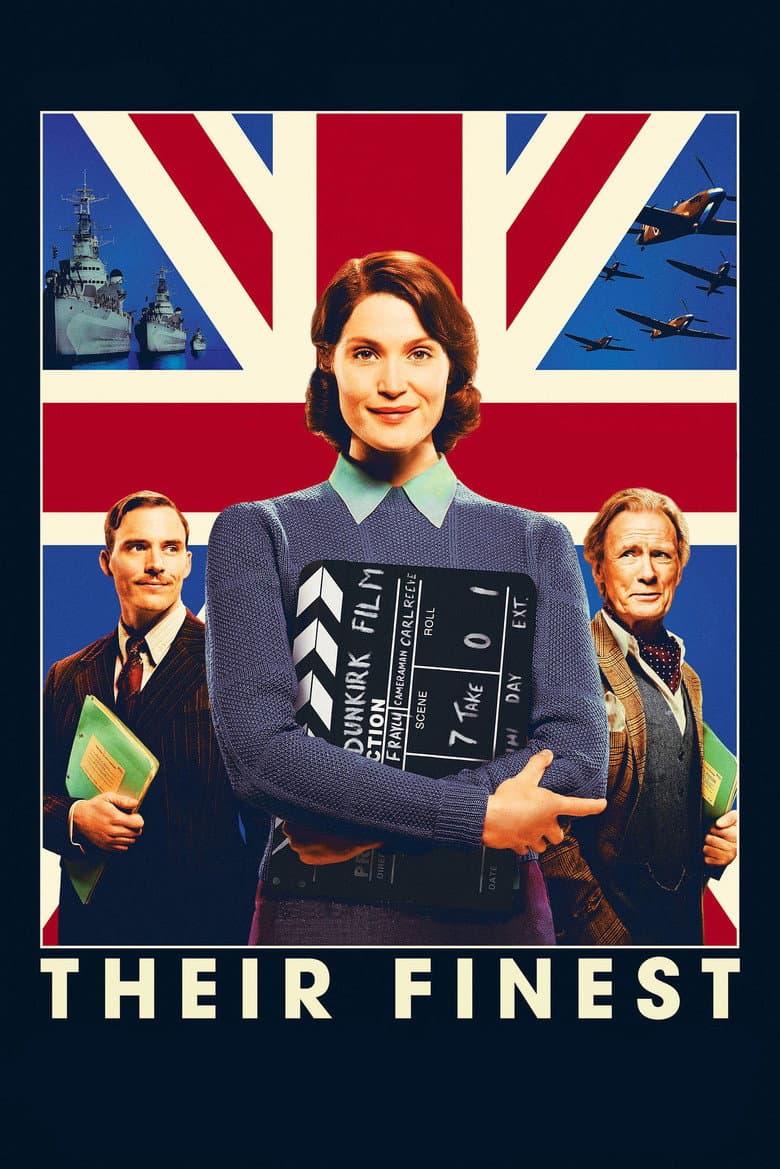
In 1940 London, Catrin Cole is a Welsh ad writer who takes a job writing film scripts during the Blitz. The Ministry of Information hires her to add believable lines for women to a movie about two sisters who help rescue soldiers during the Dunkirk evacuation. Catrin joins a mostly male film team and works with the sharp but guarded writer Tom Buckley. She also faces pressure from her struggling artist partner, Ellis, while bombs threaten the city and the production. The film mixes dry comedy, romance, wartime danger, and sadness.
The story gives Catrin a clear path from an underpaid helper to a writer whose choices shape the whole film. Male writers first call women’s dialogue “slop,” but Catrin changes the script so the women in the story can act, lead, and save lives. The film shows how bosses and partners expect women to step aside when men return from war, while a smaller character, Phyl Moore, is shown as a lesbian. Catrin’s work matters more than a romance, and the movie treats her growing independence as a good thing. The film praises stories as a way to help people face fear, while also showing that wartime propaganda can bend the truth.
Community feedback
Was our 58% Woke rating accurate?
Breakdown
These are the editorial factors and ratings behind our score for Their Finest.
Woke representation / casting
The cast centers a Welsh woman writer, two young women who become heroes in the film within the film, and a lesbian Ministry worker. These visible choices give women more important jobs and story space than a typical wartime movie. The roles fit the 1940 setting and the plot, so the casting does not look like a broad race or quota display. The identity signal is noticeable, but it is less important than the film’s written themes.
28%
Woke political dialogue
The men repeatedly call women’s dialogue “slop” and say they cannot pay Catrin as much as the men. Tom says girls want a male hero instead of being the hero, and another line says men fear women will not return to their boxes after the war. Catrin and her allies reject these ideas as unfair and keep the women’s roles in the script. The lines recur through the work story, but they are tied to the period and do not become a modern political speech.
39%
Identity-driven story themes
The main story follows Catrin as she gains power in a male-run film office. The film repeatedly treats women as writers, workers, and heroes while male coworkers dismiss them, depend on them, or become comic figures. Catrin changes the inner film so the sisters keep the heroic actions, then proves her own skill by saving the production. A minor lesbian character adds ordinary LGBTQ representation, but the movie is mainly about women’s work and independence. This feminist message shapes the plot from the opening job to the ending.
62%
Western institutional / cultural critique
The film repeatedly shows a male-run workplace that pays Catrin less and treats her ideas as lesser. It also shows her partner Ellis expecting her to put his needs and career first. The story presents these rules about male authority and female duty as unfair and worth resisting. The criticism stays inside a 1940s war and film setting, and it does not attack Christianity, capitalism, or Western society as a whole.
38%
Woke character or canon changes
Not relevant. The film adapts Lissa Evans’s novel and uses fictional characters shaped by real wartime stories. No reported race, gender, sexuality, or hero-role swap changes an established character or real historical figure.
0%
Anti-woke backlash and complaints
Not present. The supplied X research found no anti-woke posts, boycott calls, or review-bombing. The reviewed news, audience pages, and critiques also show no clear complaint that the film pushes DEI or identity politics.
0%
Creator track record context
Director Lone Scherfig often tells stories about women gaining power in male-run institutions. Writer Gaby Chiappe has backed gender equality in screenwriting and has worked with a rape crisis group on a rape storyline. Writer Lissa Evans often writes about women’s lives and overlooked wartime experiences. Producer Stephen Woolley has backed films with gender and queer themes, while Elizabeth Karlsen often supports female-focused stories. This is a moderate identity-focused record that matches the film’s feminist focus.
45%
Production

Movie · 2016
Lou Clark, a directionless 26-year-old from the English countryside, takes a job at the local castle as a caregiver and companion to a wealthy young banker, Will Traynor.
Movie · 2018
As a young New York couple goes from college romance to marriage and the birth of their first child, the unexpected twists of their journey create reverberations that echo over…
Movie · 2017
Nothing is as it seems in this riveting World War 2 thriller as a wary soldier goes to investigate a mysterious German monarch at his secluded mansion, leading him into a web of…

Movie · 2017
A brilliant but impulsive young surgeon spirals into self-destruction after a painful breakup, struggling to cope with love, loss, and the consequences of his own temper.
Movie · 2018
German artist Kurt Barnert has escaped East Germany and now lives in West Germany, but is tormented by his childhood under the Nazis and the GDR regime.

Movie · 2018
Seasoned musician Jackson Maine discovers — and falls in love with — struggling artist Ally. She has just about given up on her dream to make it big as a singer — until Jack…

Movie · 2019
Kabir, a highly intelligent but short-tempered medical surgeon spirals into addiction after his intense relationship with his girlfriend turbulently ends.
Movie · 2016
In 1958, in the state of Virginia, the idea of interracial marriage was not only considered to be immoral to many, it was also illegal.
