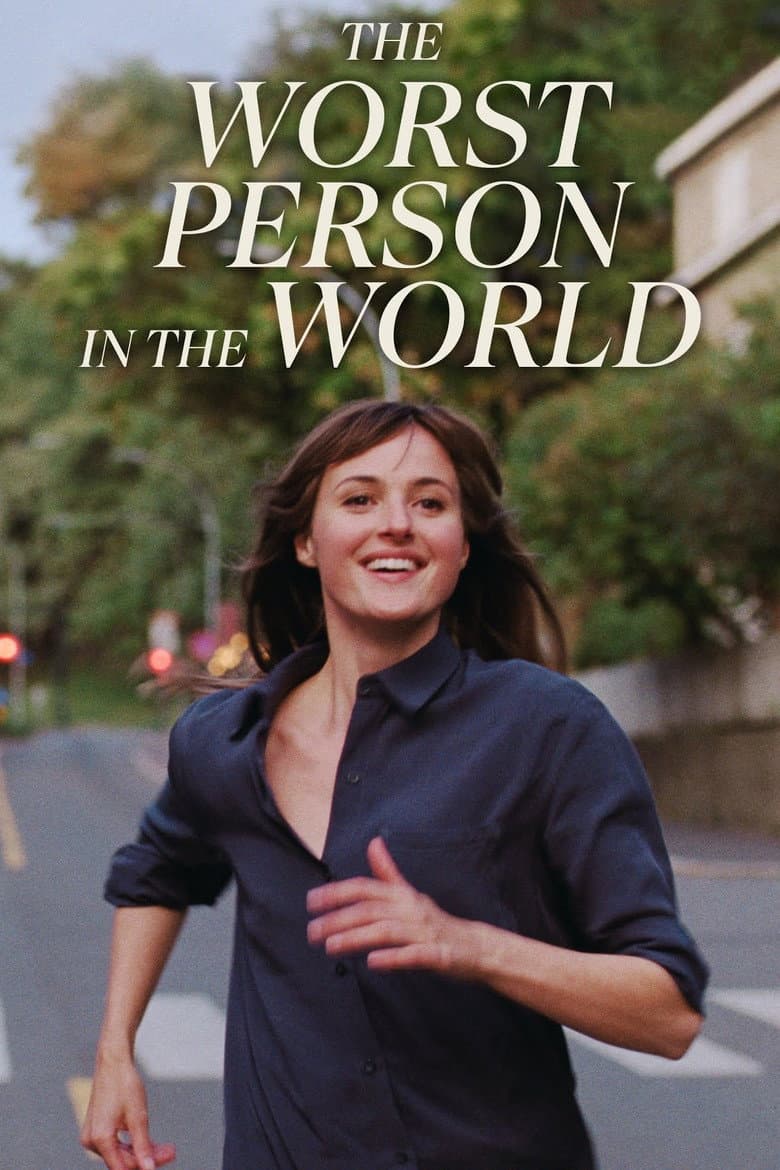
Movie review
October 13, 2021 · 128 min · R · Norwegian · Comedy · Romance · Drama
Julie is a young woman in modern Oslo who keeps changing her plans for school, work, and love. She leaves medicine, tries psychology, and moves toward photography while dating the older comic artist Aksel. She later meets Eivind, a kind barista, and must face the damage caused by leaving one relationship for another. The film mixes funny, strange scenes with sadness as Julie deals with family pain, sex, aging, pregnancy, loss, and the fear that she is wasting her life.
The film gives clear space to modern feminist ideas, but it presents them through Julie’s messy private life instead of a political campaign. Julie talks about the shame around periods and writes a viral piece called “Oral Sex in the Age of #MeToo.” She rejects pressure to become a wife or mother on a fixed schedule, and her pregnancy brings fear about what she wants from family life before it ends in a miscarriage. A short side story mocks both old-fashioned male attitudes and a loud social-justice style of talking, so the film feels more uncertain and personal than openly activist.
Community feedback
Was our 44% Woke rating accurate?
Breakdown
These are the editorial factors and ratings behind our score for The Worst Person in the World.
Woke representation / casting
Not present. The cast fits a modern Oslo story, with mainly white Norwegian characters. The film does not use a clear diversity-first casting message.
0%
Woke political dialogue
Julie asks whether a woman can be a feminist and still enjoy oral sex. Julie writes an essay called “Oral Sex in the Age of #MeToo.” A TV discussion attacks Aksel’s comic for sexist images. Sunniva talks about Sami people and climate change. These scenes are clear but brief, and the story does not turn into a political debate.
34%
Identity-driven story themes
Julie makes the search for a self and a life of her own the center of the story. Julie resists pressure to marry, have children, and stay in one career. Julie’s sexual choices and pregnancy show her trying to control her future. The film gives a woman’s view of desire, periods, shame, and family pressure. Julie remains selfish and confused, so the movie asks questions instead of presenting her as a flawless role model.
47%
Western institutional / cultural critique
The film questions the pressure to marry, have children, and follow a fixed adult path. Aksel’s wish to become a father creates a repeated conflict with Julie’s fear of motherhood. The film also pokes fun at a loud activist style through Sunniva’s Sami and climate concerns. The story does not attack Christianity, capitalism, or Western institutions. The main conflict stays inside love and family, so this factor is mild.
24%
Woke character or canon changes
Not relevant. The film uses an original story. It does not change established characters, a source text, or historical figures.
0%
Anti-woke backlash and complaints
A few niche online comments called the film’s feminist lines shallow or out of touch. Some viewers described the story as built around liberal clichés. These comments were scattered and did not form a major campaign or review-bombing event. Mainstream coverage was mostly positive or focused on whether Julie was well written.
8%
Creator track record context
Joachim Trier has a limited woke track record, with Thelma as his main queer-centered film and some feminist and humanitarian comments. Eskil Vogt has mostly made psychological stories and has no strong record of identity campaigning. Producer Thomas Robsahm has a stronger animal-rights history, but that is not the same as identity politics. The other listed producers and crew have no clear activist public profile tied to this film.
30%
Production

Movie · 2016
A week in the life of Paterson, a poet bus driver, and his wife Laura, a very creative artist, who live in Paterson, New Jersey, hometown of many famous poets and artists.

Movie · 2016
Maggie's plan to have a baby on her own with a sperm donor is derailed when she falls in love with John, an older married professor, destroying his volatile marriage to the…
Movie · 2019
Charlie suffers from a serious disease that causes acute narcolepsy whenever he is happy. Although he develops a variety of techniques to deny himself pleasure and deal with his…
Movie · 2023
Mira Ray, dealing with the loss of her fiancé, John, sends a series of romantic texts to his old cell phone number… not realizing the number was reassigned to Rob Burns' new work…
Movie · 2016
Mia, an aspiring actress, serves lattes to movie stars in between auditions and Sebastian, a jazz musician, scrapes by playing cocktail party gigs in dingy bars, but as success…
Movie · 2020
Lonely college freshman Alex has closed himself off from his peers, who all appear to have this whole "college thing" figured out.
Movie · 2024
Fran likes to think about dying. It brings sensation to her quiet life. When she makes the new guy at work laugh, it leads to more: a date, a slice of pie, a conversation, a…
Movie · 2021
Resolving to achieve professional success without compromising her ethics, Lucy embarks on a ruthless game of one-upmanship against cold and efficient nemesis Joshua, a rivalry…
