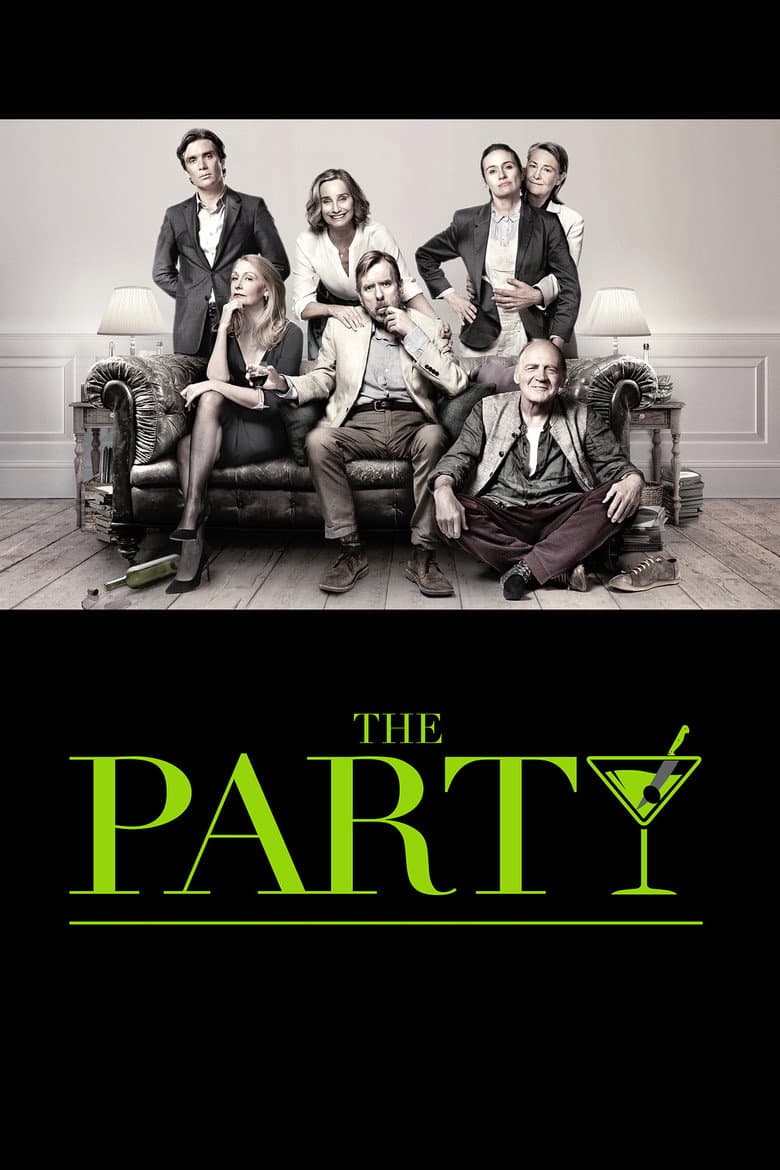
Janet is a British politician who invites close friends to her London home after being named shadow health minister for the opposition party. Her husband Bill and the guests arrive with secrets and broken relationships. Martha and Jinny are a couple expecting triplets. April, Gottfried, and Tom bring sharp arguments about love, money, health, and truth. The party soon turns into a tense black comedy with shouting, violence, drugs, and a gun.
The film makes politics part of nearly every talk, with repeated arguments about the NHS, democracy, socialism, capitalism, feminism, and the failure of the British left. It gives a major place to a lesbian couple and to women who lead, teach, and control the room, while several men appear weak, lost, or selfish. The film also treats these people as flawed and mocks their claims, so the message is more a bitter attack on a broken liberal group than a simple praise speech. Viewers are likely to notice the feminist and same-sex relationship themes even though the story is mainly a short party farce about people losing control.
Community feedback
Was our 70% Woke rating accurate?
Breakdown
These are the editorial factors and ratings behind our score for The Party.
Woke representation / casting
The main group has four women and a lesbian couple, so women hold much of the social and political power. The group also includes an American woman, an Irish banker, and a German man in a London setting. Potter described this international mix as the opposite of Brexit. The cast is mostly white and does not use a broad race-based diversity design, so the representation signal is visible but limited.
29%
Woke political dialogue
The guests repeatedly argue about the NHS, democracy, Labour-style politics, feminism, socialism, capitalism, and truth in public life. April uses lines about feminism and the end of democracy, while Tom attacks wealth and the money system. Martha and Jinny argue about children and different kinds of feminism. These ideas shape the party’s main conflicts, but the film gives no simple speech that tells viewers to accept one answer.
52%
Identity-driven story themes
Jinny and Martha are a lesbian couple, and their argument about having children is a continuing part of the plot. The story also follows Janet as a woman rising into national politics and trying to balance work with care for her sick husband. April attacks older feminist ideas, while Martha defends her own academic version of feminism. Women drive most of the important debates, while several men are shown as weak, lost, or selfish, although the film mocks all sides.
56%
Western institutional / cultural critique
Janet’s party becomes a picture of wealthy left-leaning people whose public ideals fail in private life. The film attacks party politics, comfortable privilege, private finance, public healthcare debates, and the gap between public promises and real behavior. It also questions democracy and the value of the political left. The satire hits the left as well as the right, so the critique is strong but not a one-sided activist message.
52%
Woke character or canon changes
Not relevant. The film is an original story with no established characters or real historical figures to reinterpret.
0%
Anti-woke backlash and complaints
Movieguide gave the film an “Excessive” verdict and warned that it presents leftist feminism, a lesbian marriage, mixed pagan and New Age beliefs, and anti-capitalist ideas. That review is a clear anti-left complaint about the film’s message. The supplied X search found no anti-woke reaction or specific complaints. No large online campaign or major news backlash was found, so the evidence is limited.
18%
Creator track record context
Sally Potter is the main writer and director, and her wider work often centers gender, sexuality, feminism, and changing ideas of identity. Her public record also supports anti-racist and LGBT voices and equal pay in film. The film’s focus on a female politician, a lesbian couple, feminist arguments, and a failing left fits that record. Other key crew members have more mixed or limited public links to identity activism, but Potter gives this factor strong weight.
72%
Production
Movie · 2016
An improv group deals with several crises, including the loss of their lease and one member hitting the big time.
Movie · 2017
When dictator Joseph Stalin dies, his parasitic cronies square off in a frantic power struggle to become the next Soviet leader.
Movie · 2018
Vignettes weaving together the stories of six individuals in the old West at the end of the Civil War. Following the tales of a sharp-shooting songster, a wannabe bank robber, two…
Movie · 2025
Tenderly captures a year in the life of a family as the parents navigate their separation. Through both playful and heartfelt moments, the film portrays the bittersweet essence of…
Movie · 2019
The story of Rudy Ray Moore, who created the iconic big screen pimp character Dolemite in the 1970s.

Movie · 2019
A young Scottish singer, Rose-Lynn Harlan, dreams of making it as a country artist in Nashville after being released from prison.

Movie · 2022
After discovering a once-in-a-lifetime player with a rocky past abroad, a down on his luck basketball scout takes it upon himself to bring the phenom to the States without his…

Movie · 2025
1984; Michael Larson, an unemployed ice-cream truck driver from Ohio, steps onto the game show "Press Your Luck" harboring a secret: the key to endless amounts of money.
