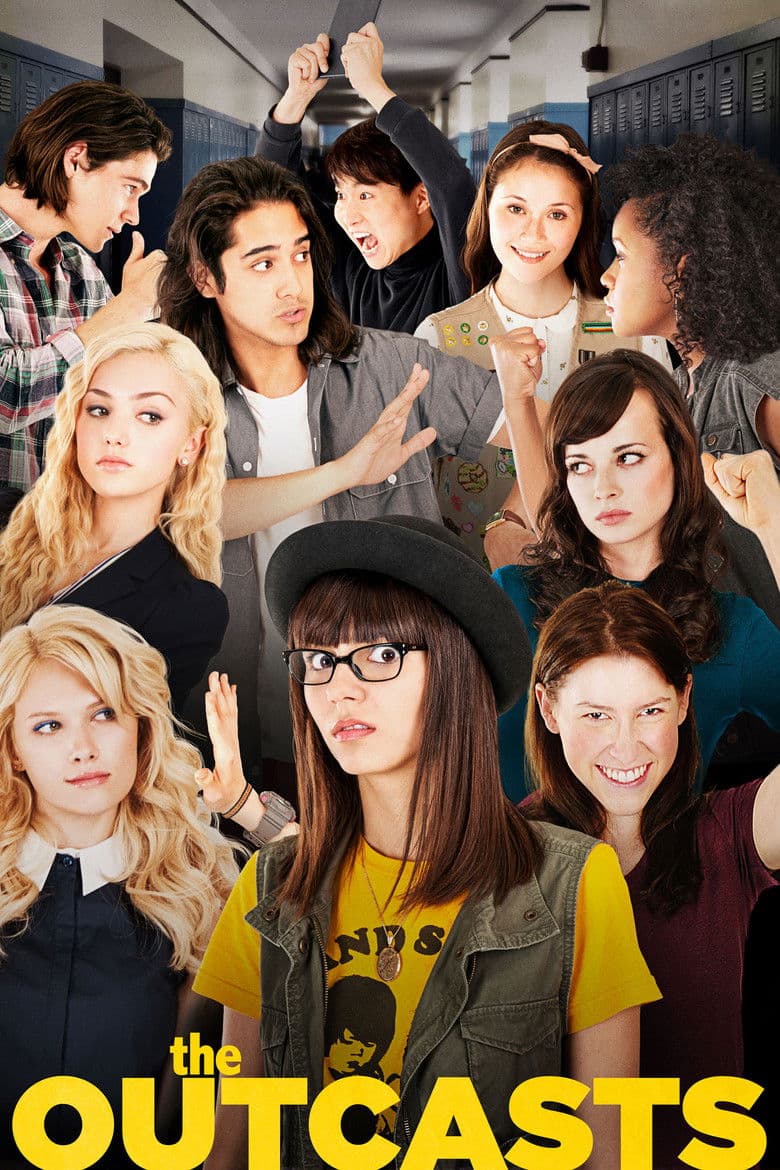
The movie follows Jodi and Mindy, two smart high school seniors at Richard Nixon High, who have spent years being mocked by Whitney, the school’s popular queen. After Whitney humiliates them with a cruel party prank, the friends decide to fight back instead of staying quiet. They recruit geeks, Girl Scouts, activists, science fans, and other students who sit outside the popular crowd. Their plan turns the school’s social order upside down, but revenge also strains their friendship and Jodi’s new romance with Dave. The tone is broad and silly, with school jokes, parties, pop culture references, and a final prom showdown.
The movie makes the outcasts’ group into a small social revolution led mainly by girls. Mindy is the science brain, Virginia uses secret files to plan attacks, and Jodi helps lead the plan. The group treats self-acceptance and joining with other outsiders as the answer to school bullying. Claire is a lesbian Girl Scout who comes out, while Sugar is linked to black rights and women’s rights. A speech names teens who reject the gender binary, anarchists, activists, and atheists, so identity and activist labels are visible even though the story remains a light revenge comedy.
Community feedback
Was our 46% Woke rating accurate?
Breakdown
These are the editorial factors and ratings behind our score for The Outcasts.
Woke representation / casting
The visible group includes an Asian performer playing a lesbian Girl Scout, a black female activist, and several other identity-marked students. The group is built around a long list of social types instead of only ordinary school cliques. The film does not market the cast as a diversity campaign, so this is a clear but not dominant casting signal.
42%
Woke political dialogue
The recruiting speech names teens who reject the gender binary, anarchists, activists, and atheists. The same group-building material links Sugar with black rights and women’s rights. These ideas are clear and modern, but they appear in short comic scenes rather than throughout the movie.
35%
Identity-driven story themes
The main story is a girl-led revolt against the school’s popular power structure. Mindy supplies the science skill, Virginia supplies secret files, and Jodi helps lead the plan, while Dave mainly supports Jodi’s romantic story. The film presents joining outsiders and accepting personal differences as the answer to bullying. The coalition includes a lesbian coming-out story, a black and women’s rights activist, and gender-binary language, so identity ideas are tied to the main plot.
55%
Western institutional / cultural critique
Not present. The movie attacks a high school popularity ladder, but it does not blame Western institutions, Christianity, family life, or traditional gender roles. The conflict stays inside a comic school setting.
0%
Woke character or canon changes
Not relevant. The movie is an original teen comedy with no established characters, source story, or real historical figures to change.
0%
Anti-woke backlash and complaints
Not present. No anti-woke complaints were found in the searched news, reviews, or public posts. Available criticism focused on clichés, weak writing, and an unrealistic school setting.
0%
Creator track record context
Available creator summaries give Peter Hutchings, the two writers, and most producers low scores and show no clear activist record. Victoria Bousis has a stronger humanitarian and refugee-focused record, and Claude Dal Farra is linked to a festival that promotes underrepresented filmmakers. That background gives mild support for a social-justice reading, but it does not show a strong activist pattern tied to this movie.
14%
Production
Movie · 2022
Exploring every facet of ‘Weird Al’ Yankovic’s life, from his meteoric rise to fame with early hits like ‘Eat It’ and ‘Like a Surgeon’ to his torrid celebrity love affairs and…
Movie · 2023
From his onstage tackle to the slap heard round the world, Dave Chappelle lets loose in this freewheeling and unfiltered stand-up comedy special.
Movie · 2018
Adam Sandler takes his comical musical musings back out on the road, from comedy clubs to concert halls to one very unsuspecting subway station.
Movie · 2016
Two teenage boys from inner-city Cork steal bicycles and ride off on a 160km quest to find an unrecovered bale of cocaine worth 7,000,000 euros.
Movie · 2024
Inseparable best friends AJ and Moose decide to run the local pool's snack shack after their plan to sell home-brewed beer goes down the drain.
Movie · 2023
A chaotic intervention. An action-packed stay in rehab. After a weird couple of years, John Mulaney comes out swinging in his return to the stage.
Movie · 2016
A comedy that follows a group of friends as they navigate their way through the freedoms and responsibilities of unsupervised adulthood.
Movie · 2022
Maurice Flitcroft, a dreamer and unrelenting optimist, managed to gain entry to The British Open Golf Championship qualifying in 1976 and subsequently shot the worst round in Open…
