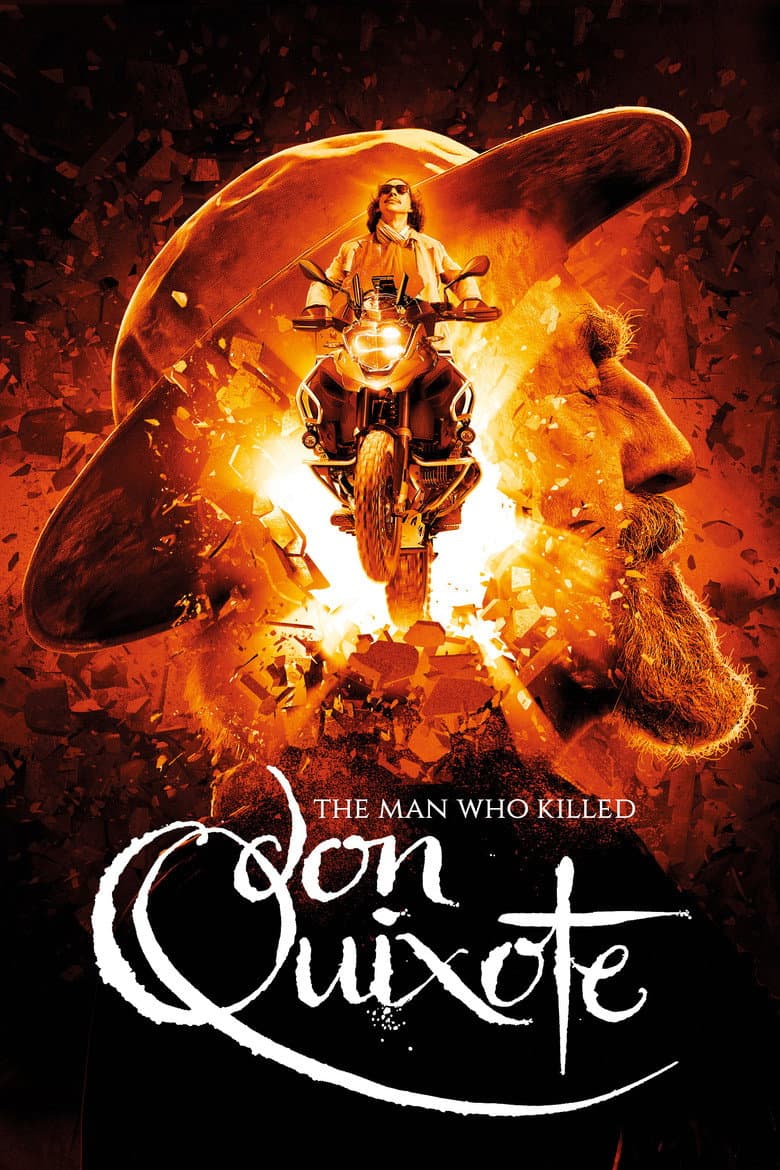
Toby is a tired film director who is shooting a Don Quixote-themed vodka ad in rural Spain. He visits a nearby village where he made a student film years earlier and finds Javier, the old shoemaker who played Don Quixote. Javier now believes he is the real knight and treats Toby as his squire, Sancho Panza. Their escape leads through fires, police chases, castles, rich people’s cruel games, and visions that mix with real life. The film is loud, strange, dark, and often silly.
The film has one clear diversity-related moment when Toby asks for white, Black, and LGBT people in a commercial crowd and says the ratio matters. The line treats identity-based casting as a joke, and it does not drive the plot. Most of the story follows Toby as he faces the harm caused by his old film and learns to care about Javier. It also shows Angelica trapped by an abusive rich man while Toby sees himself as a knight who must rescue her. The film ends with Toby accepting fantasy and friendship instead of his empty advertising life.
Community feedback
Was our 18% Woke rating accurate?
Breakdown
These are the editorial factors and ratings behind our score for The Man Who Killed Don Quixote.
Woke representation / casting
Not present. The story uses a mixed Spanish and international cast that fits its modern setting. The movie does not show a repeated representation-first pattern in its major roles. The brief identity list belongs to dialogue, not a visible casting campaign.
0%
Woke political dialogue
Toby asks for a commercial crowd made up of different races and LGBT people. He says the ratio matters, which gives the scene a quota-style diversity signal. The scene is brief, and the film does not turn it into a larger political argument.
25%
Identity-driven story themes
Not present. The plot centers on guilt, madness, fantasy, abuse, and the cost of making art. It does not make modern race, gender, sexuality, or activist identity politics a main story theme.
0%
Western institutional / cultural critique
Not present. The film mocks advertising, rich men, and the business of entertainment. Those targets support broad satire, not a modern activist attack on Western institutions, capitalism, religion, or family life.
0%
Woke character or canon changes
Not relevant. The film moves Don Quixote into a modern story about a filmmaker and a shoemaker. Its changes concern setting, plot, and character roles, not an identity or representation message.
0%
Anti-woke backlash and complaints
Not present. No clear anti-woke or anti-left complaint appears in the supplied X pass or in the reviewed Reddit and news coverage. Public criticism focused on the long production, legal dispute, mixed quality, Muslim jokes, and treatment of women, not on claims that the movie was too woke.
0%
Creator track record context
Gilliam’s public record includes strong criticism of political correctness and modern identity politics. Grisoni’s available profile shows social subjects but no strong activist persona. The other listed creators have mild or no documented identity-politics signals. This gives the film mild creator track record context, but it does not make the story identity-driven.
25%
Production
Movie · 2024
In the 19th century, a drunken applejack salesman must go from zero to hero and become North America's greatest fur trapper by defeating hundreds of beavers.
Movie · 2026
When their plan to book a show at the Rivoli goes horribly wrong, Matt and Jay accidentally travel back to the year 2008.
Movie · 2016
The feel-good story of Michael 'Eddie' Edwards, an unlikely but courageous British ski-jumper who never stopped believing in himself—even as an entire nation was counting him out.
Movie · 2023
Following the sudden death of his mother, a mild-mannered but anxiety-ridden man confronts his darkest fears as he embarks on an epic odyssey back home.
Movie · 2024
When 93-year-old Thelma Post gets duped by a phone scammer pretending to be her grandson, she sets out on a treacherous quest across the city to reclaim what was taken from her.
Movie · 2020
In 1968, engineer Giorgio Rosa established the independent state called "The Isle of Roses" off the coast of Rimini, built on a platform outside the territorial waters, with…
Movie · 2026
Two marketing executives go "balls out" and pitch a bold full‑coverage condom sponsorship with the World Cup.
Movie · 2021
When single mom Callie and her two kids Trevor and Phoebe arrive in a small Oklahoma town, they begin to discover their connection to the original Ghostbusters and the secret…
