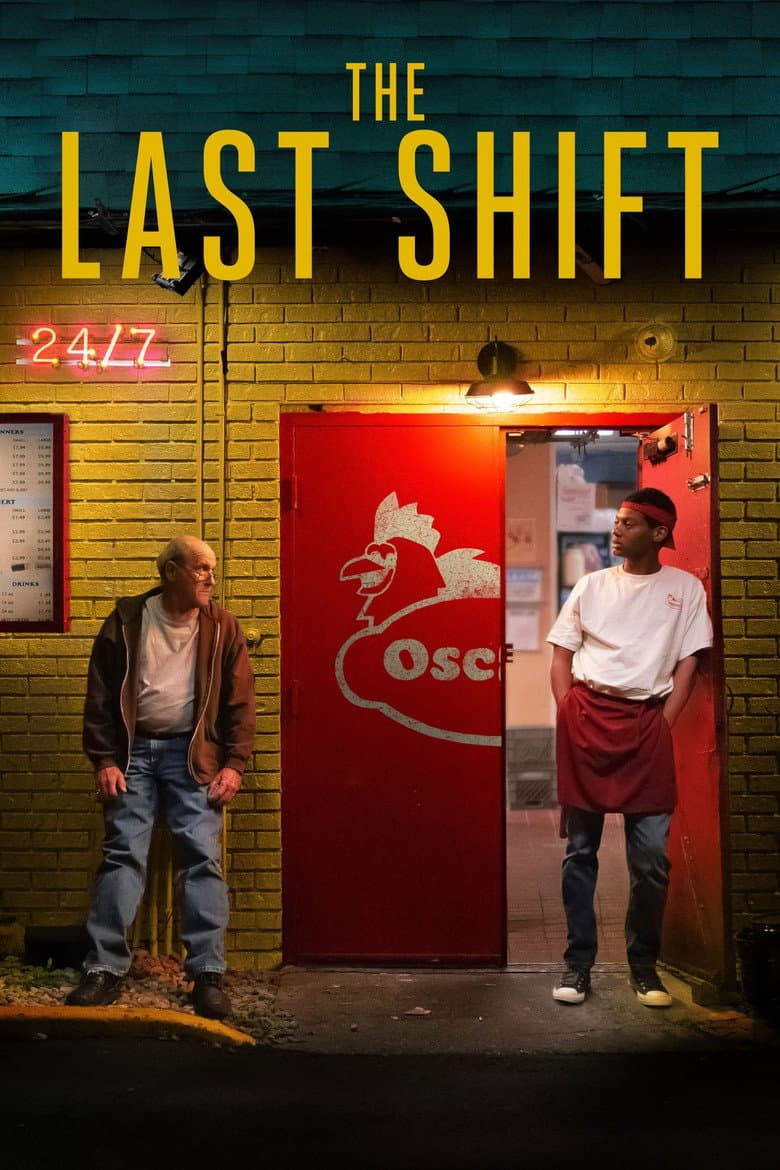
Stanley is an aging man who has worked the night shift at a small fast-food restaurant in Albion, Michigan, for 38 years. He plans to leave town and care for his sick mother, but he must train Jevon before he goes. Jevon is a young black father, writer, and former inmate who needs the job to stay out of prison. The film begins as a dry workplace comedy and becomes a sad story about work, family, guilt, and two men who do not see America in the same way.
Race and class become the main source of conflict between the men. Jevon talks about white privilege, unfair treatment, low pay, and companies making money from workers. Stanley rejects those ideas and later admits that he ran from a black classmate's beating when they were teenagers. The film also presents a black woman manager, a black family, and an immigrant worker, but the strongest woke material comes from the repeated arguments about race and work rather than from the casting.
Community feedback
Was our 66% Woke rating accurate?
Breakdown
These are the editorial factors and ratings behind our score for The Last Shift.
Woke representation / casting
The film puts an older white worker and a young black writer at the center. A black woman manages the restaurant, and Jevon's Black girlfriend and child are part of his story. An immigrant worker also appears in the shop. These roles fit a modern working-class Michigan setting, so the diversity signal is noticeable but not dominant.
25%
Woke political dialogue
Jevon repeatedly talks about corporate profit, low wages, white privilege, race, and unfair treatment. Stanley rejects the idea that white people receive hidden benefits and says he worked for everything he has. The men discuss a black classmate killed by white bullies and whether Stanley should have spoken up. These talks return across the shift and drive their break, although family and job problems also take much of the film.
58%
Identity-driven story themes
The story makes the racial divide between Stanley and Jevon central to their relationship. Jevon challenges Stanley's view of race, work, and fairness. Stanley's past silence after a black classmate was attacked becomes a major turning point. The film ends without giving Stanley a clear change of heart, so identity conflict remains tied to the story's final mood.
60%
Western institutional / cultural critique
The movie presents the fast-food company as a place that profits from low-paid workers. Jevon calls the work alienating and attacks the idea that long service proves the system is fair. The story also links a police encounter and the town's past to unequal treatment of black people. The film does not center an attack on Christianity, marriage, or ordinary family life.
52%
Woke character or canon changes
Not relevant. The film is an original story about two fast-food workers. It does not change an established character or retell a known historical event.
0%
Anti-woke backlash and complaints
Movieguide criticized the film as politically correct and anti-capitalist because Jevon speaks about white privilege and race. The review called that worldview a reason for extreme caution. The supplied X research found no anti-woke posts, boycott talk, or review-bombing. Reddit trailer comments were mostly positive and did not show an anti-woke campaign. The complaint evidence is limited and comes mainly from a niche review.
15%
Creator track record context
Andrew Cohn's cached score is 40/100, and his past work often follows overlooked working people and communities. Cohn said he wanted a more honest story about race and class and called this film not an activist movie. The producer list has mostly low or moderate cached scores, with stronger social-issue records for Jackie Kelman Bisbee and Wendy Vanden Heuvel. This gives the title a mild to moderate creator track record context rather than a dominant activist signal.
38%
Production
Movie · 2019
The story of Rudy Ray Moore, who created the iconic big screen pimp character Dolemite in the 1970s.
Movie · 2017
Ingrid becomes obsessed with a social network star named Taylor Sloane who seemingly has a perfect life. But when Ingrid decides to drop everything and move west to be Taylor's…

Movie · 2017
An aspiring actor in Hollywood meets an enigmatic stranger by the name of Tommy Wiseau, the meeting leads the actor down a path nobody could have predicted; creating the worst…

Movie · 2018
Thirteen-year-old Kayla endures the tidal wave of contemporary suburban adolescence as she makes her way through the last week of middle school — the end of her thus far…
Movie · 2024
In 2008, during the last month of summer before high school begins, an impressionable 13-year-old Taiwanese American boy learns what his family can't teach him: how to skate, how…
Movie · 2023
Allison's life falls apart following her involvement in a fatal accident. The unlikely relationship she forms with her would-be father-in-law helps her live a life worth living.

Movie · 2022
Two lifelong friends find themselves at an impasse when one abruptly ends their relationship, with alarming consequences for both of them.

Movie · 2018
In 1990s Los Angeles, a 13-year-old spends his summer navigating between a troubled home life and a crew of new friends he meets at a skate shop.
