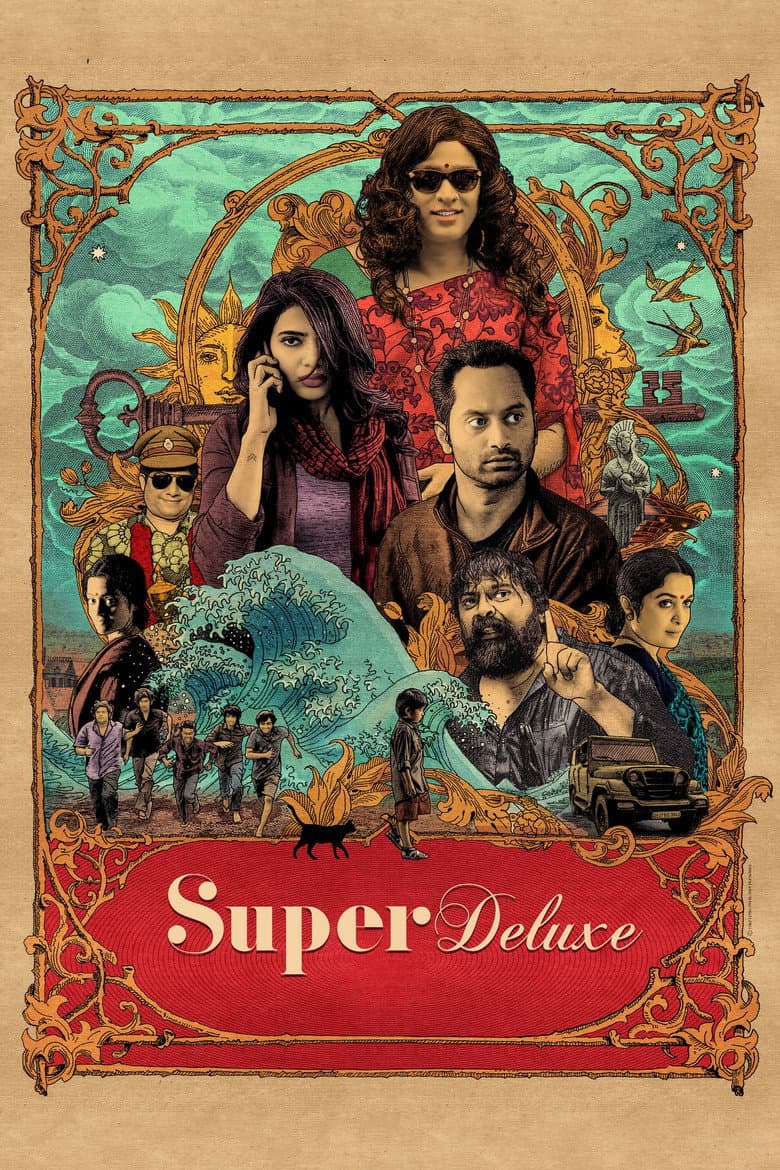
Super Deluxe is a Tamil movie set in Chennai during one strange day. Four stories follow people facing sex, family trouble, faith, crime, and sudden danger. Shilpa, a transgender woman who returns to her wife and young son, stands at the heart of the most emotional story. A cheating wife hides a dead lover, a mother fights to save her injured son, and schoolboys stumble into an alien mystery. The movie mixes dark comedy, shock, crime, and strange science fiction.
The film makes gender and social acceptance major parts of Shilpa's story. Her son accepts her as a woman, while the family and a corrupt policeman expose the pressure placed on people who break old gender rules. The movie also treats a wife's affair and a former adult film actress with less moral punishment than a traditional story would give them. Several scenes question sexual purity, religious certainty, caste pride, patriotism, and the idea that society can label people as good or bad. These ideas recur across the three adult storylines, but the movie presents them through wild events and dark jokes instead of a direct political speech.
Community feedback
Was our 69% Woke rating accurate?
Breakdown
These are the editorial factors and ratings behind our score for Super Deluxe.
Woke representation / casting
Vijay Sethupathi, a male star, plays Shilpa, a transgender woman, in one of the four main stories. The trailer and release coverage made this identity choice a central part of the film’s public image. The rest of the cast is a normal local South Indian group, so the film does not use an obvious one-of-each diversity design. The score comes mainly from one prominent identity casting choice and its mismatch between actor and role.
54%
Woke political dialogue
One scene has Mugil compare love of a country and language with pride in caste, and he calls out the labels people use. Other lines question patriotism, caste division, surveillance, and social rules. Shilpa also explains her gender through a simple body story, and another character says that people are the same. These ideas appear in short bursts rather than in repeated political speeches.
35%
Identity-driven story themes
Shilpa’s return makes transgender identity, family acceptance, public shame, and police abuse a major story. Her son accepts her as a woman, and the ending supports her choice to live with her family. Vaembu’s affair is treated with sympathy, and Leela keeps her dignity after her son learns about her adult film. The film repeatedly challenges sexual shame, fixed gender roles, and moral labels across its adult stories.
70%
Western institutional / cultural critique
Shilpa faces harassment from a policeman, school staff, and other adults because she is transgender. Berlin uses police power to demand sex, and the film presents him as a cruel abuser. The film mocks the idea that a woman’s sexual purity decides her worth and questions religious certainty through Arputham’s faith crisis. Mugil’s talk about caste, patriotism, and labels adds a smaller social critique.
48%
Woke character or canon changes
Not relevant. Super Deluxe is an original story with no established characters or source canon. The film’s gender and family changes belong to its own plot.
0%
Anti-woke backlash and complaints
Not present. The reported dispute came from transgender critics who said the film used harmful stereotypes and a non-trans actor, not from viewers attacking the movie for being too woke. The supplied X research found only a tiny, unshared claim that the film was “super woke,” while wider reactions were mostly praise.
0%
Creator track record context
Thiagarajan Kumararaja’s established work shows recurring interest in sexual morality, gender, family rules, religious authority, and outsiders. Mysskin’s work and public statements add feminism, strong women, and the view that films make political statements. Swathi Raghuraaman’s work adds a women-focused freedom theme, while Nalan Kumarasamy, Neelan K. Sekar, and the other producers show weaker signals. These patterns fit the film’s focus on Shilpa, sexual rules, and religious doubt.
48%
Production

Movie · 2023
Inspired by a true story, an oddball group of cops, criminals, tourists and teens converge in a Georgia forest where a 500-pound black bear goes on a murderous rampage after…

Movie · 2017
The true story of pilot Barry Seal, who transported contraband for the CIA and the Medellin cartel in the 1980s.
Movie · 2019
Los Angeles, 1969. TV star Rick Dalton, a struggling actor specializing in westerns, and stuntman Cliff Booth, his best friend, try to survive in a constantly changing movie…

Movie · 2018
The true story of Forrest Tucker, from his audacious escape from San Quentin at the age of 70 to an unprecedented string of heists that confounded authorities and enchanted the…

Movie · 2017
Lynn, a brilliant student, after helping her friends to get the grades they need, develops the idea of starting a much bigger exam-cheating business.
Movie · 2016
As a math savant uncooks the books for a new client, the Treasury Department closes in on his activities and the body count starts to rise.

Movie · 2017
A newly-released prison gangster is forced by the leaders of his gang to orchestrate a major crime with a brutal rival gang on the streets of Southern California.

Movie · 2019
During the 1980s, a failed stand-up comedian is driven insane and turns to a life of crime and chaos in Gotham City while becoming an infamous psychopathic crime figure.
