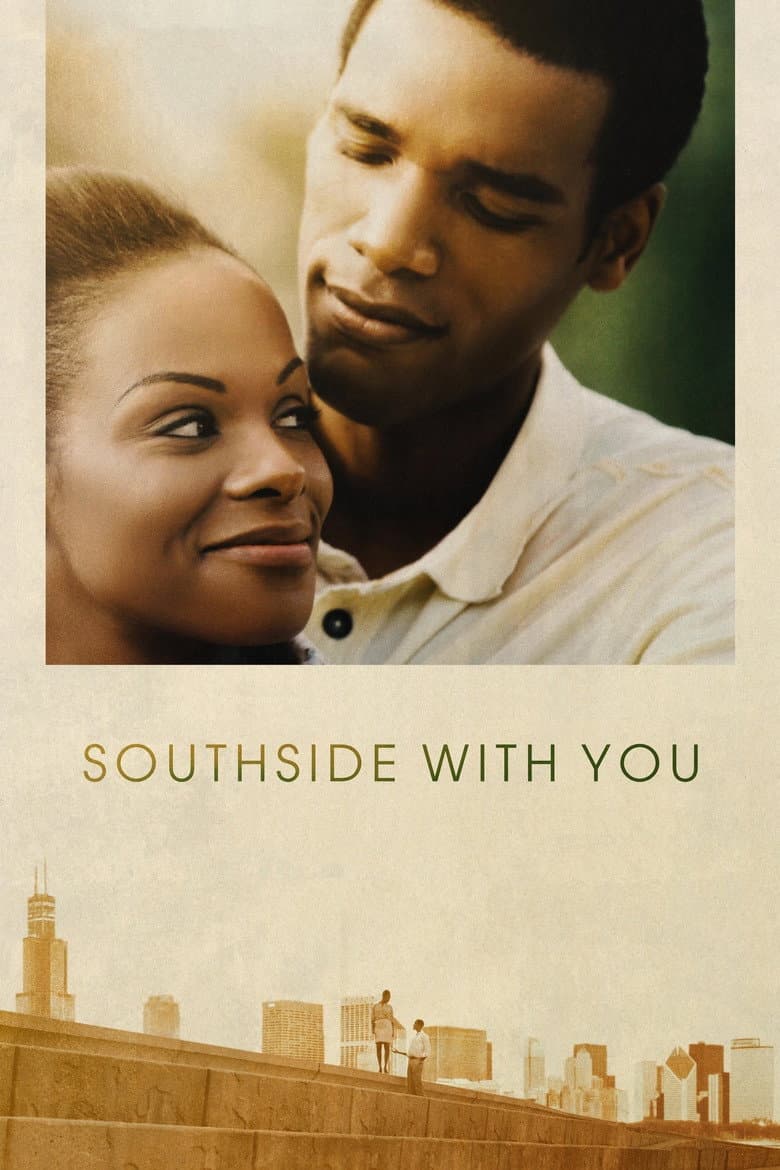
Southside with You follows Michelle Robinson, a young lawyer in Chicago, as she agrees to spend a summer day with Barack Obama, a new worker at her law firm. Michelle says the outing is not a date, while Barack keeps trying to turn it into one. They visit an art museum, a church meeting, a movie theater, and an ice cream shop across the South Side in 1989. The film is quiet and warm, with romance built through jokes, arguments, and long talks.
The story makes black identity part of the couple’s bond and their work lives. Michelle worries that white coworkers will judge her for dating one of the only other black lawyers at the firm, and she wants to be seen as a skilled lawyer rather than as his girlfriend. Barack’s community speech, their talk about race, and their debate about violence in Do the Right Thing give the date a clear social and political edge. The film also presents Michelle as ambitious and careful about protecting herself, while Barack is shown as a persuasive organizer whose charm often hides his weak points.
Community feedback
Was our 64% Woke rating accurate?
Breakdown
These are the editorial factors and ratings behind our score for Southside with You.
Woke representation / casting
Barack and Michelle are played by black actors because they were black historical figures, so the casting fits the story’s time and place. The film also presents their Black romance as part of why the story matters. The leads discuss race and Black life in Chicago, and the marketing stressed the rarity of Black love stories on screen. This makes representation a clear part of the film, even without a mismatch in casting.
39%
Woke political dialogue
Barack and Michelle repeatedly talk about race, class, work, public service, and the place of black people in America. Barack gives a community speech about helping a neighborhood and the hard work of democracy. The couple argues about the meaning of violence in Do the Right Thing and about whether corporate law serves people. The movie uses these talks throughout the date, but it keeps them inside a romance rather than turning them into a long political speech.
46%
Identity-driven story themes
The romance is built around two Black professionals thinking about race, success, and their duties to their community. Michelle’s story stresses the pressure on a black woman to protect her career and prove her skill in a mostly white firm. Barack’s community work and Michelle’s questions about his goals connect their attraction to public service. These themes are important across the movie, though the main plot remains their first date.
53%
Western institutional / cultural critique
The law firm is shown as a mostly white workplace concerned with status and money, where Michelle fears sexist and racial judgments. Barack questions why she works for corporate clients instead of helping people directly. A male partner tells Michelle to take care of Barack, which exposes a sexist assumption about the couple. The movie criticizes workplace bias and profit-focused work, but it does not attack Western institutions as a whole.
39%
Woke character or canon changes
Not relevant. The film changes the timing of a community meeting and invents much of the dialogue. Those changes do not alter the race, gender, sexuality, or real-life roles of the two historical figures.
0%
Anti-woke backlash and complaints
Conservative critics called the film flattering Obama propaganda. Some said Hollywood was using a romantic story to improve Obama’s public legacy or promote progressive attitudes. The complaints were limited and focused on political praise rather than a DEI casting dispute or a boycott. X research found no anti-woke posts or specific complaints.
26%
Creator track record context
Several key producers have a recurring record of black-centered stories and work for underrepresented voices. John Legend and Mike Jackson add public social-justice and multicultural media context, while Stephanie Allain has a strong diversity advocacy record. Tika Sumpter has repeatedly backed stories about black women and used this film to support a rare black romance. Richard Tanne’s track record is milder and he described this title as a love story first, so the overall creator context is notable but mixed.
54%
Production
Movie · 2023
Set in 1889 France, Dodin Bouffant is a chef living with his personal cook and lover Eugénie. They share a long history of gastronomy and love but Eugénie refuses to marry Dodin…
Movie · 2022
A young couple's relationship clashes with the harsh realities of the California Gold Rush of 1850. Angel, experiencing love for the first time and facing demons unsurmountable…
Movie · 2016
In 1958, in the state of Virginia, the idea of interracial marriage was not only considered to be immoral to many, it was also illegal.

Movie · 2016
Lou Clark, a directionless 26-year-old from the English countryside, takes a job at the local castle as a caregiver and companion to a wealthy young banker, Will Traynor.

Movie · 2020
Young musician Zach Sobiech discovers his cancer has spread, leaving him just a few months to live. With limited time, he follows his dream and makes an album, unaware that it…
Movie · 2023
After decades apart, childhood friends Nora and Hae Sung are reunited in New York for one fateful weekend as they confront notions of destiny, love, and the choices that make a…
Movie · 2017
The story of four characters whose lives intertwine amid the hustle and bustle of the Coney Island amusement park in the 1950s: Ginny, an emotionally volatile former actress now…

Movie · 2018
German artist Kurt Barnert has escaped East Germany and now lives in West Germany, but is tormented by his childhood under the Nazis and the GDR regime.
