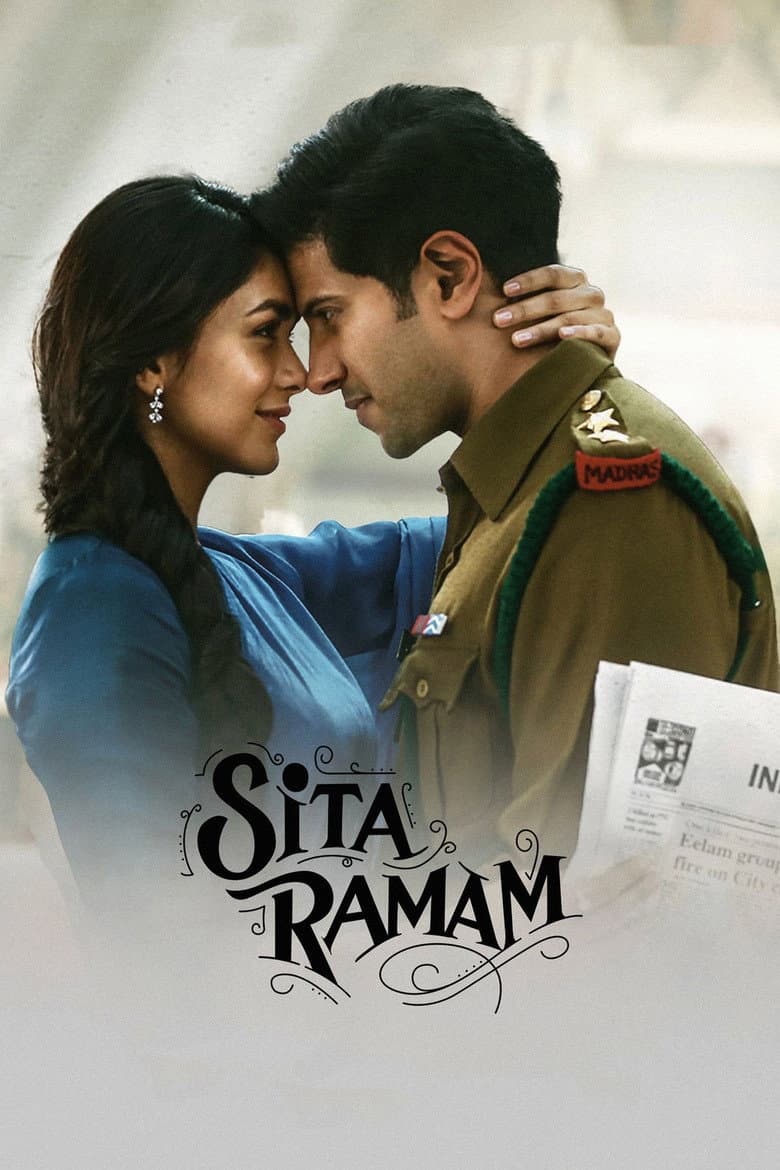
Sita Ramam follows Lieutenant Ram, an orphaned Indian Army officer serving in Kashmir in the 1960s. He starts receiving letters from a woman named Sita Mahalakshmi, who says she is his wife before they have met. Twenty years later, Pakistani student Afreen must deliver Ram’s last letter to Sita in Hyderabad to receive her late grandfather’s money. The story moves between romance, war, family secrets, and a tense India-Pakistan conflict, with a soft and tragic tone.
The film puts a Hindu Indian soldier and a Muslim Hyderabad princess at the heart of its love story, while a Pakistani woman leads the search that joins their lives. Sita chooses Ram over a planned royal marriage and gives up wealth, and Afreen changes after learning that Ram once saved her as a child. The story repeatedly says that people of different faiths can live as brothers and that loving one’s country does not require hatred of a neighbor. These ideas are important because the romance, Afreen’s journey, and the Kashmir conflict all depend on them, but the film presents them through a period love story rather than modern activist politics.
Community feedback
Was our 37% Woke rating accurate?
Breakdown
These are the editorial factors and ratings behind our score for Sita Ramam.
Woke representation / casting
Not present. The film’s Muslim princess and Pakistani student leader are central because the plot requires their identities. The cast is not presented as a diversity-first mix.
0%
Woke political dialogue
Afreen is told that loving her country is not wrong, but hating the neighboring country is wrong. The story says that Hindus and Muslims can live as brothers and that humanity matters more than religious division. These lines support peace and humanism, but they are brief and are not modern activist speeches.
15%
Identity-driven story themes
An Indian Hindu soldier and a Muslim princess fall in love while her royal family plans another marriage. Afreen begins as a hostile Pakistani student and changes after she learns that Ram saved her as a child. The plot repeatedly joins personal love with peace between Indians and Pakistanis and between Hindus and Muslims. Sita also refuses a family plan and chooses her own partner. These ideas drive the main romance and mystery.
48%
Western institutional / cultural critique
Not present. The film does not attack Western institutions or modern family and gender norms. Its conflict is about war, extremism, military duty, and family pressure.
0%
Woke character or canon changes
Not relevant. The film is an original period romance, not a new version of an established character or canon. The Ramayana names and echoes do not change the Ramayana’s characters.
0%
Anti-woke backlash and complaints
Right-leaning X accounts repeatedly called the film woke for humanizing a Pakistani officer, softening jihad, and using an Indo-Pak romance as political cover. One larger nationalist account drew tens of thousands of views, but most posts came from a small circle. A few users mentioned a boycott, yet no organized boycott or launch-year review attack followed. Much of the higher-reach debate came later in 2026.
28%
Creator track record context
The director and writer have no substantial record of woke activism or identity campaigns. Kishore Garikipati and C. Ashwini Dutt have mainly commercial profiles, with Dutt’s political history being conventional regional politics. Priyanka Dutt has a moderate women-focused record, including Mahanati, but no strong activist profile. Overall, the creator context adds only a small signal beyond the film itself.
16%
Production
Movie · 2018
Dan, a 21-year-old carefree boy is always surrounded by a bunch of friends and fellow hotel interns who feed off each other's everyday moments, their ups and downs.

Movie · 2019
The beloved Crawleys and their intrepid staff prepare for the most important moment of their lives. A royal visit from the King and Queen of England will unleash scandal, romance…

Movie · 2019
A family dog – with a near-human soul and a philosopher's mind – evaluates his life through the lessons learned by his human owner, a race-car driver.

Movie · 2020
A widow with three children hires a handyman to fix her house during a major storm. When not doing home repairs, he shares his philosophy of believing in the power of the universe…
Movie · 2019
Following a group of friends from university as they progress into middle-age life and go their own separate ways.

Movie · 2020
The true-life story of Christian music star Jeremy Camp and his journey of love and loss that looks to prove there is always hope.

Movie · 2018
After his classmate and crush is diagnosed with a pancreatic disease, an average high schooler sets out to make the most of her final days.

Movie · 2016
Set against the backdrop of a beautiful garden in the heart of London, this contemporary fairy tale revolves around the unlikely friendship between a reclusive young woman and a…
