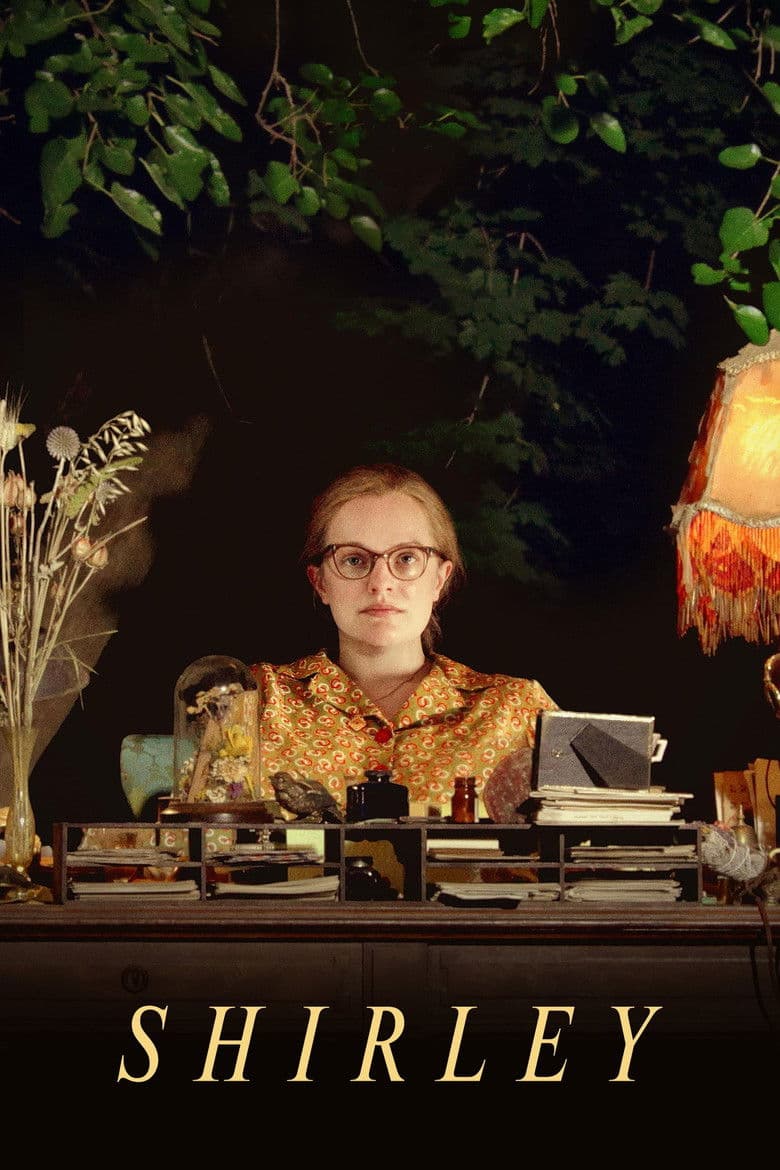
Shirley follows the famous horror writer Shirley Jackson in 1950s Vermont. Jackson is stuck at home, drinking, avoiding people, and unable to finish her next book. Her husband Stanley takes in a young married couple, Fred and Rose, while Fred starts work at the college. Jackson uses Rose as a helper, model, and source for a book about a missing student. The film feels tense, strange, dark, and often dreamlike.
The strongest woke elements come from the film’s focus on women breaking out of strict wife and mother roles. Rose gives up school for marriage and pregnancy, then gains confidence as Jackson draws her into a close, sexually charged bond. The movie treats this bond as a source of creative and sexual freedom, even though the women never have sex. It repeatedly shows the husbands as controlling, unfaithful, or entitled, and it ends with Rose rejecting a quiet, obedient life. These ideas are central to the story, but the film presents them through a twisted character drama rather than direct political speeches.
Community feedback
Was our 78% Woke rating accurate?
Breakdown
These are the editorial factors and ratings behind our score for Shirley.
Woke representation / casting
Not present. The main cast is made up of white Americans in a 1950s Vermont college setting. The movie does not use race-swapped roles or a diversity-first group of characters.
0%
Woke political dialogue
Shirley tells Rose that Fred treats her return to school as something he can permit after the baby. Shirley says that girls face a cruel world and describes lonely girls who cannot make the world see them. Shirley attacks entitled men, and the women discuss professors who use their authority with students. These gender-focused lines appear in several scenes, but the film never stops for a long political speech.
42%
Identity-driven story themes
Rose gives up college to become a wife and mother, then starts to question that life. Shirley draws Rose into a close bond that mixes friendship, artistic work, and sexual desire. The film treats their bond as a release from rules about marriage, housework, and female behavior. The ending has Rose reject a quiet, obedient life after both women are changed by the relationship. These themes drive the main plot, so the identity-driven message is hard to miss.
72%
Western institutional / cultural critique
Stanley uses his place at the college to control Fred and to turn Rose into a housekeeper. Fred and Stanley both have sex with students, and the film links their authority to selfish and abusive behavior. Rose’s marriage and the college world push her toward a narrow wife role. The ending rejects that role, so the film repeatedly questions male power and traditional domestic life. This critique stays inside the 1950s story instead of becoming a broad attack on Western society.
48%
Woke character or canon changes
Shirley Jackson was a real writer, but the film adds a fictional young woman named Rose and builds an erotic bond between them. The film leaves out Jackson’s children and other parts of her home life to make room for this plot. The film presents itself as a made-up version built from Susan Scarf Merrell’s novel rather than a close life story. The added attraction is important because it drives Rose’s awakening and much of the story.
55%
Anti-woke backlash and complaints
One deleted Reddit comment complained about Moss being cast in a “feminist identity” role. The remark was isolated and did not identify a specific scene or call for a boycott. The supplied X pass and wider coverage found no sustained anti-woke backlash.
3%
Creator track record context
Josephine Decker has a strong feminist and queer-focused track record and has spoken about the female gaze. Christine Vachon has a long history of queer and activist films. Elisabeth Moss has supported stories about women’s rights. The writers and most other producers have little public activist record. This group gives the film a strong creator-context signal that matches its themes.
62%
Production
Movie · 2021
A truffle hunter who lives alone in the Oregon wilderness must visit Portland to find the mysterious person who stole his beloved foraging pig.

Movie · 2019
The quiet life of Baker Dill, a fishing boat captain who lives on the isolated Plymouth Island, where he spends his days obsessed with capturing an elusive tuna while fighting his…
Movie · 2025
When intelligence agent Kathryn Woodhouse is suspected of betraying the nation, her husband – also a legendary agent – faces the ultimate test of whether to be loyal to his…
Movie · 2017
Paul is a down-on-his-luck screenwriter who picks up a drifter and offers him a place to stay. However, when the deranged stranger takes Paul hostage and forces him to write…
Movie · 2022
Leonard is an English tailor who used to craft suits on London’s world-famous Savile Row. After a personal tragedy, he’s ended up in Chicago, operating a small tailor shop in a…

Movie · 2022
One woman's journey for self-discovery and turns into a harrowing tale of survival.

Movie · 2016
When his girlfriend goes missing, David must track down her whereabouts after he realizes she's not who she was pretending to be.
Movie · 2020
Nothing is as it seems when a woman experiencing misgivings about her new boyfriend joins him on a road trip to meet his parents at their remote farm.
