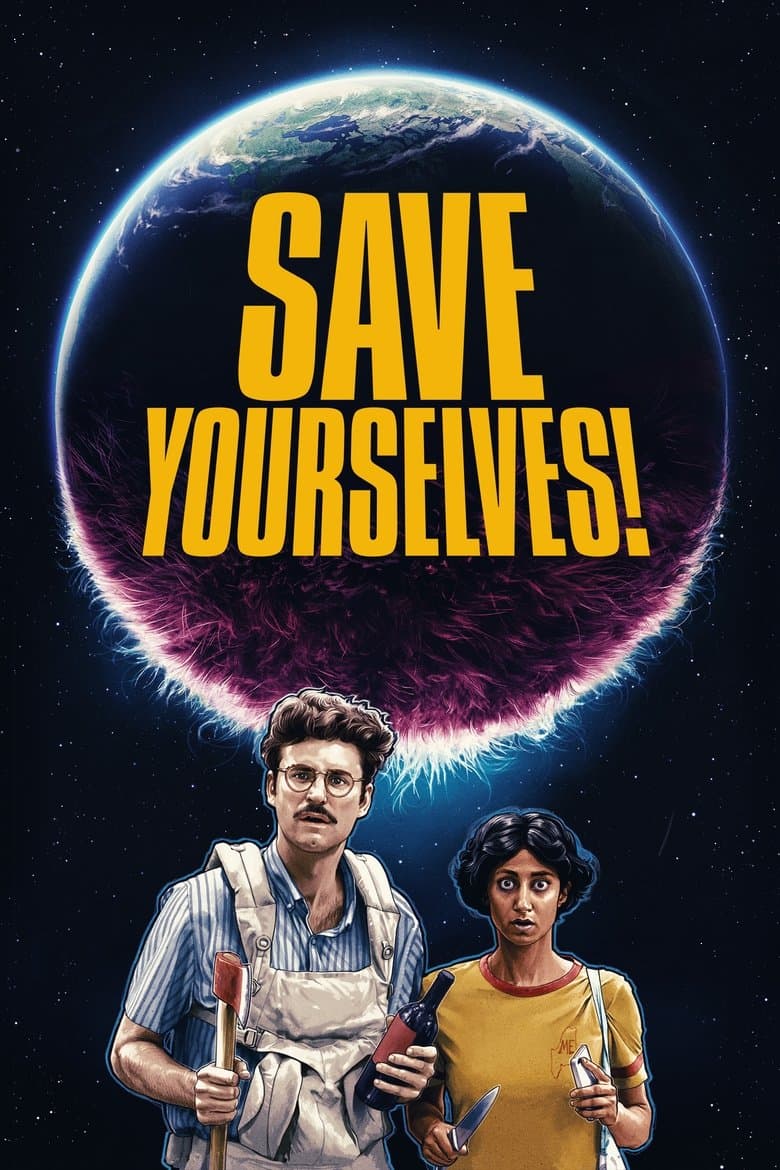
Save Yourselves! follows Su and Jack, a Brooklyn couple in their thirties who spend too much time on phones and online feeds. They leave the city for a cabin in upstate New York so they can talk, relax, and repair their relationship. An alien attack begins while their phones are off, so they miss the warnings and do not know what is happening. The film uses awkward jokes, strange creatures, and a light end-of-the-world tone as the couple tries to survive.
The film gives its main identity-related message to Jack, who says he does not know how to be a man. He rejects his father’s fishing, plumbing, and other old male skills as “bullshit masculinity” and says he hid behind the idea of being a modern man. Su pushes him to speak openly, while the story treats listening and honest feelings as better than macho habits. This material is clear in one important relationship scene, but the larger story focuses on phone addiction, self-centered behavior, and learning to take responsibility during a crisis.
Community feedback
Was our 31% Woke rating accurate?
Breakdown
These are the editorial factors and ratings behind our score for Save Yourselves!.
Woke representation / casting
The lead pair includes Sunita Mani, an Indian-American actress, and John Reynolds, a white actor, as a mixed-race couple. The film does not make their backgrounds a problem or a lesson inside the story. A contemporary interview described the pairing as normalizing different backgrounds. This creates a small representation signal, but the movie does not keep returning to identity.
15%
Woke political dialogue
Jack says, “I don’t know how to be a man.” Jack calls old male skills “bullshit masculinity” and says he hid behind the idea of a modern man. The scene presents his doubts about traditional male roles in direct spoken dialogue. The film does not repeat this idea in speeches, so the message remains limited to one major conversation.
30%
Identity-driven story themes
Jack spends much of the cabin trip feeling that he fails both old and new ideas of manhood. Su pushes him to share feelings and listen instead of hiding behind silence. The story treats emotional honesty as a better way to build the relationship than macho skill tests. The theme matters to the couple, but phone addiction and alien survival take up more of the film.
30%
Western institutional / cultural critique
The film makes old male roles look foolish through Jack’s failed attempts at chopping wood, handling guns, and driving a manual car. Jack also says that old ideas of masculinity are false and that he cannot succeed at the newer version either. The story gently questions the value of toughness and traditional gender expectations. It does not attack churches, families, capitalism, or Western institutions, so the critique stays narrow.
24%
Woke character or canon changes
Not relevant. The film is an original story with no established characters or real historical figures.
0%
Anti-woke backlash and complaints
Not present. The supplied X pass found no anti-woke reaction. Reviewed news, audience posts, and reviews showed no clear complaint that the film pushes woke or DEI ideas.
0%
Creator track record context
The two directors have low cached woke scores and no clear activist or DEI record. Most listed producers also have low cached scores and business or arts backgrounds. Mandy Tagger has a higher cached score because her work often highlights underrepresented viewpoints and varied perspectives. This gives mild supporting context, not a strong overall activist pattern.
15%
Production
Movie · 2026
When their plan to book a show at the Rivoli goes horribly wrong, Matt and Jay accidentally travel back to the year 2008.

Movie · 2025
Set against the backdrop of a postapocalyptic Earth whose Eastern Hemisphere was destroyed by a massive solar flare, leaving what life remains mutated from radiation and fallout.
Movie · 2022
Three friends come together to defend their valuable mining company from…aliens?! What could possibly go wrong?

Movie · 2020
When carefree Nyles and reluctant maid of honor Sarah have a chance encounter at a Palm Springs wedding, things get complicated when they find themselves unable to escape the…
Movie · 2024
Two high school nobodies make the decision to crash the last major celebration before the new millennium on New Year's Eve 1999.
Movie · 2026
Two gangsters and the woman they love try to survive the most dangerous night of their lives. As if that wasn’t enough, there’s one wild ingredient added to the mix: a time…
Movie · 2026
A 'Man from the Future' arrives at an LA diner where he must recruit the precise combination of disgruntled patrons to join him on a one-night quest to save the world from the…
Movie · 2018
After being uprooted by his parents' separation and unable to fit into his new hometown, a teenager stumbles upon a magical app that causes his social media updates to come true.
