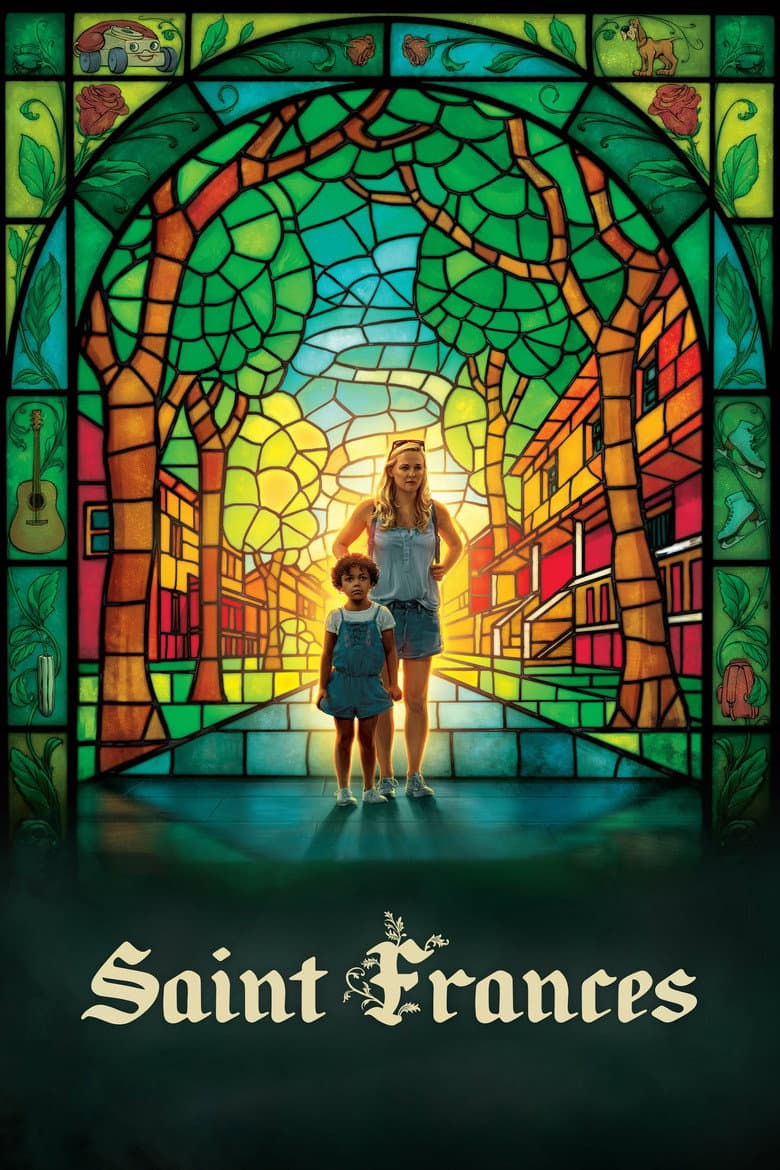
Saint Frances follows Bridget, a 34-year-old woman who feels stuck after leaving college and working in a restaurant. In a wealthy suburb near Chicago, she takes a summer job caring for six-year-old Frances, even though she says she does not like children. At the same time, Bridget becomes pregnant after casual sex and chooses a medical abortion without changing her mind. The gentle comedy turns messy body problems, family stress, and uncertain adult life into a warm but sometimes blunt story about friendship and growing up.
The film puts abortion and the right to choose near the center of Bridget’s story, and it treats her decision as normal rather than shameful. It also shows periods, sex, breastfeeding, after-birth depression, and motherhood in direct ways that challenge older ideas about what women should hide. Frances lives with Maya and Annie, a couple from different racial backgrounds, and the film treats their two-mother family as a normal and loving home. Bridget also explains that men have traditionally held power over women, while many male characters are shown as selfish, childish, or less caring than the women around them.
Community feedback
Was our 71% Woke rating accurate?
Breakdown
These are the editorial factors and ratings behind our score for Saint Frances.
Woke representation / casting
The film gives major roles to Maya and Annie, a couple from different racial backgrounds who are raising children together. Their same-sex family is easy for viewers to notice. The story takes place in modern suburban Illinois, and the family is presented as part of the local community rather than as a special diversity message. The wider cast does not show a repeated identity pattern across every major role.
30%
Woke political dialogue
Bridget tells Jace that men should wear condoms instead of leaving birth control to women. Bridget explains patriarchy to Frances as a system where men rule women. Bridget links having children with climate change, school shootings, and possible nuclear war. The film repeats this kind of talk while discussing abortion, sex, and gender roles.
44%
Identity-driven story themes
Bridget chooses an abortion, and the film presents that choice as calm, valid, and free of regret. The story repeatedly treats periods, sex, breastfeeding, after-birth depression, and motherhood as subjects women should discuss without shame. Maya and Annie’s same-sex family is a central home setting, and the film treats their relationship and parenting as normal. Bridget also accepts a life that does not follow marriage, children, or a fixed career.
64%
Western institutional / cultural critique
The film often contrasts women who carry emotional and family burdens with some men who are selfish, childish, or unable to handle blood and feelings. Bridget defines patriarchy as a world where men make the rules and women obey. The story questions the idea that women should want marriage, children, or tidy motherhood. Catholic prayer appears through Maya, but the film does not make a broad attack on churches or other Western institutions.
45%
Woke character or canon changes
Not relevant. The film is an original story about Bridget and a fictional family. It does not change an established character, source story, or historical figure.
0%
Anti-woke backlash and complaints
Movieguide calls the film politically correct and strongly feminist, pro-abortion, and pro-homosexual, and it rejects the film’s message. A Common Sense Media review calls it a “Woke Checklist for Millennials” and says it pushes an agenda. Two Rotten Tomatoes users describe a woke worldview, a left-wing tract, and a story that treats heterosexual men as the only people without victim status. The supplied X search found no anti-woke posts, boycott calls, or review-bombing, so the backlash evidence is clear but limited.
42%
Creator track record context
Alex Thompson has a moderate record tied to stories about gender, reproduction, family, and moving beyond white and straight characters as the default. Kelly O’Sullivan has a moderate feminist record centered on women’s bodies and a same-sex parenting family. Producer Raphael Nash has a stronger record in racial representation, media justice, and activist film teaching. Most other listed producers and the casting directors have limited or mixed public evidence of identity-focused activism.
49%
Production
Movie · 2024
When a construction worker unexpectedly joins a local theater's production of Romeo and Juliet alongside his estranged teenage daughter, the drama onstage starts to mirror his own…
Movie · 2020
Scott has been a case of arrested development ever since his firefighter father died when he was seven. He's now reached his mid-20s having achieved little, chasing a dream of…
Movie · 2023
Single mom Flora is at a loss about what to do with her rebellious teenage son, Max. Her efforts to keep him out of trouble lead to a beat-up acoustic guitar, a washed-up LA…
Movie · 2016
Two high school girls are best friends until one dates the other's older brother, who is totally his sister's nemesis.
Movie · 2018
Thirteen-year-old Kayla endures the tidal wave of contemporary suburban adolescence as she makes her way through the last week of middle school — the end of her thus far…
Movie · 2019
The story of Mötley Crüe and their rise from the Sunset Strip club scene of the early 1980s to superstardom.

Movie · 2018
Vignettes weaving together the stories of six individuals in the old West at the end of the Civil War. Following the tales of a sharp-shooting songster, a wannabe bank robber, two…

Movie · 2017
An aspiring actor in Hollywood meets an enigmatic stranger by the name of Tommy Wiseau, the meeting leads the actor down a path nobody could have predicted; creating the worst…
