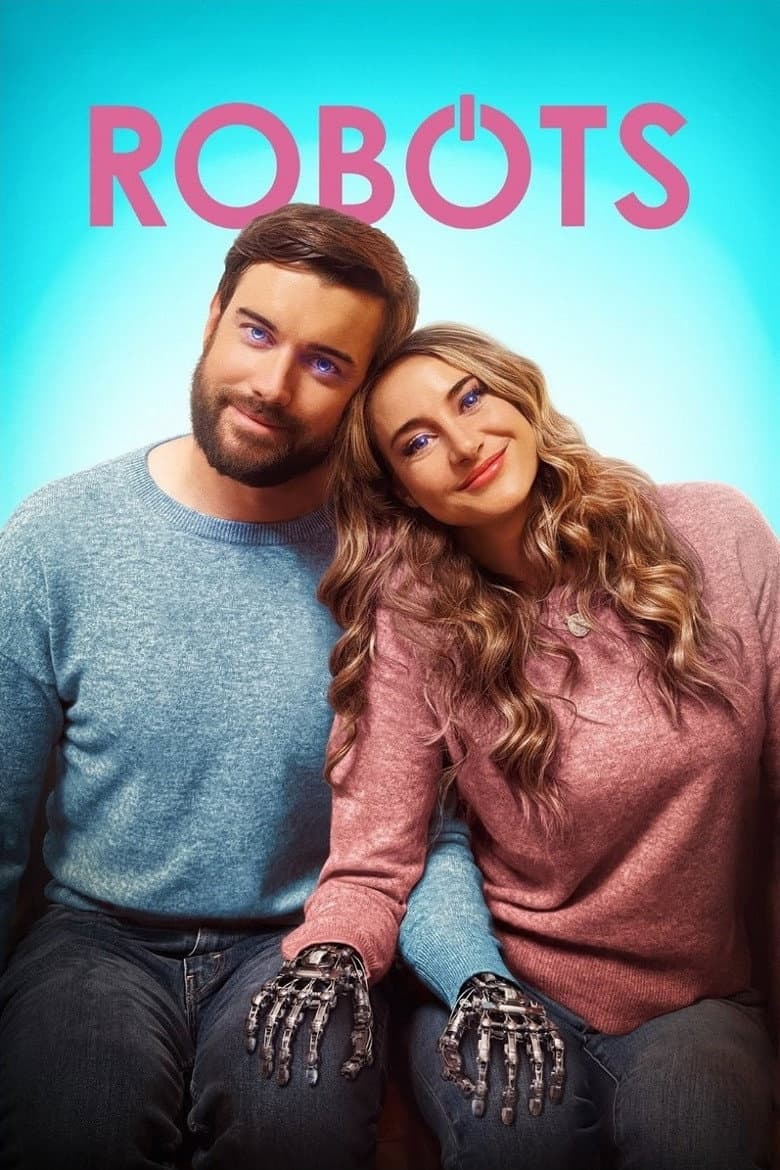
Robots is a science fiction romantic comedy set in America in 2032, where human-looking androids work as servants and laborers. Charles Cameron is a wealthy, selfish womanizer who sends his robot double to date women before he arrives for sex. Elaine is a wealthy gold digger who uses her own double to date men and collect expensive gifts. Their two robots meet by accident, fall in love, and run away, so Charles and Elaine must work together to find them and avoid arrest. The film uses crude jokes, chase scenes, mistaken identities, and a soft message about learning to be human.
The film also links its robot world to American arguments about immigration and work. Its opening shows a president celebrating a border wall that has stopped illegal immigration, while robot workers replace the migrants who once did manual jobs. A foolish friend blames immigrants and robots for his job problems, and the story presents him as a bigot. The robot couple is treated as a pair of enslaved workers who want freedom, and their trip to Mexico turns that comparison into the ending. These ideas give the movie a mild activist tone, but the romance and sex comedy remain more important than the politics.
Community feedback
Was our 37% Woke rating accurate?
Breakdown
These are the editorial factors and ratings behind our score for Robots.
Woke representation / casting
Not present. Most main and supporting characters are white, and the small supporting cast includes a Latino woman detective. The film does not present the casting as an identity statement or build the story around diversity.
0%
Woke political dialogue
The opening shows a president celebrating a completed wall and claiming that illegal immigration has ended. The film links migrant labor to robot labor, and Ashley blames immigrants and robots for his own job problems. The border returns in the final chase, where the robot couple seeks a freer life in Mexico. The politics recur across the opening, the chase, and the ending, but they support the romance instead of driving every scene.
39%
Identity-driven story themes
The robot doubles are treated as property and as programmed slaves. They choose love and freedom, and the ending lets them cross into Mexico and live outside human control. The jail scene treats their feelings as real even though they are artificial. This gives the story a repeated acceptance message, but the message is about robots and human connection rather than a human identity group.
32%
Western institutional / cultural critique
The film mocks a government that celebrates a border wall and claims that immigrants are gone. It shows wealthy people using robot labor and robot doubles to avoid work, dating, and ordinary duties. It presents a male police boss taking credit for Detective Chavez's work and treats an anti-immigrant friend as a foolish bigot. The film also attacks Charles's male entitlement, although Elaine's money-seeking behavior receives similar blame.
36%
Woke character or canon changes
Not relevant. The film expands Robert Sheckley's short story into a two-person romance with Elaine and a second robot double. That change serves the new plot and is not presented as an identity or diversity statement. No clear race, gender, queer, or real-history rewrite is reported.
0%
Anti-woke backlash and complaints
A few audience reviews call the political opening woke or complain that the film takes a jab at conservatives. Other viewers and reviewers mainly criticize the weak humor, sex jokes, and thin romance rather than its politics. No major boycott, news fight, or organized anti-woke campaign appears in the checked coverage. The backlash is scattered and low in volume.
8%
Creator track record context
Anthony Hines has a cached score of 22/100 from comedy and satire work, with no clear DEI activist profile. Casper Christensen has a cached score of 3/100 and is mainly known for provocative comedy. Most listed casting directors and producers have low cached scores, while Cassian Elwes has a mild record of supporting gender parity. The available creator context gives only a weak supporting signal for a woke reading of this film.
12%
Production
Movie · 2021
Teddy wakes up the morning after his wedding to discover that he's jumped forward a year in his life to his first anniversary.
Movie · 2019
A struggling musician realizes he's the only person on Earth who can remember The Beatles after waking up in an alternate reality where the group was forgotten.

Movie · 2020
When carefree Nyles and reluctant maid of honor Sarah have a chance encounter at a Palm Springs wedding, things get complicated when they find themselves unable to escape the…
Movie · 2018
Stillman, a heartbroken physics student, builds a time machine when his girlfriend breaks up with him. Going back in time, he attempts to save their relationship by fixing every…
Movie · 2023
Hapless family man Paul Matthews finds his life turned upside down when millions of strangers suddenly start seeing him in their dreams.
Movie · 2026
A 'Man from the Future' arrives at an LA diner where he must recruit the precise combination of disgruntled patrons to join him on a one-night quest to save the world from the…
Movie · 2023
Two twenty-somethings, both reeling from bad break-ups, connect over the course of an eventful day in South London – helping each other deal with their nightmare exes, and…
Movie · 2021
A figure known as "The Assassin" descends from the heavens into a nightmarish pit full of monsters, titans, and cruelty.
