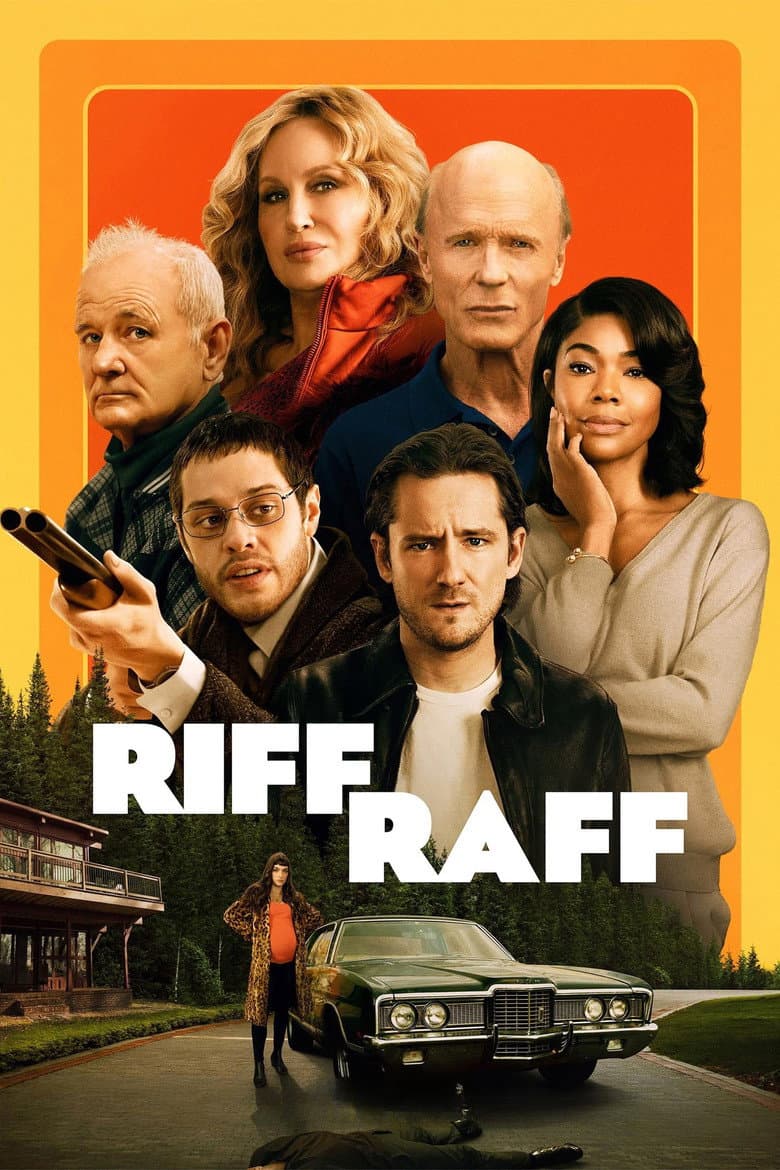
Riff Raff follows Vincent, a retired hit man who has built a quiet life in a Maine cabin with his younger wife Sandy and their college-bound son DJ. His peace ends when his former wife Ruth and his estranged son Rocco arrive with Marina, Rocco’s pregnant girlfriend. Two old mob associates soon hunt the visitors and put the whole household at risk. Vincent must face the violent life he left behind while the family tries to survive a dangerous New Year’s gathering. The movie mixes dark jokes, family fights, flashbacks, and sudden bloody violence, so its tone stays rough and uneasy.
The main social message comes from the damage caused by Vincent’s old criminal life, his abandonment of his first family, and the hard male gang culture around him. The story gives a black wife and Black teenage son a central place in the blended family, but it treats them as people in a crime plot rather than as symbols of a larger cause. The film also shows family, fatherhood, marriage, and personal change as messy choices instead of simple ideals. Its identity material stays limited beside the revenge plot, family secrets, and struggle to escape the past.
Community feedback
Was our 14% Woke rating accurate?
Breakdown
These are the editorial factors and ratings behind our score for Riff Raff.
Woke representation / casting
The main household pairs a white father with a black wife and a black teenage son, making race visible in a major family group. Sandy comes from a wealthy black family, but the film treats her as a troubled wife and mother rather than as a diversity symbol or flawless savior. The modern setting makes the family believable, so the casting signal remains slight.
12%
Woke political dialogue
Not present. The dialogue centers on crime, sex, family secrets, and survival. It does not make recurring speeches about current politics, identity, or social policy.
0%
Identity-driven story themes
Not present. The main themes are family loyalty, fatherhood, marriage, revenge, and the cost of crime. The story does not make race, sex, sexuality, or group identity the main problem or answer.
0%
Western institutional / cultural critique
The film repeatedly shows male violence, cheating, abandonment, and mob power damaging families. Vincent’s old crime life and his failure as a father are treated as harm that he must face. Montiel also describes toxic masculinity as a root of his work, which gives the story a mild critique of harmful male behavior. The movie does not turn that idea into a broad attack on modern institutions, capitalism, Christianity, or family life.
18%
Woke character or canon changes
Not relevant. The movie adapts John Pollono’s play and does not retell a known franchise or real historical story. No established character or real person is changed for identity or DEI reasons.
0%
Anti-woke backlash and complaints
Not present. Public complaints focus on weak writing, uneven tone, violent scenes, and a wasted cast. No major anti-woke, DEI, or identity-politics backlash appears in the available coverage.
0%
Creator track record context
The supplied creator notes rate Dito Montiel at 0/100 and John Pollono at 12/100. Jennifer Coolidge is rated 35/100 because of her LGBTQ ally work, while the other supplied producers range from 0 to 18/100. The title-related interviews focus on family pain, crime, acting, and the ensemble cast. This gives the film only a weak creator track record context.
8%
Production
Movie · 2018
The true story of Forrest Tucker, from his audacious escape from San Quentin at the age of 70 to an unprecedented string of heists that confounded authorities and enchanted the…

Movie · 2017
When a depressed woman is burglarized, she finds a new sense of purpose by tracking down the thieves alongside her obnoxious neighbor.
Movie · 2017
The true story of pilot Barry Seal, who transported contraband for the CIA and the Medellin cartel in the 1980s.

Movie · 2016
Based on the true story of two young men, David Packouz and Efraim Diveroli, who won a $300 million contract from the Pentagon to arm America's allies in Afghanistan.

Movie · 2017
A disgraced former cop, fresh off a six-year prison sentence for attempted murder, returns home looking for redemption but winds up trapped in the mess he left behind.

Movie · 2017
A young man seeking a father he has never met, through no fault of his own, ends up barricaded in a liquor store with five other people on Christmas Eve in the fictitious town of…

Movie · 2017
Lynn, a brilliant student, after helping her friends to get the grades they need, develops the idea of starting a much bigger exam-cheating business.
Movie · 2016
When a Hollywood star mysteriously disappears in the middle of filming, the studio sends their fixer to get him back.
