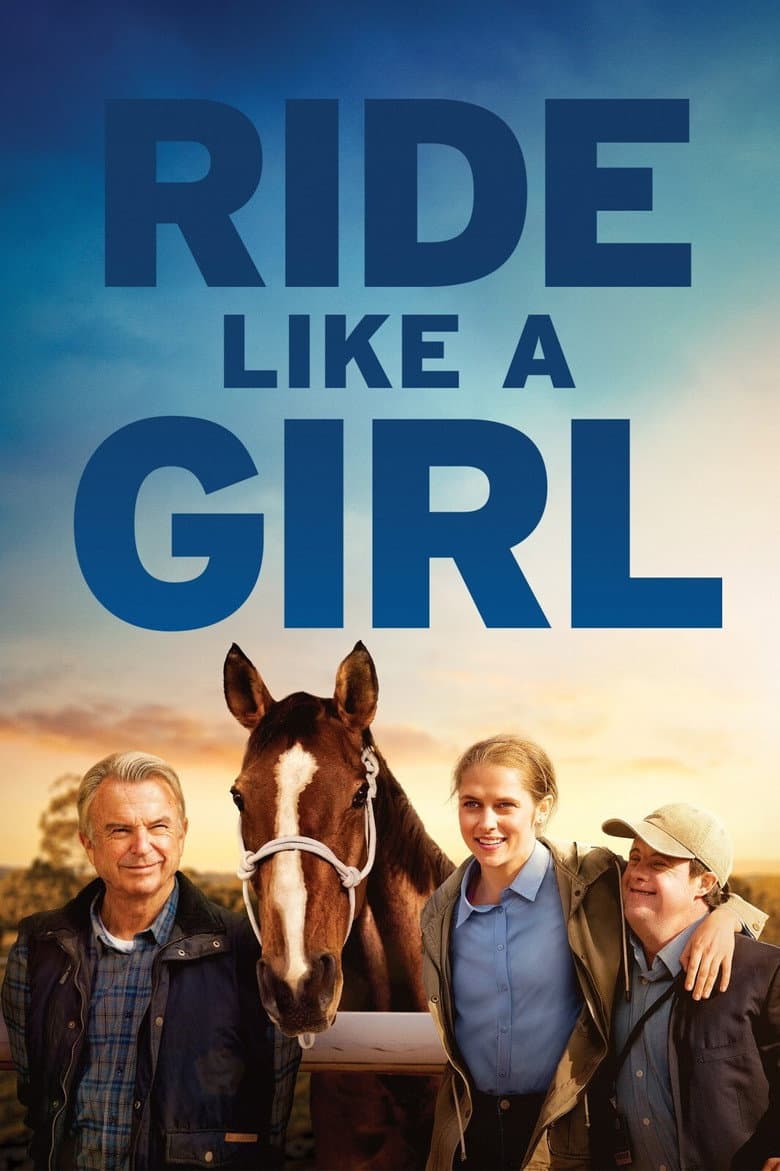
Ride Like a Girl follows Michelle Payne, the youngest child in a large horse-racing family in rural Victoria, Australia. After her mother dies, her father raises Michelle and her siblings while they train horses and chase races. Michelle wants to become a jockey, but injuries, family loss, strict weight rules, and doubts from people in a male-dominated sport block her path. The film uses a warm, emotional sports-drama tone as she works toward the 2015 Melbourne Cup.
The film presents Michelle's victory as a story about women proving they belong in a sport long ruled by men. Men question her skill, call her a girl, or say women lack the strength to win, while Michelle keeps choosing the harder path and later speaks about giving female jockeys more chances. The story repeatedly praises female courage, persistence, and role-model power, but it also gives major weight to her father, brother Stevie, siblings, horses, and family loyalty. The film is more a direct, feel-good underdog story than a broad debate about politics or society.
Community feedback
Was our 51% Woke rating accurate?
Breakdown
These are the editorial factors and ratings behind our score for Ride Like a Girl.
Woke representation / casting
Teresa Palmer plays the real Michelle Payne in the Australian racing world shown by the film. The film does not change a known character's race or gender for the cast. Stevie Payne also plays himself, so the disability portrayal is tied to the real family. The film and its promotion strongly stress that Michelle is the first woman to win and present her as a model for girls, which gives the casting a mild identity signal.
24%
Woke political dialogue
The film includes repeated comments that Michelle is less capable because she is a girl. Men question her strength and say women do not get enough chances in top races. The closing speech asks for more chances for female jockeys and calls out the sport's male dominance. These lines are clear but stay tied to Michelle's real sports career instead of a wider political program.
34%
Identity-driven story themes
The film centers on Michelle's fight to stay in a male-dominated sport and win the Melbourne Cup. The story shows men doubting her while she proves her skill through training, injury, and competition. The victory is presented as hope for other female jockeys, so the empowerment theme is hard to miss. The film also gives strong space to family, grief, faith, horses, and personal endurance, which keeps the gender message from taking over every scene.
52%
Western institutional / cultural critique
The racing world is shown as a place where men doubt Michelle, make sexist comments, and control chances to ride. The film treats those attitudes as unfair and presents the old idea that women lack strength as wrong. The criticism stays inside horse racing and is tied to Michelle's time and place. The movie does not attack family, religion, Australia, or Western institutions in a broad way.
38%
Woke character or canon changes
Not relevant. The movie is a biographical story about the real Michelle Payne and her 2015 win. No identity-based rewrite of a known fictional character or historical figure is reported.
0%
Anti-woke backlash and complaints
Not present. No anti-woke or right-leaning complaint about the film's gender message was found in the supplied X pass or mainstream coverage. The reported premiere protest focused on horse welfare, not woke or DEI content.
0%
Creator track record context
Rachel Griffiths has a moderate activist record focused on gender equality and other social issues. Elise McCredie has a stronger women-centered record and has discussed gender equality in film work. Richard Keddie supported a woman directing the project and linked it to Screen Australia's Gender Matters program. Andrew Knight, Tim Haslam, Nikki Barrett, and Susie Struth have little recorded activist focus, so the wider record is mixed.
40%
Production
Movie · 2023
Hirayama is content with his life as a toilet cleaner in Tokyo. Outside of his structured routine, he cherishes music on cassette tapes, books, and taking photos of trees.
Movie · 2023
British stockbroker Nicholas Winton visits Czechoslovakia in the 1930s and forms plans to assist in the rescue of Jewish children before the onset of World War II, in an operation…
Movie · 2024
Inspired by the incredible true story of a hairdresser who single-handedly rallies an entire community to help a widowed father save the life of his critically ill young daughter.
Movie · 2018
A father and daughter live a perfect but mysterious existence in Forest Park, a beautiful nature reserve near Portland, Oregon, rarely making contact with the world.
Movie · 2016
Based on the life story of Mahendra Singh Dhoni, and his journey to being the world cup winning captain of the Indian cricket team.
Movie · 2019
A look at the Apollo 11 mission to land on the moon led by commander Neil Armstrong and pilot Buzz Aldrin.
Movie · 2021
The enthralling, against-all-odds story that transfixed the world in 2018: the daring rescue of twelve boys and their coach from deep inside a flooded cave in Northern Thailand.
Movie · 2018
Dan, a 21-year-old carefree boy is always surrounded by a bunch of friends and fellow hotel interns who feed off each other's everyday moments, their ups and downs.
