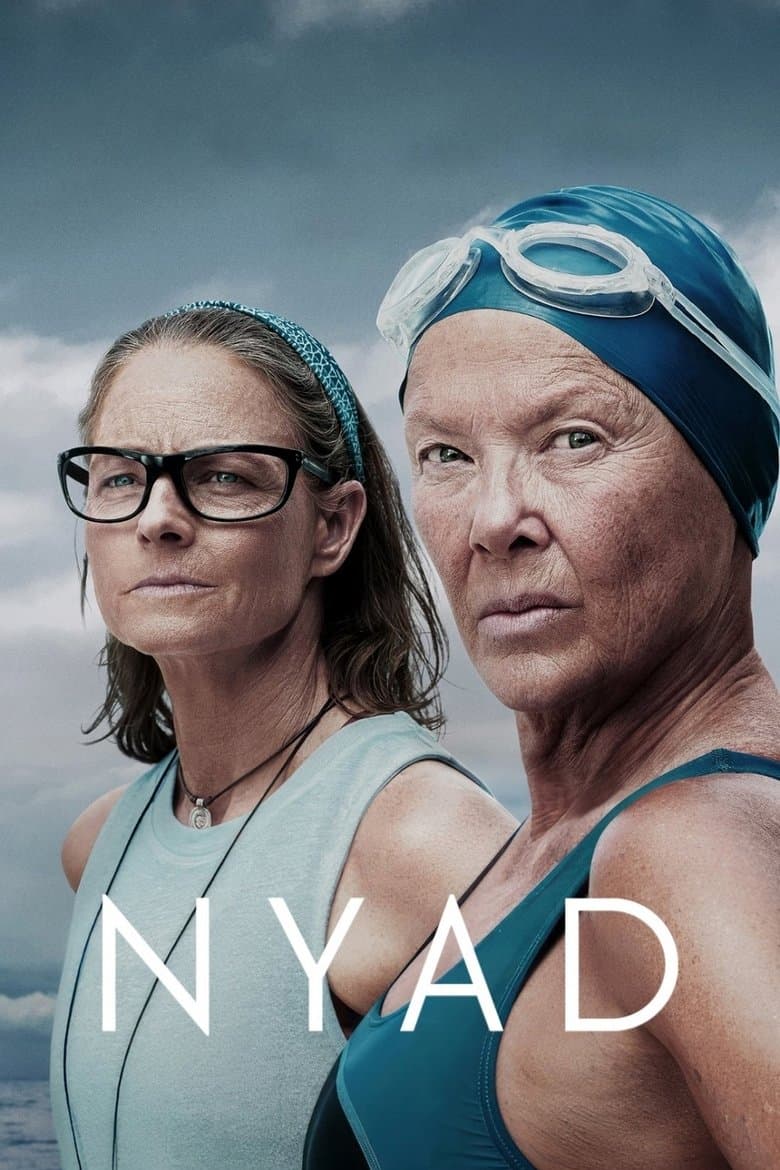
Diana Nyad is a retired long-distance swimmer who turns 60 and refuses to leave her biggest dream behind. She wants to swim more than 100 miles from Cuba to Florida without a shark cage. Her best friend Bonnie Stoll becomes her coach, while navigator John Bartlett and the boat team help her face storms, jellyfish, sharks, hunger, pain, and repeated failure. The movie moves between training, dangerous swims, childhood memories, and hard talks with the people who love her, so its tone is tough, emotional, and hopeful.
The story puts two older lesbian women at the center through Diana and Bonnie, who dated briefly before building a lifelong friendship. Their bond becomes a chosen family, and Bonnie’s loyalty helps Diana learn that the swim depends on a whole team. Flashbacks show that a swimming coach sexually abused Diana when she was young, and the film treats that pain as part of her life rather than a simple reason for her success. The main message stays focused on courage, discipline, friendship, and persistence as Diana chases a dream late in life.
Community feedback
Was our 42% Woke rating accurate?
Breakdown
These are the editorial factors and ratings behind our score for NYAD.
Woke representation / casting
Annette Bening and Jodie Foster play the real Diana Nyad and Bonnie Stoll, two older lesbian women. Their past romance and lifelong bond are visible in central roles. The film and its interviews openly frame this as queer friendship and chosen family. The casting matches the real people, so the identity emphasis comes from the story and its framing rather than a mismatch with the real world.
42%
Woke political dialogue
Diana says that turning 60 makes the world treat her as useless. The team jokes about using more material made for women and less material led by men in suits. Diana also repeats a line that links female strength with male standards. These are brief age and gender lines, not a repeated activist speech.
10%
Identity-driven story themes
The film makes Diana and Bonnie’s lesbian identities part of a major emotional arc. The women dated briefly and later became each other’s family while Bonnie coached Diana. Their bond shapes the training, the break between attempts, and the final swim. The abuse and age barriers add personal pain, but the movie does not turn them into a broad activist message. The swim remains the main plot.
47%
Western institutional / cultural critique
The film shows Diana’s teenage swimming coach sexually abusing her. The film also shows her being dismissed because she is an older female athlete. These moments point to abuse, ageism, and sexist doubt, but they stay tied to Diana’s personal story. The movie does not build a wider attack on men, capitalism, religion, or Western society.
15%
Woke character or canon changes
Not relevant. The film combines real crew members and changes the timing of some events for drama. It keeps the real people’s names, identities, and basic story without an ideological rewrite.
0%
Anti-woke backlash and complaints
Not present. Public criticism centered on whether the swim followed accepted rules and whether Nyad’s other claims were accurate. The supplied X pass found no anti-woke reaction, and no strong reports tied the film to DEI or identity-politics complaints.
0%
Creator track record context
The directors are mainly known for endurance, nature, and human stories, with little public identity-politics work. Diana Nyad has public LGBTQ and gay-rights advocacy, and Julia Cox has limited past work on gender topics. Casting director Avy Kaufman has worked on several projects with strong LGBTQ themes. Most producers have conventional records with little public activism. This gives the film some supporting identity context, but it does not show a broad activist pattern.
25%
Production

Movie · 2024
On the brink of the Second World War, a young Norwegian man's drive to resist the Nazis sets a new course for his future – and the future of his country.

Movie · 2026
While people across 1990s Iraq struggle to survive the war and food shortages, Saddam Hussein requires each school in the country to prepare a cake to celebrate his birthday.

Movie · 2022
Based on a true tragedy, the emotionally triggering film sheds light on the plight of Kashmiri Pandits (Hindus), a religious minority in the 1990s Kashmir valley, who were…
Movie · 2017
Members of the Granite Mountain Hotshots battle deadly wildfires to save an Arizona town.

Movie · 2023
American ballet dancer Joy Womack is accepted into Moscow's infamously tough Bolshoi Ballet Academy, with the dream of becoming a great ballerina.
Movie · 2025
A logger leads a life of quiet grace as he experiences love and loss during an era of monumental change in early 20th-century America.

Movie · 2023
The story of J. Robert Oppenheimer's role in the development of the atomic bomb during World War II.

Movie · 2016
After his older brother passes away, Lee Chandler is forced to return home to care for his 16-year-old nephew.
