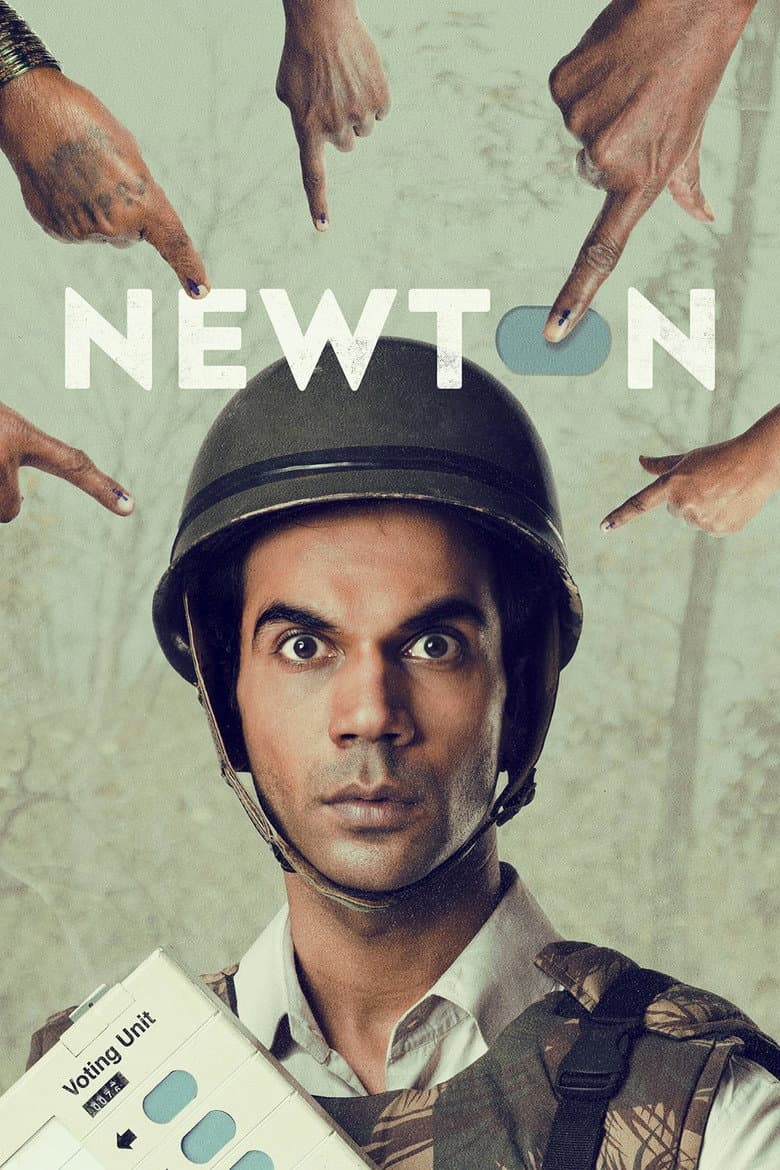
Newton Kumar is a strict but lonely government clerk who volunteers to run a polling station in a remote forest in Chhattisgarh. The village has only 76 voters, and Maoist rebels, armed security forces, poor roads, and deep distrust surround the election. Newton believes every rule matters, while commander Aatma Singh wants to finish the job and leave before dark. The day becomes a dry, tense comedy about duty, fear, and the gap between law and real life. The film gives strong attention to the Adivasi, or tribal, people who live between the state and the rebels. Malko Netam, a local teacher and election worker, understands the area better than Newton and points to the limits of outside ideas about progress, voting, and order. The story also hints that Newton comes from a lower caste through his family, an Ambedkar portrait, and a marriage dispute, but it does not make caste his main struggle. Its main message supports honest elections and basic rights, while showing that government power, armed force, mining, and Maoist violence all fail to give villagers control over their lives.
Community feedback
Was our 57% Woke rating accurate?
Breakdown
These are the editorial factors and ratings behind our score for Newton.
Woke representation / casting
Anjali Patil plays Malko, a local Adivasi woman, while coverage says Patil is Marathi-speaking and learned Gondi lines with a coach. The role is a prominent supporting part and gives the film a visible tribal identity voice. The movie also uses local people and Gondi speech, so the casting pattern is mostly tied to place rather than a broad diversity-first design.
15%
Woke political dialogue
The film repeatedly discusses free elections, citizens’ rights, local culture, mining, and the way state forces treat Adivasi villagers. Malko pushes back when Newton assumes that voting rules can solve problems the village has faced for years. Other characters expose corrupt officials, staged media scenes, and armed power. The film also shows Maoist violence, so its political talk is critical of the whole conflict rather than a simple call for revolution.
44%
Identity-driven story themes
The film makes tribal identity and local rights a continuing part of the election story. Malko is a local woman whose knowledge challenges Newton’s outside view, and the voters are shown as people caught between government forces and Maoist rebels. The story also hints that Newton is lower-caste through an Ambedkar portrait, a job-reservation clue, and a marriage dispute. These ideas shape the film’s view of citizenship, but the main arc still follows one clerk trying to finish his duty.
52%
Western institutional / cultural critique
The film repeatedly shows government offices, security forces, election rules, and news media failing the people they claim to serve. The story points to mining, forced movement, poor services, and outside control of tribal land. It presents both the Maoists and the state as sources of pressure, so the criticism targets power and broken institutions rather than one simple political side. It does not attack Christianity, family life, or traditional gender roles.
45%
Woke character or canon changes
Not relevant. Newton is an original story about a fictional election clerk. It does not change an established character or retell a real historical event.
0%
Anti-woke backlash and complaints
One r/IndiaSpeaks post called the movie anti-army and anti-state propaganda and said it made the Maoists look too sympathetic. Several replies debated the claim, but the discussion stayed in one niche thread. The supplied X pass found no anti-woke complaints. The bigger 2017 dispute was an alleged copy of Secret Ballot, which was not an anti-woke complaint and was rejected by that film’s makers.
12%
Creator track record context
Masurkar’s stored score is 60/100 because his films often follow local people facing state power, environmental conflict, and social pressure. Tewari’s stored score is 45/100 because his writing often examines politics and broken systems, but no clear activist persona is established. Mundra’s stored score is 50/100 for backing socially focused independent films, while Gupta’s is 0/100 and the two casting scores are mixed. This gives Newton a clear socially engaged context, but not a strongly partisan or queer-centered one.
50%
Production
Movie · 2020
Scott has been a case of arrested development ever since his firefighter father died when he was seven. He's now reached his mid-20s having achieved little, chasing a dream of…

Movie · 2022
Maurice Flitcroft, a dreamer and unrelenting optimist, managed to gain entry to The British Open Golf Championship qualifying in 1976 and subsequently shot the worst round in Open…

Movie · 2020
Four stagnant high school teachers decide to test out a theory that maintaining a constant level of intoxication will improve their overall lives.

Movie · 2018
Tony Lip, a bouncer in 1962, is hired to drive pianist Don Shirley on a tour through the Deep South in the days when African Americans, forced to find alternate accommodations and…

Movie · 2016
Aspiring New York City artist John Hollar returns to his Middle America hometown on the eve of his mother’s brain surgery.
Movie · 2023
A resourceful 12-year-old, who secretly lives alone in her flat in a working-class suburb of London, makes money stealing bikes with her best friend Ali and keeps the social…

Movie · 2024
When a construction worker unexpectedly joins a local theater's production of Romeo and Juliet alongside his estranged teenage daughter, the drama onstage starts to mirror his own…
Movie · 2023
Leo and Angela Russo live a simple life in Queens, surrounded by their overbearing Italian-American family. When their son finds success on his high school basketball team, Leo…
