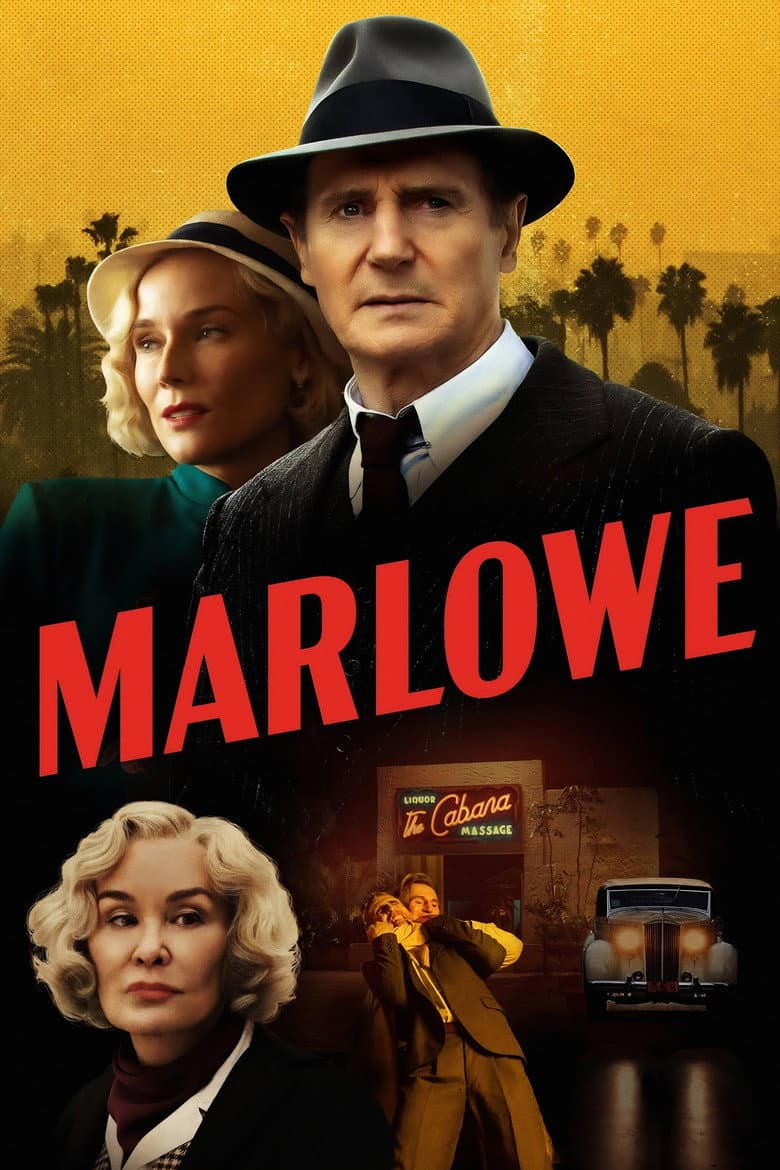
Marlowe follows Philip Marlowe, an aging private detective who works by his own code in 1939 Los Angeles. A wealthy heiress hires him to find Nico Peterson, her former lover, but the search soon leads to murder, drug smuggling, crooked police, and a powerful Hollywood family. Marlowe faces gangsters, rich people, and people who hide behind the movie business. The film uses a dark, slow, old-fashioned crime style with sharp talk, gun fights, and grim humor.
The strongest audience-visible identity-focused element is the power given to Clare Cavendish and her mother, Dorothy. Clare starts the case, tricks men and women, and takes control of events while Marlowe follows her trail. The film presents both women as highly clever, and their struggle gives the story a continuing female-power theme. This idea matters to the mystery, but the film keeps it inside a crime story about secrets, greed, sex, and hard choices instead of turning it into a modern political campaign.
Community feedback
Was our 28% Woke rating accurate?
Breakdown
These are the editorial factors and ratings behind our score for Marlowe.
Woke representation / casting
Not present. The film uses a mainly white cast for a wealthy 1939 Los Angeles story. Cedric is a black supporting chauffeur and fighter, but the movie does not frame his race or the casting as a diversity message.
0%
Woke political dialogue
Not present. The characters talk about crime, corruption, war, sex, and personal codes. They do not give modern speeches about race, gender, identity, or activism.
0%
Identity-driven story themes
Clare Cavendish drives the case and repeatedly outplays men around her. The film presents Clare and her mother Dorothy as highly intelligent women who use power, secrecy, and charm to control events. Their struggle gives the movie a continuing female-power thread. The idea is noticeable, but it stays inside a dark crime story instead of becoming a wider activist message.
33%
Western institutional / cultural critique
Not present. The movie shows a corrupt film studio, rich criminals, crooked police, and old Hollywood sexism. These problems stay inside the 1930s crime plot and do not become a modern attack on Western institutions, capitalism, patriarchy, or Christianity.
0%
Woke character or canon changes
Not relevant. The movie follows an authorized Marlowe continuation based on John Banville's novel. No identity-driven rewrite of Marlowe or another established character is central to this adaptation.
0%
Anti-woke backlash and complaints
One small Reddit reaction called the film a postmodern bait and switch and objected to its Black sidekick and female lead defeating their enemies. That reader treated those choices as a left-leaning change in the story. Most other reaction focused on Neeson's age, the slow pace, weak dialogue, and confusion. The evidence is fringe, so the score is very low.
8%
Creator track record context
Neil Jordan's supplied creator score is 59/100 because The Crying Game and Breakfast on Pluto center on gender identity. His interviews about Marlowe focus on noir, Liam Neeson, and moral uncertainty, not activism. Raymond Chandler, William Monahan, and John Banville have low supplied scores and little identity-focused history. The listed producers and casting director are also mostly low, although Celine Haddad has worked on queer-centered films. This gives the title a moderate creator track record context, but it does not prove an activist message in this movie.
45%
Production
Movie · 2018
On the night she plans on taking her own life, 17-year-old 'Lisa McVey' is kidnapped and finds herself fighting to stay alive and is raped.

Movie · 2024
Hired to cover up a high-profile crime, a fixer soon finds his night spiralling out of control when he's forced to work with an unexpected counterpart.
Movie · 2017
After being coerced into working for a crime boss, a young getaway driver finds himself taking part in a heist doomed to fail.

Movie · 2025
When a mentally ill young man thinks he witnesses an abduction and the police refuse to believe him, he reluctantly turns to his next door neighbor – a bitter, retired security…
Movie · 2022
In the 1980s, a team of lawyers takes on the heads of Argentina's bloody military dictatorship in a battle against odds and a race against time.

Movie · 2024
In this twisting documentary, a mechanic tries online dating for the first time and meets a woman who takes romantic obsession to a deadly extreme.

Movie · 2019
Istanbul Police Department homicide detectives encounter a murder nothing like they’ve seen before.Commissioners Emin, Salih, Asuman and deputy Alaattin begin investigating.But…

Movie · 2024
FBI Agent Lee Harker is a gifted new recruit assigned to the unsolved case of an elusive serial killer. As the case takes complex turns, unearthing evidence of the occult, Harker…
