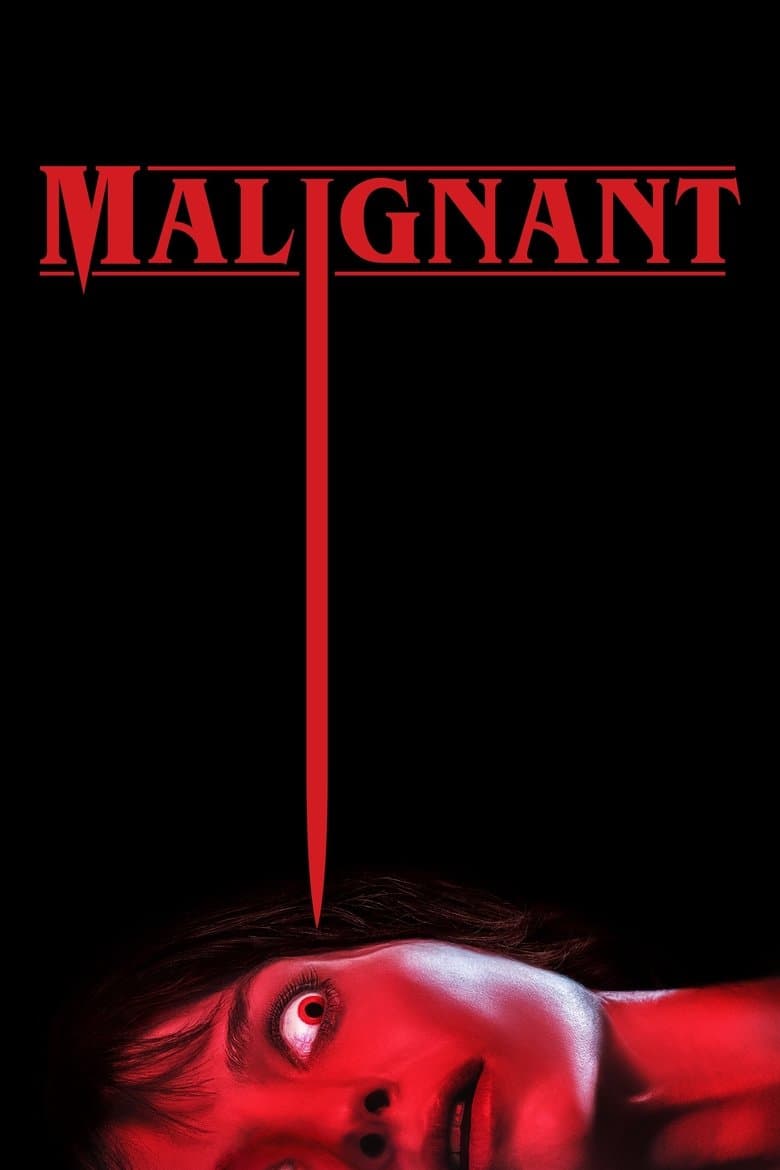
Malignant is a James Wan horror film about Madison Mitchell, who suffers visions of brutal murders that turn out to be real. Those crimes link to a suppressed childhood and a parasitic twin sealed inside her skull. Her abusive husband smashes her head during a fight over miscarriages, and the killings soon begin. The killer is Gabriel, her twin brother, who seizes control of her body. The climax has Madison reclaim her body and protect her adoptive sister. The movie leans on giallo style, heavy gore, body horror, and a late twist rather than social-issue drama.
On screen the throughline is personal trauma, repressed memory, sibling bond, and a literal bodily takeover. Race politics and queer identity are not the engine of the plot. A multiethnic police pair appears in a modern Seattle setting in ordinary ways rather than as a diversity showcase. Domestic abuse and a fight for control of her own body sit inside the genre package and can read as autonomy subtext. The finished film still puts thrills, camp, gore, and the Gabriel twist first. Progressive readings stress mistreatment of women, yet the main audience takeaway stays the wild twist and body horror.
Community feedback
Was our 19% Woke rating accurate?
Breakdown
These are the editorial factors and ratings behind our score for Malignant.
Woke representation / casting
The white female lead works in modern Seattle with supporting cops who include an Asian-coded detective and a black female partner in capable roles. That mix fits a normal city setting more than a loud diversity showcase. There is no identity swap of known characters and no cast-as-statement marketing.
10%
Woke political dialogue
Not present. Plot and coverage do not show activist or identity-politics speech; conflict is personal (abuse, murder investigation, body-horror twin), not sermonizing about systemic identity ideology.
0%
Identity-driven story themes
On screen the spine is body horror and a woman taking back control from a parasitic twin after domestic abuse. That can read as an autonomy idea under the surface. The story still runs mainly on thrills, gore, and the Gabriel twist. Race, queer, or DEI identity politics are not the main engine.
24%
Western institutional / cultural critique
An abusive husband, medical mishandling that trapped Gabriel, and police wrongly jailing Madison create mild friction with men and institutions. The film does not run a long modern attack on Christianity, capitalism, or Western culture as activist targets. Those beats stay inside the horror plot.
14%
Woke character or canon changes
Not relevant. original story, not an adaptation of established characters or history rewritten for identity messaging.
0%
Anti-woke backlash and complaints
Not present. No meaningful right-leaning or anti-woke campaign treating the film as DEI/woke propaganda; discourse focused on the twist, camp, quality, and a plagiarism dispute.
0%
Creator track record context
Cached scores for Wan, Cooper, Bisu, and key producers and casting sit low overall, mostly under 20. Cooper has said she values genre escape over forced social commentary. Feminist framing from Wan and Bisu is mainly about this title. It does not show a high long-term activist slate.
10%
Production

Movie · 2025
A woman's obsessive search for her missing sister leads her into a terrifying mystery at the hands of an unknown evil.
Movie · 2024
After the brutal murder of her twin sister, Darcy goes after those responsible by using haunted items as her tools for revenge.
Movie · 2018
The crew of a horror web series travels to an abandoned asylum for a live broadcast, but they encounter much more than expected as they move deeper inside the nightmarish old…

Movie · 2017
After a mysterious global crisis, a young girl is left alone to hide from a malevolent power that stalks her home.
Movie · 2023
After a Black Friday riot ends in tragedy, a mysterious Thanksgiving-inspired killer terrorizes Plymouth, Massachusetts - the birthplace of the holiday.

Movie · 2023
Between the events of 'Saw' and 'Saw II', a sick and desperate John Kramer travels to Mexico for a risky and experimental medical procedure in hopes of a miracle cure for his…
Movie · 2021
A lone drifter suffering from partial memory loss accepts a job to look after a psychologically troubled woman in an abandoned house on an isolated island.
Movie · 2023
Jess, a newly separated mother and nurse, moves into her old family farmhouse with Tyler, her teenage daughter, and Owen, her eight-year-old son.
