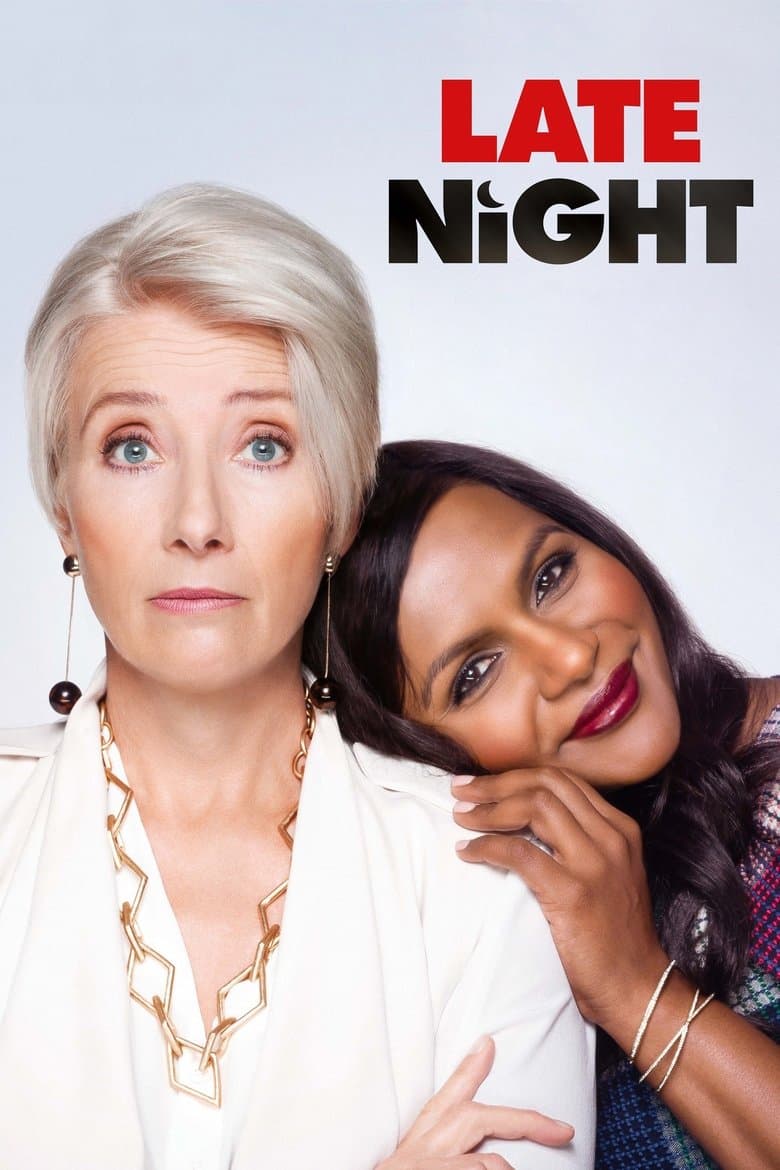
Late Night follows Katherine Newbury, a famous host whose long-running television comedy show is losing viewers. The network wants to replace her, and she is accused of being out of touch and disliking women. Katherine hires Molly Patel, an Indian-American woman who has never worked in television, to join her all-male writing room. Molly must win over the writers, help repair the show, and prove that she belongs while Katherine faces trouble at work and at home. The film uses sharp jokes, workplace conflict, and a warm but sometimes pointed tone. The movie puts diversity, sexism, age, and the place of women in comedy at the center of its story. Molly is hired partly because Katherine wants to answer complaints that her staff is all white and male, and the film openly calls Molly a diversity hire. The story treats a wider range of voices as good for the show and shows male writers blocking or belittling Molly. It also follows two women who learn to support each other, while jokes about white privilege, male power, white rescuers, and women of color make the message easy to notice. The movie still gives space to ambition, marriage, work mistakes, and the need to earn success through good writing.
Community feedback
Was our 77% Woke rating accurate?
Breakdown
These are the editorial factors and ratings behind our score for Late Night.
Woke representation / casting
The movie makes identity part of its visible casting pattern. Molly is an Indian-American woman and the only woman and person of color in an all-white, all-male writers’ room. Katherine is a woman who holds the top job in a field shown as male-led. The film repeatedly presents these choices as diversity hiring and as a way to fix an old workplace. The supporting room remains mostly white and male, so the design is strong but not an all-purpose diverse cast.
54%
Woke political dialogue
The characters repeatedly talk about diversity hiring, sexism, ageism, and women being shut out of comedy jobs. Molly calls out the white patriarchy and argues that she should not be judged as a symbol for every Indian woman. The writers joke that women of color get jobs easily, and the film also uses a white-savior joke. These lines appear in several workplace and TV scenes, so the politics are easy to notice even though the film keeps a comic tone.
48%
Identity-driven story themes
Identity is a main part of the story, not a side detail. Molly is hired to answer complaints about an all-white male staff, then must fight the belief that she is only a quota hire. The story supports more women and minority voices in comedy and treats inclusion as helpful to the whole show. Katherine also learns that women should support each other instead of competing for one place. The movie balances this message with a demand that Molly earn trust through strong writing.
68%
Western institutional / cultural critique
The film presents the television workplace as a male club that rewards old connections and shuts out women. Male writers dismiss Molly, block her ideas, and one pushes her toward sex. Katherine’s age and sex also make her job less secure. The story calls these habits unfair and links them to the show’s creative failure. Its criticism stays focused on entertainment workplaces and does not attack Christianity, family life, or Western society as a whole.
44%
Woke character or canon changes
Not relevant. The film is an original workplace comedy with no established character, historical figure, or source canon being changed.
0%
Anti-woke backlash and complaints
A few online critics treated the diversity-hire premise as forced identity politics. One opinion piece called the film a woke-liberal dream and questioned why Molly gets the job despite little comedy experience. Small audience posts also called the final diverse-office image cringe. The separate X search found no campaign, review bomb, boycott, or large anti-woke reaction, so the backlash stayed fringe.
32%
Creator track record context
stored context places writer Mindy Kaling at 58/100 and director Nisha Ganatra at 60/100. Kaling is known for supporting minority representation, and she has described this story through feminism, ageism, and her experience in a less diverse comedy workplace. Ganatra has a strong diversity and representation focus and has said that inclusion is the film’s main message. The other stored producers and crew have mixed or mostly low scores.
60%
Production
Movie · 2018
Thirteen-year-old Kayla endures the tidal wave of contemporary suburban adolescence as she makes her way through the last week of middle school — the end of her thus far…

Movie · 2016
Two high school girls are best friends until one dates the other's older brother, who is totally his sister's nemesis.
Movie · 2023
Two mismatched entrepreneurs – egghead innovator Mike Lazaridis and cut-throat businessman Jim Balsillie – joined forces in an endeavour that was to become a worldwide hit in…

Movie · 2017
An aspiring actor in Hollywood meets an enigmatic stranger by the name of Tommy Wiseau, the meeting leads the actor down a path nobody could have predicted; creating the worst…
Movie · 2018
Vignettes weaving together the stories of six individuals in the old West at the end of the Civil War. Following the tales of a sharp-shooting songster, a wannabe bank robber, two…
Movie · 2023
A curmudgeonly instructor at a New England prep school is forced to remain on campus during Christmas break to babysit the handful of students with nowhere to go.
Movie · 2024
Pansy is a woman so full of rage that every interaction she has devolves into lashing out, whether at her utterly cowed husband and son, or random strangers who have the temerity…

Movie · 2020
A once-celebrated kid detective, now 31, continues to solve the same trivial mysteries between hangovers and bouts of self-pity.
