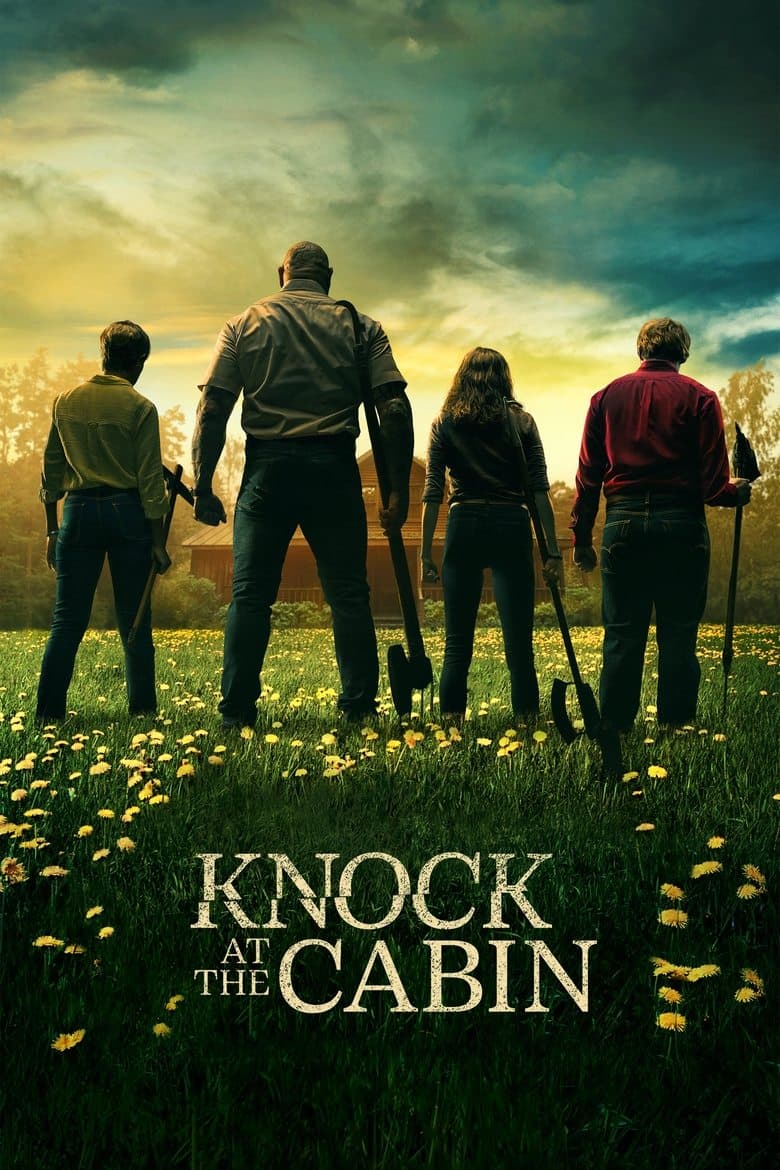
While on vacation at a remote cabin in Pennsylvania, married couple Eric and Andrew and their young adopted daughter Wen are taken hostage by four armed strangers. The strangers say they share the same visions of the end of the world. They demand that the family willingly sacrifice one of their own to stop that end. As disasters appear on television and the strangers die one by one after each refusal, the family must decide what they believe and what they are willing to do.
The film centers a same-sex married couple with an adopted East Asian daughter as the core family under siege. Flashbacks and present talk cover parental rejection of the couple, a homophobic bar assault, and hurdles around adoption. Andrew often frames the siege as possible anti-gay targeting and questions why a hostile world deserves saving. Their love, trauma, and bond drive the premise and the resolution, so LGBTQ identity sits front and center rather than as a side detail. The thriller still turns on sacrifice and belief, and the story ultimately rejects the idea that they were chosen only because they are gay.
Community feedback
Was our 73% Woke rating accurate?
Breakdown
These are the editorial factors and ratings behind our score for Knock at the Cabin.
Woke representation / casting
The film puts a same-sex married couple and their adopted East Asian daughter at the center. The director wanted openly gay actors so the leads would feel real. A black British actress and a mixed supporting group appear among the invaders. The queer family is the main casting focus, and the racial mix matters less.
64%
Woke political dialogue
Flashbacks and present talk cover parental rejection, a homophobic bar assault, and adoption trouble. Andrew often treats the siege as possible anti-gay hate and asks if a hostile world is worth saving. Identity talk shows up often and clearly. It does not turn into nonstop activist speech.
40%
Identity-driven story themes
The core unit is a queer family whose love, trauma, and bond drive the premise and the ending. Homophobia shapes Andrew’s path and several flashbacks. LGBTQ identity is front and center rather than a small side note. The thriller still rests on sacrifice and belief.
78%
Western institutional / cultural critique
The film shows family and social hostility to gay men through parents, a hate crime, and adoption friction. It is not a wide attack on Western institutions, capitalism, or Christianity. Apocalypse images nod to the biblical Horsemen. Some critics read the ending as a conservative faith parable.
28%
Woke character or canon changes
Not relevant. The gay couple and daughter come from Paul Tremblay’s novel.
0%
Anti-woke backlash and complaints
Some user reviews and posts call the film woke or an LGBT agenda. A few also frame it as agenda-driven box-office bait. Those complaints exist but stay scattered. There was no large mainstream anti-woke campaign on this point.
26%
Creator track record context
Key creatives’ stored profiles sit low, with Shyamalan near fifteen and others in the teens or low twenties. Promotion focused on craft, family love, adoption resonance, and authentic gay casting. It did not lean on a long activist filmography.
18%
Production
Movie · 2019
A lone fisherman on his daily run finds himself lost in a thick fog which proves impossible to navigate. The worst is yet to come when his encounter with a seemingly abandoned…

Movie · 2021
A group of families on a tropical holiday discover that the secluded beach where they are staying is somehow causing them to age rapidly – reducing their entire lives into a…
Movie · 2018
Following the death of the Leigh family matriarch, Annie and her children uncover disturbing secrets about their heritage.
Movie · 2017
Though Kevin has evidenced 23 personalities to his trusted psychiatrist, Dr. Fletcher, there remains one still submerged who is set to materialize and dominate all the others.
Movie · 2019
Newcomer Evan joins a group of teens on a getaway in Joshua Tree. While exchanging ghost stories around the campfire, Evan reads aloud a mysterious chant from an internet site.
Movie · 2018
The crew of a horror web series travels to an abandoned asylum for a live broadcast, but they encounter much more than expected as they move deeper inside the nightmarish old…
Movie · 2016
Four friends break into an abandoned insane asylum in search of a death certificate which will grant one of them a large inheritance.
Movie · 2025
Two parents enter a race against time when they receive a distressing late-night phone call from their daughter after she caused a tragic car accident.
