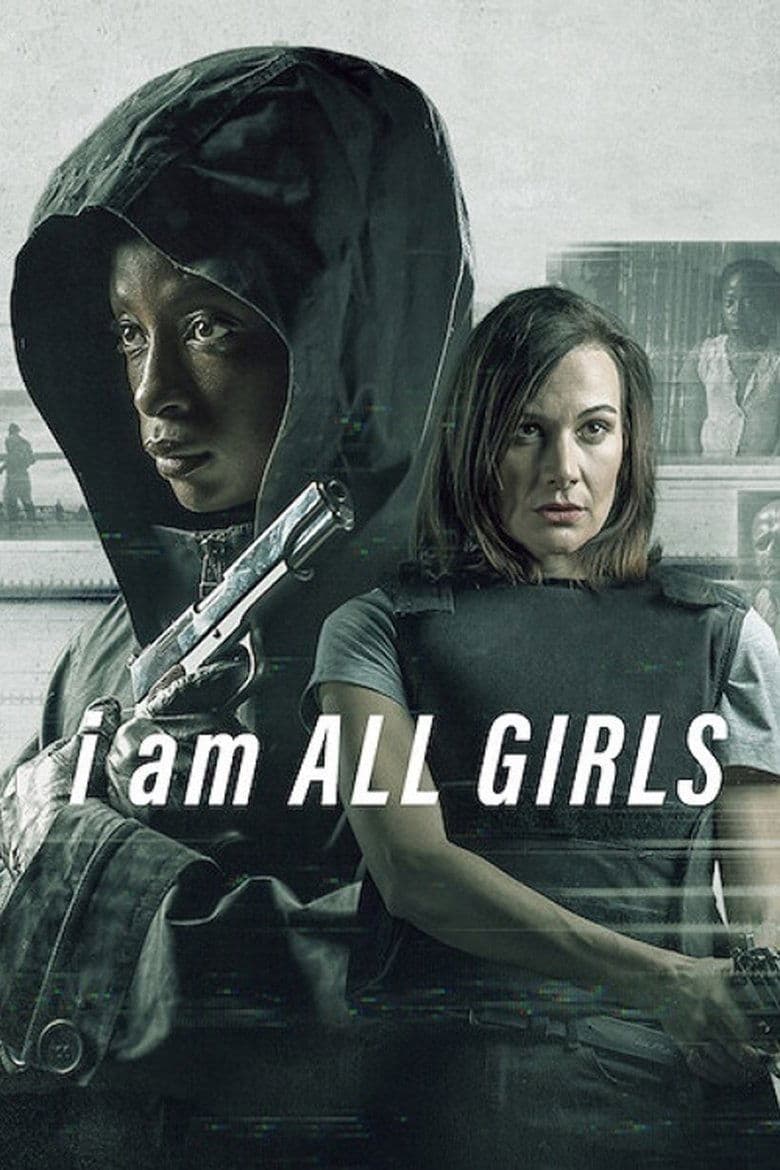
I Am All Girls is a dark South African crime thriller set between Johannesburg in 1994 and the present day. Special crimes investigator Jodie Snyman follows murders linked to six girls who vanished during apartheid. Her work leads to a child trafficking ring tied to powerful officials, businessmen, and buyers overseas. Jodie also suspects that her colleague Ntombizonke Bapai is hiding a secret linked to the killings. The film uses flashbacks, police work, and violent revenge to tell a grim story about abuse, guilt, and justice.
The clearest audience-visible woke element is the female-led design. The film gives its two central crime-solving roles to women, including a white detective and a black forensic officer. Jodie and Ntombizonke share an intimate relationship, so LGBTQ representation is part of the main character drama. Ntombizonke's past as a trafficked girl drives her revenge, and Jodie later continues that mission. These themes matter across the story, but the film stays focused on trafficking and punishment instead of modern political or DEI speeches.
Community feedback
Was our 34% Woke rating accurate?
Breakdown
These are the editorial factors and ratings behind our score for I Am All Girls.
Woke representation / casting
The film gives its two main crime-solving roles to women, with one as a Hawks investigator and the other as a forensic detective. The pair are also shown as a white and black couple. News and interviews describe them as fierce, powerful, and empowering women. The modern South African setting makes the casting believable, but the repeated female-led design and its identity framing remain clear.
32%
Woke political dialogue
Not present. The film mentions apartheid, white and township children, and a National Party minister. The dialogue uses those details for the crime story and does not push a modern identity, DEI, or activist argument.
0%
Identity-driven story themes
The story makes two women the central investigators and gives them most of the emotional and action focus. The film makes Ntombizonke’s history as a trafficked child the reason she hunts the men who hurt her. The film shows her turning to killings when official justice fails. The two women have an intimate relationship, and Jodie takes over Ntombizonke’s revenge mission at the end.
50%
Western institutional / cultural critique
Not present. The film shows corrupt apartheid officials, wealthy traffickers, and a police unit with little funding. It treats these points as history and crime, not as a modern attack on Western culture, capitalism, religion, or family life.
0%
Woke character or canon changes
Not relevant. The film uses fictional investigators and a fictionalized thriller plot around a real case. It does not change an established fictional character or clearly recast a named real person by race, sex, or sexuality.
0%
Anti-woke backlash and complaints
Not present. The supplied X research found no anti-woke reaction. Broader reviews, Reddit posts, and news coverage discussed trafficking, violence, and story quality instead of DEI or identity politics.
0%
Creator track record context
The cached creator scores run from 0 to 8, with Marsh at 3 and all listed writers at 0 or 1. The producers and casting director also have no clear record of DEI activism or identity-first work. Title interviews focus on trafficking awareness and police work, so the crew context adds only a very small signal.
3%
Production
Movie · 2016
Denmark, 2016. A blurred note is found in a bottle that has traveled across the ocean for a long time. After deciphering the cryptic note, Department Q follow a sinister trail…
Movie · 2019
After a mass shooting at a police funeral, reclusive ex-cop Gannon finds himself unwittingly forced out of retirement when he realizes that the killer belongs to the same militia…
Movie · 2023
Following the brutal murder of a young real estate agent, a hardened detective attempts to uncover the truth in a case where nothing is as it seems, and by doing so dismantles the…
Movie · 2019
In the wake of his dramatic escape from captivity, Jesse Pinkman must come to terms with his past in order to forge some kind of future.
Movie · 2024
A middle-class bank clerk who longs to trade stability for adventure gets more than he bargained for when he unexpectedly becomes a wealthy man.
Movie · 2021
A cold and mysterious new security guard for a Los Angeles cash truck company surprises his co-workers when he unleashes precision skills during a heist.

Movie · 2021
The seemingly casual reunion of three old friends at an out-of-the-way repair shop masks a hidden agenda fuelled by the arrival of a privileged young yuppie.
Movie · 2018
Young and disenchanted Sam meets a mysterious and beautiful woman who's swimming in his building's pool one night.
