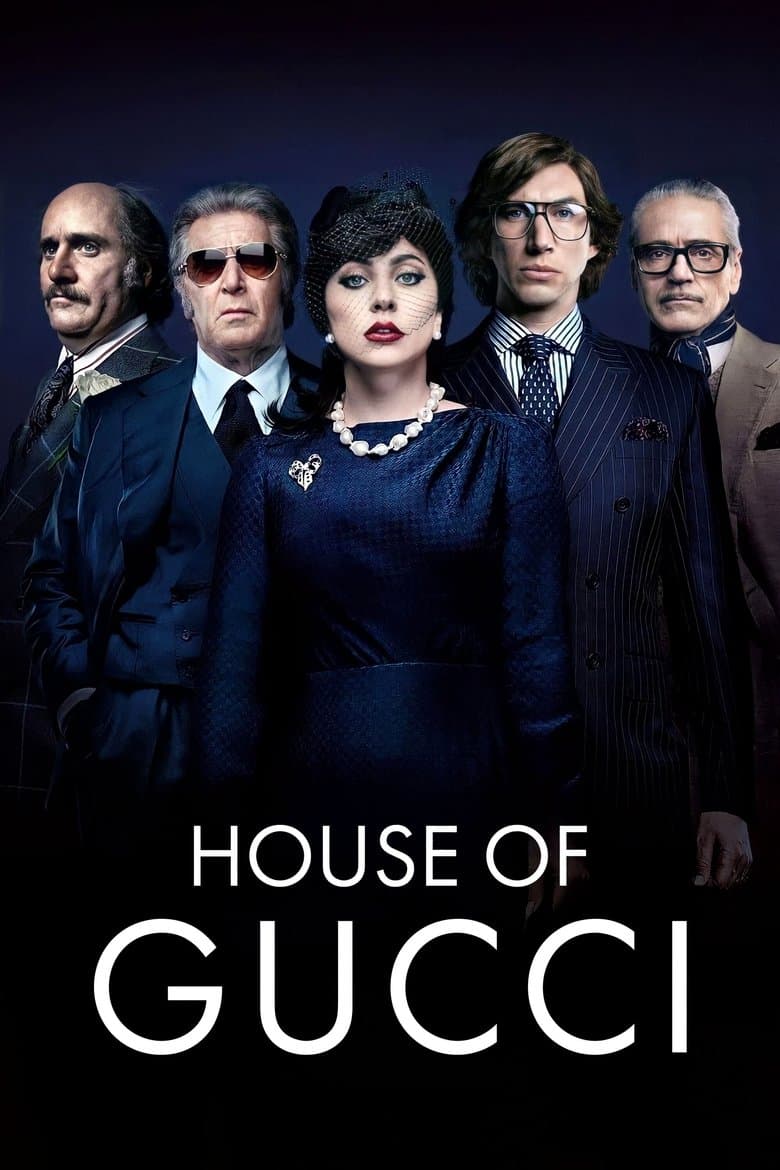
Patrizia is a sharp, hungry outsider who works for her father’s trucking firm in Italy. She meets Maurizio Gucci, a quiet heir to the famous fashion house, and pushes hard to marry him. Their love turns into a fight over money, power, and the family name. The movie feels big, flashy, and often over-the-top as greed, betrayal, and revenge lead to murder.
The story is mainly about ambition, family fighting, luxury, and crime. A normal viewer mostly sees a woman fighting her way into a rich men’s family business, then losing control when her marriage falls apart. Some press and cast talk used words about power, gender, and “empowerment,” and the Gucci family said the film treated Patrizia too kindly as a woman stuck in a macho company world. That gender-and-power angle is there in the plot, but the film still centers greed, glamour, and murder more than activist identity messages. Casting mostly fits the Italian fashion setting. Public fights were about accents, makeup, and family accuracy, not a big “too woke” wave.
Community feedback
Was our 29% Woke rating accurate?
Breakdown
These are the editorial factors and ratings behind our score for House of Gucci.
Woke representation / casting
Leads and core family roles match an Italian fashion dynasty story. Salma Hayek as Italian psychic Pina is a mild stretch, and some supporting business or hitman parts use non-Italian actors, but this does not read as heavy quota or identity-first casting in main roles.
5%
Woke political dialogue
Talk centers on money, status, family control, and revenge. Gender and class tension show up in how Patrizia is treated, but the film is not full of modern activist speeches or social-justice lectures.
18%
Identity-driven story themes
Core arc is an ambitious woman outsider pushing into a male-run family business, then destroying it. Viewers can notice power-between-men-and-women themes. Still, the main engine is greed, betrayal, and murder, not race, queer identity, or modern activist identity politics.
28%
Western institutional / cultural critique
Shows rich family corruption, tax trouble, and a closed male fashion world that freezes Patrizia out. That can feel like a light critique of old male power. It is not a big modern attack on capitalism, whiteness, Christianity, or Western culture as systems.
24%
Woke character or canon changes
Real people are compressed and dramatized for a biopic. The notable identity-linked complaint is framing Patrizia more as a woman fighting macho power than only as a cold killer. No major race or gender swaps of famous characters drive the story.
15%
Anti-woke backlash and complaints
Public fights focused on accents, prosthetics, family accuracy, and tone. No clear mainstream wave of anti-woke claims that the film pushes DEI or identity propaganda. Left-side “not feminist enough” takes do not count here.
0%
Creator track record context
Cached scores are mostly low to mild. Scott is modest; writers and many producers near zero; Gilbert is the clearest higher DEI-linked producer. Overall crew context is light support, not a hard activist package.
14%
Production
Movie · 2017
The story of the kidnapping of 16-year-old John Paul Getty III and the desperate attempt by his devoted mother to convince his billionaire grandfather Jean Paul Getty to pay the…
Movie · 2019
Pennsylvania, 1956. Frank Sheeran, a war veteran of Irish origin who works as a truck driver, accidentally meets mobster Russell Bufalino.

Movie · 2018
Earl Stone, a man in his eighties, is broke, alone, and facing foreclosure of his business when he is offered a job that simply requires him to drive.
Movie · 2021
A cold and mysterious new security guard for a Los Angeles cash truck company surprises his co-workers when he unleashes precision skills during a heist.

Movie · 2016
Nate Foster, a young, idealistic FBI agent, goes undercover to take down a radical white supremacy terrorist group.

Movie · 2022
In the 1980s, a team of lawyers takes on the heads of Argentina's bloody military dictatorship in a battle against odds and a race against time.
Movie · 2018
On the night she plans on taking her own life, 17-year-old 'Lisa McVey' is kidnapped and finds herself fighting to stay alive and is raped.

Movie · 2019
A young agent is tasked with investigating a tangled web of corruption and fraud in New York.
