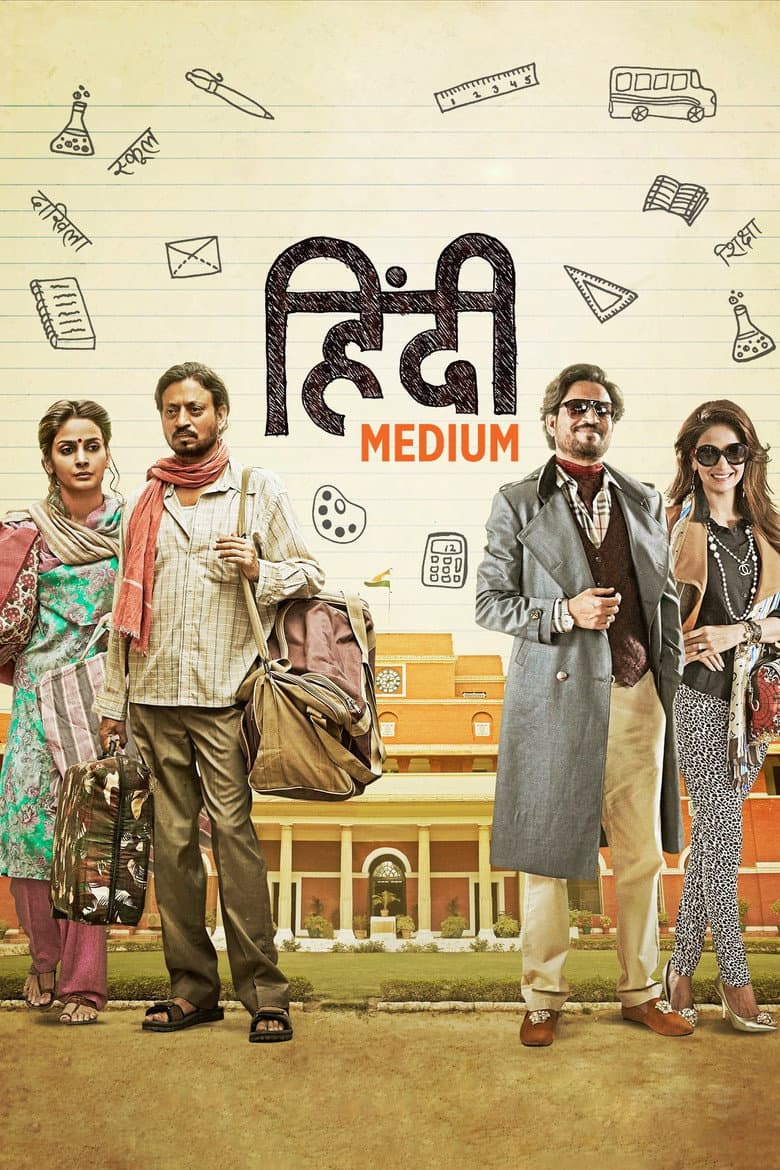
Raj Batra runs a successful clothes shop in Delhi’s Chandni Chowk, but he feels small beside English-speaking families. His wife Mita wants their daughter Pia in a top English-medium school because she thinks that school will lift the family into a higher social class. The couple moves to Vasant Vihar, changes their clothes and manners, and tries every trick after the school rejects them. They later move into a poor settlement, pretend to be poor for a seat meant for low-income children, and meet Shyam and Tulsi, whose son needs the same chance. The film mixes broad jokes about status and bad English with a serious story about parents, money, and a child’s future.
The film makes English a clear sign of class power, and several scenes show parents being judged by their accent, clothes, home, and school ties. It attacks elite private schools, paid admission coaching, and the misuse of the Right to Education quota for poor children. Raj’s final speech calls out this unfair system, and he and Mita choose a government school for Pia after Raj faces his guilt. The message supports equal access to education and respect for Hindi-speaking families, but it stays tied to class and schooling rather than race, gender, or sexuality.
Community feedback
Was our 39% Woke rating accurate?
Breakdown
These are the editorial factors and ratings behind our score for Hindi Medium.
Woke representation / casting
Saba Qamar, a Pakistani actor, plays the lead wife in a Delhi family. The film does not make her nationality part of the character or plot. The rest of the main cast fits the Indian setting, and the director said nationality was not part of the casting decision. The choice is noticeable, but it is not pushed as a diversity message.
10%
Woke political dialogue
Raj and Mita repeatedly describe English as a class marker instead of only a language. Characters talk about unfair school access and the seat meant for poor children. Raj gives a final speech about English, education rights, and the damage caused by status rules. These lines support a social message, but they stay inside the school story and do not promote party politics.
28%
Identity-driven story themes
The main story is built around class, language, and unequal access to education. Raj and Mita try to buy a higher social place, then take a poor child’s quota seat and face the harm they caused. The film treats English-speaking status, private-school gatekeeping, and weak government schools as linked social problems. The message is central and activist in tone at times, but it is about Indian class and education rather than race, sex, or queer identity.
38%
Western institutional / cultural critique
The film attacks elite private schools, admission consultants, school branding, and the misuse of the Right to Education quota. It also contrasts rich neighborhoods with poor settlements and points to weak government schools. The story links English status to India’s colonial past. Its target is Indian education and class pressure, not Western culture or religion.
26%
Woke character or canon changes
Not relevant. This is a contemporary original story about Raj, Mita, Pia, and Shyam. It does not change established characters, canon, or real historical figures.
0%
Anti-woke backlash and complaints
Not present. Public complaints focused on the film’s writing, stereotypes, sentimental ending, and alleged copying. No sustained complaint said that the film pushed woke, DEI, or identity-politics content.
0%
Creator track record context
The director and writer often build stories around class pressure, status, family demands, and unequal access. The producer Dinesh Vijan and casting director Honey Trehan also have records of socially themed or representation-focused films. Producer Bhushan Kumar has a mainly commercial record, so the full team is mixed. This gives the title a moderate creator track record context, but not a strong activist or identity-politics signal.
40%
Production

Movie · 2020
Four stagnant high school teachers decide to test out a theory that maintaining a constant level of intoxication will improve their overall lives.

Movie · 2022
Two lifelong friends find themselves at an impasse when one abruptly ends their relationship, with alarming consequences for both of them.

Movie · 2016
Two high school girls are best friends until one dates the other's older brother, who is totally his sister's nemesis.

Movie · 2023
Allison's life falls apart following her involvement in a fatal accident. The unlikely relationship she forms with her would-be father-in-law helps her live a life worth living.

Movie · 2020
Scott has been a case of arrested development ever since his firefighter father died when he was seven. He's now reached his mid-20s having achieved little, chasing a dream of…
Movie · 2019
The story of Rudy Ray Moore, who created the iconic big screen pimp character Dolemite in the 1970s.

Movie · 2023
Single mom Flora is at a loss about what to do with her rebellious teenage son, Max. Her efforts to keep him out of trouble lead to a beat-up acoustic guitar, a washed-up LA…

Movie · 2018
Vignettes weaving together the stories of six individuals in the old West at the end of the Civil War. Following the tales of a sharp-shooting songster, a wannabe bank robber, two…
