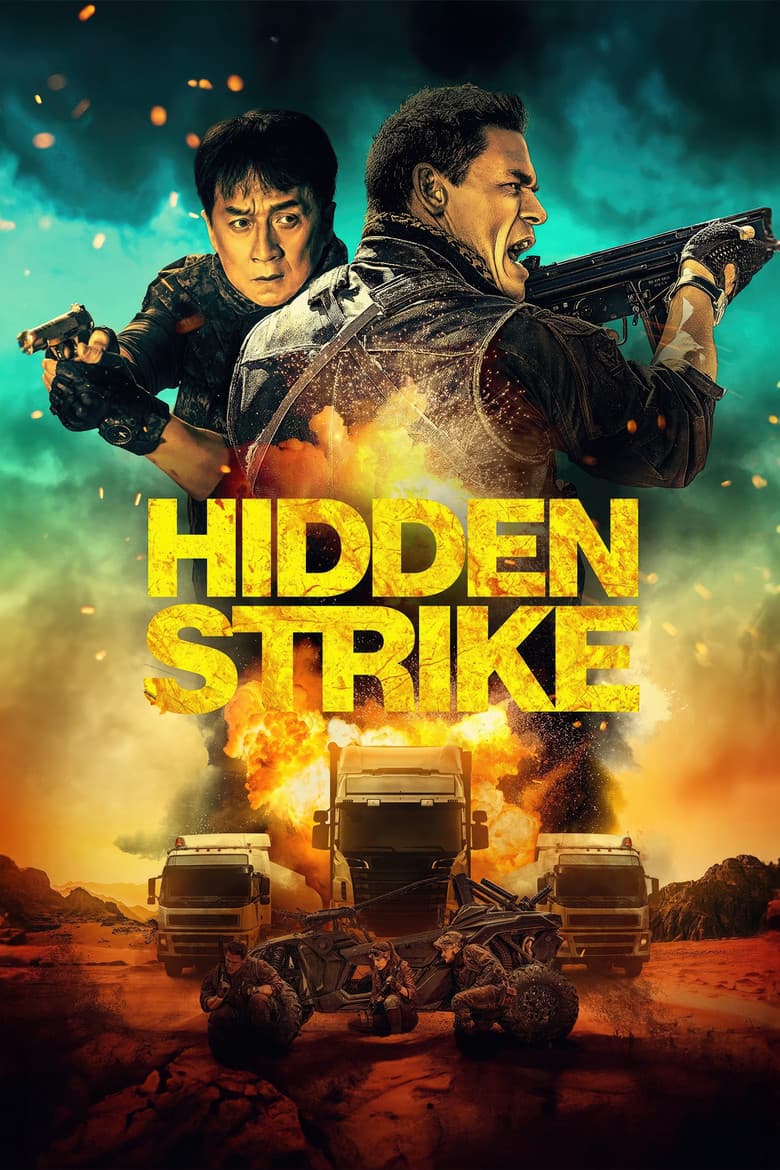
Hidden Strike follows Dragon Luo, a Chinese security leader who must move nearly 500 refinery workers and their families across a dangerous road in near-future Iraq. Former U.S. Marine Chris Van Horne attacks the convoy because he needs money to restore water for a village, but he learns that the mission is a trap. Luo and Chris then join forces against Owen Paddock, a mercenary who wants control of the refinery and its oil. The film uses explosions, vehicle chases, martial arts, jokes, and a father-daughter story to make a loud, cartoon-like action comedy.
The film presents Chinese and American fighters as rivals who overcome language and cultural mistakes and work together. It also shows a company controlling the local water supply while a village struggles to get enough water, so the story gives a mild anti-corporate message. That idea supports the rescue plot but does not control the movie. The main focus stays on family regret, survival, teamwork, and broad action entertainment.
Community feedback
Was our 16% Woke rating accurate?
Breakdown
These are the editorial factors and ratings behind our score for Hidden Strike.
Woke representation / casting
Not present. The cast matches the story’s world: Chinese refinery workers, an American former Marine, and Iraqi villagers. The film includes capable Chinese women in refinery jobs, but it does not frame their gender or ethnicity as a diversity message.
0%
Woke political dialogue
Chris’s village scenes say Unicorp has cut off the water and can make water cost more than oil. Owen later says the company got rich while he worked for nothing and that he will take back what it owes. Those lines give the movie a brief anti-corporate political message. The rest of the dialogue is about combat, money, family, language mistakes, and jokes.
15%
Identity-driven story themes
Not present. Cross-cultural teamwork creates jokes and confusion, but the film does not make race, gender, sexuality, identity rights, or a modern activist cause its main message. The main themes are survival, family regret, teamwork, and redemption.
0%
Western institutional / cultural critique
Hidden Strike shows Unicorp as a company that blocks a village’s water and makes the villagers find $100,000 to restore it. Owen says he watched the company get rich while he worked for nothing, and he plans to take its oil for himself. This gives the story a mild anti-corporate message about control of basic resources. The film does not attack Western culture, religion, family life, or traditional gender roles, so the signal stays low.
20%
Woke character or canon changes
Not relevant. Hidden Strike is an original action movie with no known fictional series or source canon. The writer said the film changed a real evacuation into a near-future setting after Chinese censorship concerns, not because of identity or DEI messaging.
0%
Anti-woke backlash and complaints
Not present. The separate X check found no anti-woke reaction or specific complaints. Wider reviews and audience posts focused on CGI, the plot, tone, and the Chan-Cena pairing, while a few China or propaganda comments did not make a woke or identity-politics complaint.
0%
Creator track record context
Arash Amel has a mild record of writing stories about immigrant and minority people. Scott Waugh’s work centers on military action and has no strong public activist pattern. Jackie Chan’s public profile is tied more to martial arts and pro-China views than Western identity politics. The other listed producers have no strong activist record in the available summaries. This gives the title weak creator track record context.
8%
Production
Movie · 2016
The most dangerous former operative of the CIA is drawn out of hiding to uncover hidden truths about his past.
Movie · 2020
A couple flying on a small plane to attend a tropical island wedding must fight for their lives after their pilot suffers a heart attack.
Movie · 2018
Framed and on the run, a former FBI agent must save his family from a blazing fire in the world's tallest building.

Movie · 2016
A man who bears a striking resemblance to a renowned movie star becomes an obsessive fan, but when his fierce love is spurned by the star, he decides to destroy the star's life…
Movie · 2023
When a mysterious caller plants a bomb under his car seat, a bank executive begins a high-speed chase across the city to complete a specific series of tasks — all with his kids…
Movie · 2016
A detective from Hong Kong teams up with an American gambler to battle against a notorious Chinese criminal.

Movie · 2024
When the plots of reclusive author Elly Conway's fictional espionage novels begin to mirror the covert actions of a real-life spy organization, quiet evenings at home become a…
Movie · 2016
The life of a bank manager is turned upside down when a friend from his past manipulates him into faking his own death and taking off on an adventure.
