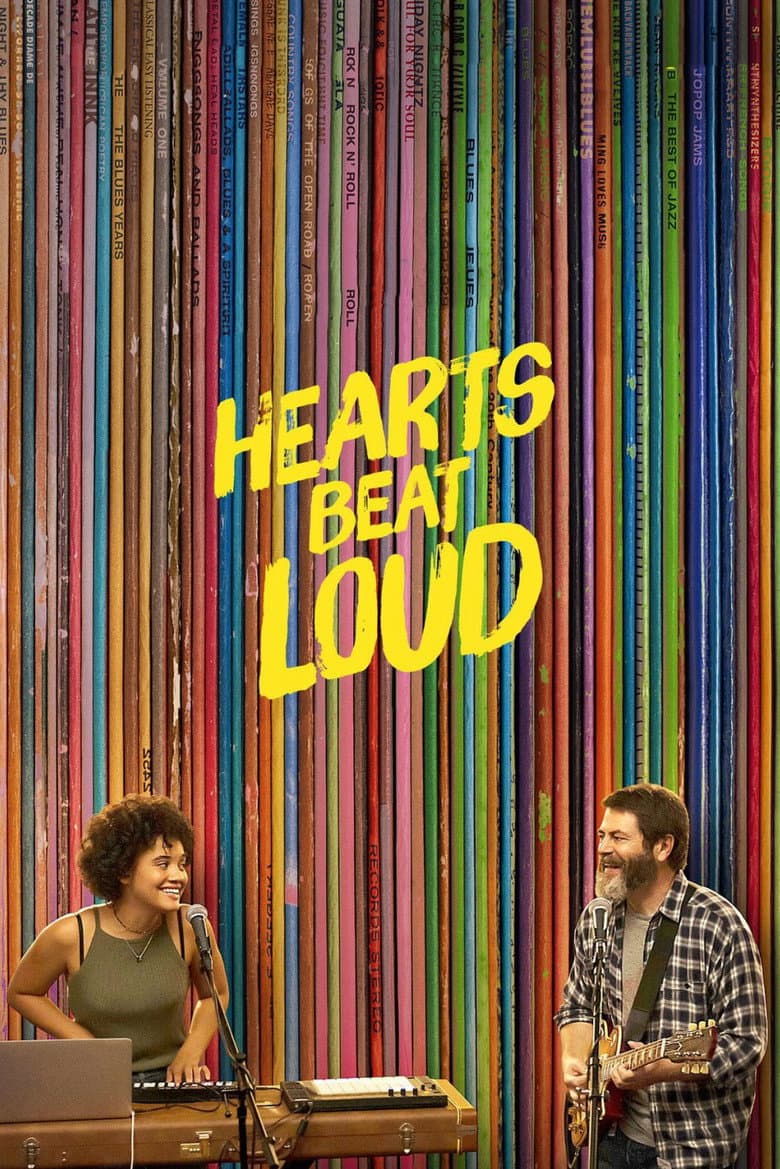
Hearts Beat Loud follows Frank Fisher, a widowed father who runs a small record shop in Red Hook, Brooklyn. The shop is failing, and Frank is scared of losing both his business and his daughter Sam, who is leaving for college in California. Frank pulls Sam into making songs with him, and their first track becomes an online hit that brings sudden attention from music people. The film uses gentle comedy, family drama, and live music to show how both of them face grief, money trouble, and the end of their old family routine.
Sam is a hard-working future doctor, a singer, and a young woman who dates Rose, an artist she meets in Brooklyn. Their romance is open and calm, with no coming-out fight or attack from the family, and Rose becomes part of Sam's final summer. The story also presents Sam as more responsible than Frank, so the daughter often guides the father while he tries to hold on to her. The film gives visible weight to a biracial black lead and a queer relationship, but its main focus remains family, music, grief, and the need to let a child grow up.
Community feedback
Was our 48% Woke rating accurate?
Breakdown
These are the editorial factors and ratings behind our score for Hearts Beat Loud.
Woke representation / casting
The film puts a biracial black young woman in the main role and a visibly mixed-race woman in the main romance. Brett Haley said he specifically wanted Sam to be mixed race or biracial and let Kiersey Clemons shape the role from her experience. Press coverage also framed the two young leads around diversity and representation. The Brooklyn setting makes the casting believable, but the repeated identity choices and direct framing make representation a clear production focus.
57%
Woke political dialogue
Not present. The dialogue does not give identity, DEI, or activist speeches. The characters talk about music, college, family, and the record shop.
0%
Identity-driven story themes
Sam is a biracial queer young woman who chooses medicine and her own future. Her romance with Rose gives her a real emotional arc and shapes one of the main songs. The story treats their relationship as normal and makes Sam more responsible than Frank, who often needs her guidance. The main message is still about a father letting go and a daughter growing up, so identity is important but not the whole plot.
44%
Western institutional / cultural critique
Not present. The film shows a record shop struggling with digital music and changing tastes. It does not turn that problem into an activist attack on capitalism, patriarchy, religion, or Western institutions.
0%
Woke character or canon changes
Not relevant. The film is an original story about Frank, Sam, and Rose. It does not change an established character, source, or historical figure.
0%
Anti-woke backlash and complaints
Not present. The separate X research pass found no anti-woke reaction, and wider searches found no sustained claim that the film pushes DEI or identity politics. One hateful audience comment attacked race and sexuality, but it did not make a clear woke-content complaint.
0%
Creator track record context
Brett Haley has a soft representation-first pattern and publicly described wanting Sam to be mixed race or biracial. Nick Offerman has a public record of LGBTQ support and liberal views. Jackie Kelman Bisbee and some other producers have backed socially focused films, while many listed producers have little public activist record. This gives the film a moderate creator track record context, but it is not a strongly activist group overall.
40%
Production

Movie · 2020
A gorilla named Ivan who’s living in a suburban shopping mall tries to piece together his past, with the help of other animals, as they hatch a plan to escape from captivity.
Movie · 2017
In 1843, despite the fact that Dickens is a successful writer, the failure of his latest book puts his career at a crossroads, until the moment when, struggling with inspiration…

Movie · 2017
The film follows a man with an unwanted gift for healing who meets a teenager with cancer who helps him to find himself.
Movie · 2022
Two years after a Super Bowl win when NFL head coach Sean Payton is suspended, he goes back to his hometown and finds himself reconnecting with his 12-year-old son by coaching his…

Movie · 2024
The Herdman kids are undeniably the worst kids in the history of the world. They lie, steal, cheat, bully and overall terrorize their small community.
Movie · 2016
James Bowen, a homeless busker and recovering drug addict, has his life transformed when he meets a stray ginger cat.

Movie · 2022
Follows Ralphie, now adult, who returns to the house on Cleveland Street to give his kids a magical Christmas like the one he had as a child, reconnecting with childhood friends…
Movie · 2018
An aging Chinese mother suffering from empty nest syndrome gets another chance at motherhood when one of her dumplings springs to life as a lively, giggly dumpling boy.
