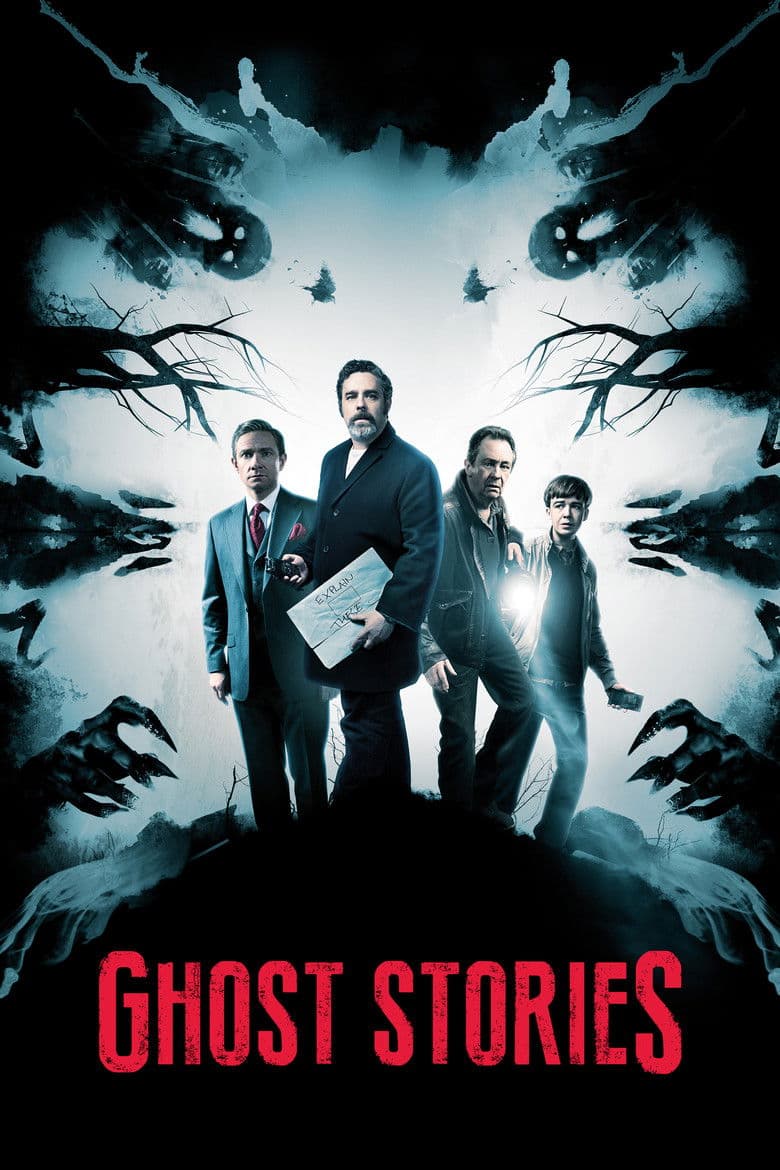
Ghost Stories follows Professor Philip Goodman, a British skeptic who exposes fake psychics on television. He travels through Yorkshire after his old hero gives him three cases that seem to involve ghosts. The cases lead him through an empty women's asylum, a lonely country road, and a rich man's home as he searches for plain answers. The film uses dark jokes, slow fear, and sudden shocks before it turns toward guilt, memory, and a painful family secret.
The film includes a short story about identity and prejudice. Goodman's strict Jewish father rejects his daughter after she dates a South Asian man, and boys later insult Goodman for being Jewish while bullying a disabled boy. These scenes condemn family prejudice and the harm caused when a witness stays silent, but they serve Goodman's personal guilt rather than a modern political campaign. The main plot stays focused on ghosts, faith, grief, fathers, and the danger of hiding past wrongs.
Community feedback
Was our 23% Woke rating accurate?
Breakdown
These are the editorial factors and ratings behind our score for Ghost Stories.
Woke representation / casting
Not present. The film uses a mostly British cast in present-day Yorkshire. It does not present its casting as a diversity message or build a representation-first group.
0%
Woke political dialogue
Not present. The film has lines about religious family conflict, an antisemitic insult, and a priest's complaint about modern focus on personal gain. These lines explain the characters and the horror, but they do not push modern identity, DEI, gender, or activist politics.
0%
Identity-driven story themes
The story uses Goodman's Jewish family history as part of his guilt. The opening shows his father rejecting his daughter after she dates a South Asian man. The climax recalls boys using an antisemitic insult and abandoning a disabled child. These scenes make prejudice and failure to help part of the main character's past, but the film stays focused on personal guilt rather than modern identity politics.
28%
Western institutional / cultural critique
The film briefly shows a strict father whose religious prejudice harms his family. The cases also show men failing as fathers through neglect, pride, or silence. The movie treats these as personal guilt in a horror story. It does not attack Western institutions or traditional social norms as a broad modern political system.
18%
Woke character or canon changes
Not relevant. The film changes its stage-play structure for the screen, but it does not change an established character's race, gender, sexuality, or identity.
0%
Anti-woke backlash and complaints
Not present. No specific complaint was found that the film pushes woke, DEI, or identity politics. Public discussion focused on the scares, the twist, and whether the ending makes sense.
0%
Creator track record context
Cached profiles describe Nyman and Dyson as horror, comedy, and magic creators with no broad activist record. The producer profiles are mostly commercial or independent-film work. Shaheen Baig's stored profile includes inclusive casting and training work. The available profiles do not show a strong activist or identity-led public profile among the key creators.
20%
Production
Movie · 2022
In the wake of a young Jewish girl’s disappearance, the son of a Hasidic funeral director returns home with his pregnant wife in hopes of reconciling with his father.
Movie · 2016
A mother and her 10-year old daughter are trapped in a forest. There is something in this forest. Something unlike anything they have heard before.
Movie · 2018
When Simon brings his twelve year-old son, Finn, to rural Vermont to help flip an old farmhouse, they encounter the malicious spirit of Lydia, a previous owner.
Movie · 2023
On the day of his scheduled execution, a convicted serial killer gets a psychiatric evaluation during which he claims he is a demon, and further claims that before their time is…
Movie · 2017
In a small town in Maine, seven children known as The Losers Club come face to face with life problems, bullies and a monster that takes the shape of a clown called Pennywise.
Movie · 2026
After breaking the mysterious "One Wish Willow" to win his crush's heart, a hopeless romantic finds himself getting exactly what he asked for but soon discovers that some desires…
Movie · 2017
Real zombies arrive and terrorize the crew of a zombie film being shot in an abandoned warehouse, said to be the site of military experiments on humans.
Movie · 2020
When an outbreak hits, Aidan barricades himself inside his apartment and starts rationing food. His complex is overrun by infected Screamers, and with the world falling apart into…
