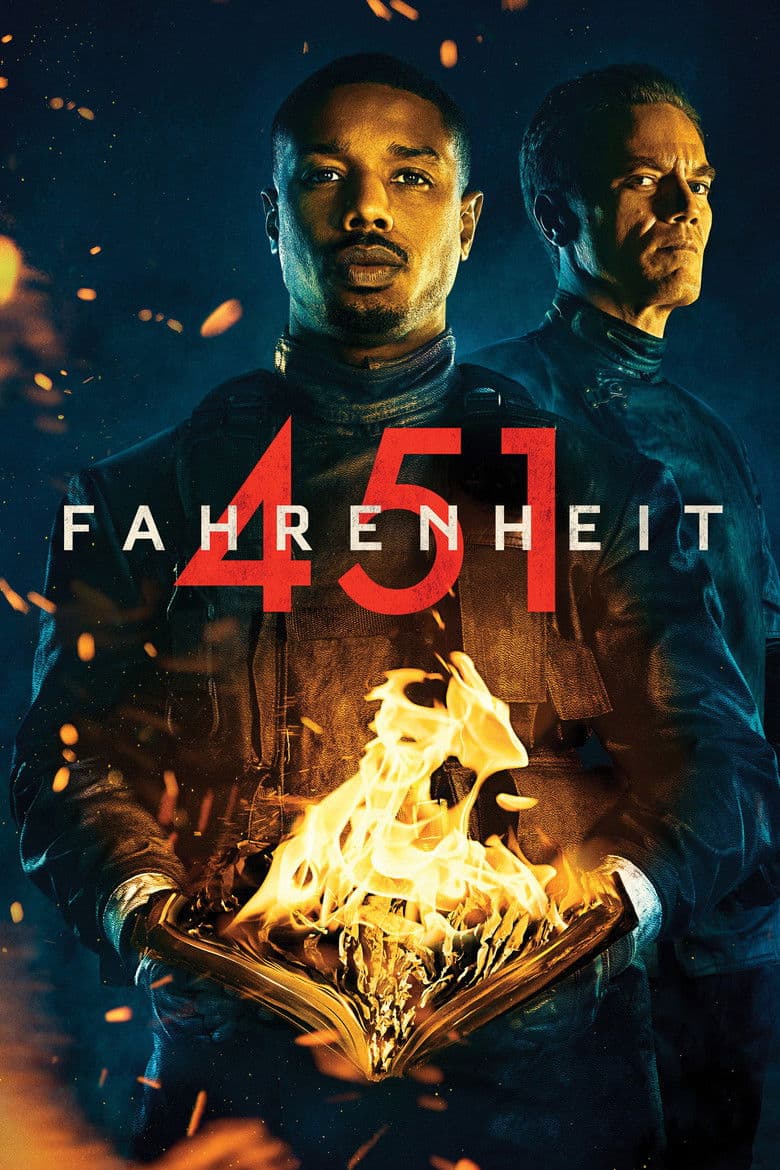
Guy Montag works as a fireman in a future Cleveland that has survived a second American Civil War. His unit burns books, records, films, and other things that may make people think for themselves. The Ministry keeps order through the Nine, a giant online system that feeds people simple messages, drugs, and nonstop shows. Montag starts to doubt his work after a woman dies rather than give up her books, and he joins Clarisse and the hidden Eels. The film feels dark, tense, and angry, with flashes of violent action.
The film adds a visible focus on race, gender, immigration, and who gets to control public speech. Captain Beatty says books were burned because black people and feminists objected to some writers, then says fire makes everyone equal. The Eels are treated as illegal outsiders, and their identity, money, and travel rights can be erased by the state. The story presents the Ministry, its tech companies, and its online crowds as a modern system that uses fear, false facts, and forced happiness to crush free thought. These ideas support the film’s warning about censorship, but the main plot stays focused on saving books and preserving human memory.
Community feedback
Was our 60% Woke rating accurate?
Breakdown
These are the editorial factors and ratings behind our score for Fahrenheit 451.
Woke representation / casting
Michael B. Jordan plays Guy Montag as a black man in a role long shown as white in earlier versions. Sofia Boutella plays the important rebel Clarisse, and Laura Harrier plays Montag’s wife. Bahrani said he wanted a more inclusive science-fiction world, so the prominent casting pattern also carries a clear identity message.
45%
Woke political dialogue
Captain Beatty says books were burned because black people and feminists objected to some writers. The firemen chant, “Time to burn for America again,” while state messages speak about illegal migration, jobs, taxes, and national security. The film also repeats messages about equality, forced happiness, and control of public information. Much of the other political dialogue focuses on censorship and technology.
38%
Identity-driven story themes
Montag’s rebellion centers on a Ministry that erases the identity of people who keep banned ideas. The Eels are called illegal outsiders, and the film links their treatment to border control, jobs, taxes, and fear of strangers. Beatty ties the destruction of books to complaints about race and feminism. The story mainly defends free thought and books, but its identity and immigration ideas remain part of the resistance plot.
46%
Western institutional / cultural critique
The Ministry controls speech, memory, travel, and money through firemen and the Nine. Old technology companies become part of the Ministry after a second civil war, and the film says citizens traded freedom for comfort. The firemen act like a militarized police force, while state news and online crowds turn arrests into public shows. The film ties this system to false facts, illegal-migration language, and “America again” slogans, giving its anti-authority message a present-day political edge.
43%
Woke character or canon changes
The film presents Guy Montag as a black man, while Bradbury’s novel and earlier screen versions generally treated him as white. The film adds books by Toni Morrison and Zadie Smith to the banned material. Bahrani said these choices were part of a more inclusive version of a genre that often centers white male writers. The adaptation changes both a major character’s presentation and the cultural voices represented by the books.
45%
Anti-woke backlash and complaints
Not present. The separate X research pass found no anti-woke reaction and listed no specific complaints. Web and audience coverage focused on adaptation quality, censorship, social media, and Trump-era politics instead.
0%
Creator track record context
Ramin Bahrani has a limited record of modern identity activism, and Ray Bradbury’s work centers on books, freedom, and individual thought rather than DEI. Amir Naderi also has no clear identity-activist record. Michael B. Jordan has publicly supported Black Lives Matter and spoken about racial inequality, and he produced the film. His role adds some context because the movie also uses race and inclusion themes, but the story is not built around his activism.
28%
Production
Movie · 2019
In a series of escalating encounters, former security guard David Dunn uses his supernatural abilities to track Kevin Wendell Crumb, a disturbed man who has twenty-four…

Movie · 2017
A young tech worker takes a job at a powerful Internet corporation, quickly rises up the company's ranks, and soon finds herself in a perilous situation concerning privacy…

Movie · 2019
A man becomes obsessed with facts and events that have been collectively misremembered by thousands of people.

Movie · 2016
After a catastrophic car crash, a young woman wakes up in a survivalist's underground bunker, where he claims to have saved her from an apocalyptic attack that has left the…
Movie · 2021
After a sudden global event wipes out all electronics and takes away humankind’s ability to sleep, chaos quickly begins to consume the world.

Movie · 2022
Mike and Kate, a young couple, get the once-in-a lifetime chance to win a cool five million dollars. The challenge: Live for 50 days in a blank space.
Movie · 2017
“2048: Nowhere to Run” takes place one year before the events of Blade Runner 2049. The short film focuses on Sapper, a man who is trying to make it through life day-by-day…

Movie · 2017
On a romantic getaway to Iceland, a young American couple wake up one morning to discover every person on Earth has disappeared.
