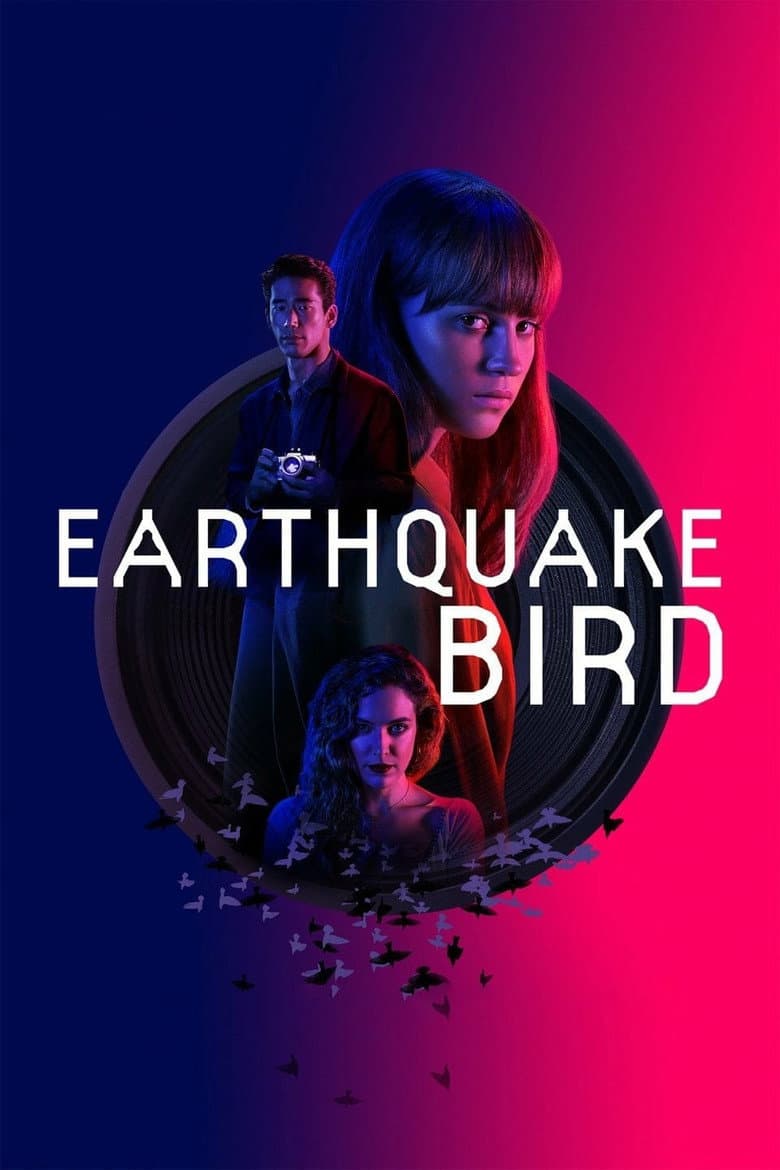
Earthquake Bird follows Lucy Fly, a Swedish translator living in Tokyo in 1989. Lucy has escaped a painful past, but she carries guilt and fears that death follows her. She falls into a tense relationship with Teiji, a Japanese photographer, after he starts taking her picture. When Lucy befriends Lily, an American newcomer, jealousy and suspicion grow around the three of them, and the story moves through police questioning, memories, and dreamlike scenes.
The film gives most of its attention to a guarded woman dealing with sex, trauma, jealousy, and fear. Lucy and Lily share an uneasy closeness, including an imagined sexual moment and a brief kiss that gives the friendship a queer edge. A short talk about single women, marriage, intimidating men, and caring for an old husband questions old ideas about what women should do. These ideas matter to the mood and the love triangle, but the film presents them through a dark mystery rather than a direct political message.
Community feedback
Was our 39% Woke rating accurate?
Breakdown
These are the editorial factors and ratings behind our score for Earthquake Bird.
Woke representation / casting
Not present. The story’s main cast matches its setting: a Swedish translator, an American newcomer, and a Japanese photographer in 1989 Tokyo. No diversity-first casting campaign or clearly out-of-place identity choice is reported.
0%
Woke political dialogue
A short talk at a kimono fitting says that being a single woman in Japan is hard. A female magistrate jokes that her job scares men and that marriage would mean caring for an old husband. The film uses the exchange to question marriage pressure, but the idea appears in one brief scene.
23%
Identity-driven story themes
The film centers on Lucy’s female view of trauma, sex, jealousy, and fear. The story gives Lucy and Lily an uneasy closeness, including an ambiguous kiss and Lucy’s imagined sexual moment with Lily and Teiji. The noir setup also makes a troubled woman the main mystery figure and treats her feelings as the story’s guide. These ideas shape the love triangle, but the film does not turn them into a direct activist message.
39%
Western institutional / cultural critique
A brief conversation presents marriage as a burden that can limit a working woman. A female magistrate jokes that her job scares men and that she would otherwise be expected to care for an old husband. The film does not build a wider attack on Western institutions, religion, family, or capitalism.
17%
Woke character or canon changes
The source novel places Lucy and Lily in Yorkshire, while the film makes Lucy Swedish and Lily American. The director linked Lucy’s nationality change to casting Alicia Vikander and avoiding a Yorkshire accent. The identity change is visible, but it is not presented as an activist or representation-first rewrite.
12%
Anti-woke backlash and complaints
Not present. No anti-woke complaints were found in the supplied X pass or in the reviewed news and audience pages. The visible discussion focuses on the plot, ending, pacing, and character depth.
0%
Creator track record context
Wash Westmoreland has a repeated history of queer and identity-framed films, including The Fluffer, Gay Republicans, Quinceañera, and Colette. Susanna Jones has no strong public record of activist or DEI work. The listed producers and technical staff mostly have low or unclear political profiles, so the director supplies most of this signal.
42%
Production
Movie · 2020
Nothing is as it seems when a woman experiencing misgivings about her new boyfriend joins him on a road trip to meet his parents at their remote farm.
Movie · 2019
A woman grieving over the death of her daughter loses grip of reality when she begins to think her girl may still be alive.

Movie · 2019
The quiet life of Baker Dill, a fishing boat captain who lives on the isolated Plymouth Island, where he spends his days obsessed with capturing an elusive tuna while fighting his…
Movie · 2022
7 years after the case related to Vijay Salgaonkar and his family was closed, a series of unexpected events bring truth to light that threatens to change everything for the…
Movie · 2018
A man and a woman meet in the ruins of post-war Poland. With vastly different backgrounds and temperaments, they are fatally mismatched and yet drawn to each other.
Movie · 2017
Paul is a down-on-his-luck screenwriter who picks up a drifter and offers him a place to stay. However, when the deranged stranger takes Paul hostage and forces him to write…
Movie · 2017
Barcelona, Spain. Adrián Doria, a young and successful businessman accused of murder, meets one night with Virginia Goodman, an expert interrogation lawyer, in order to devise a…
Movie · 2025
Based on a true story, two down-on-their-luck musicians form a joyous Neil Diamond tribute band, proving it's never too late to find love and follow your dreams.
