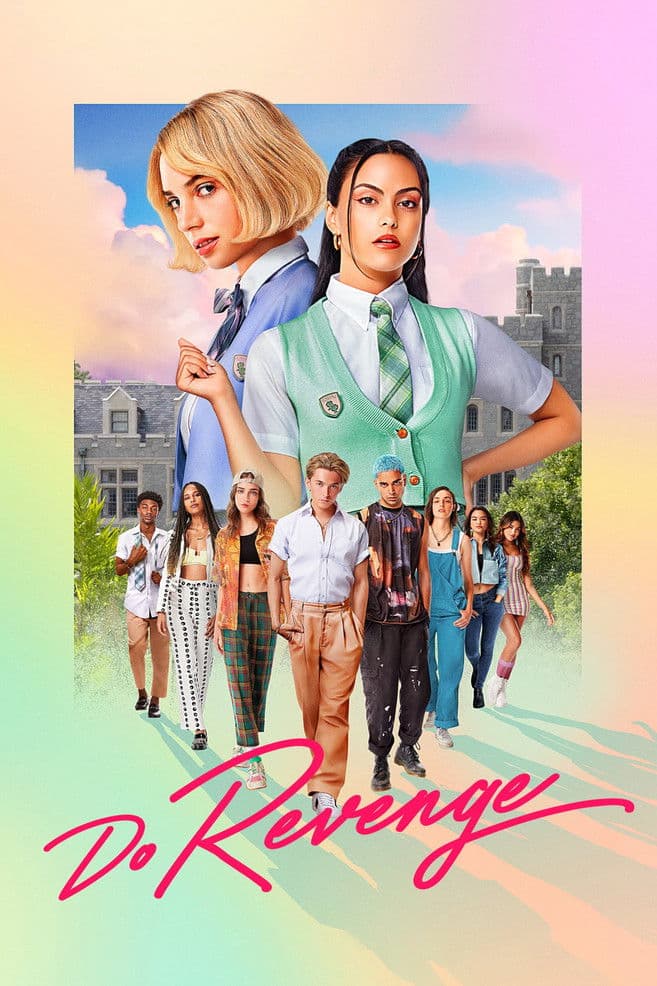
Drea Torres is a popular student at an expensive Miami private school. Her life falls apart after her boyfriend Max leaks a private video, and she loses her friends and place at school. Drea meets Eleanor, a quiet new student who was shamed by a false story about her sexuality. The girls make a deal to ruin each other’s enemies, but their plan turns into a messy fight over trust, guilt, and friendship. The film uses bright clothes, sharp jokes, school parties, and many twists to create a glossy dark comedy.
Visible woke elements are built into the main plot rather than added in one short scene. Eleanor is openly queer, dates Gabbi, and carries the pain of being branded a dangerous lesbian when she was younger. The film also treats Max as a fake feminist who uses words about women, identity, and patriarchy while he harms Drea, then sends him to a men’s group about toxic masculinity. Drea and Eleanor are shown as smart, forceful girls who can outplan the boys and expose the school’s unfair social rules. These ideas appear often, but the movie still centers revenge, betrayal, and the girls’ friendship.
Community feedback
Was our 61% Woke rating accurate?
Breakdown
These are the editorial factors and ratings behind our score for Do Revenge.
Woke representation / casting
The film puts a Latina scholarship student and a white queer student at the center of a private Miami school. It also gives visible roles to Black, South Asian, and other mixed-background students, with a woman serving as headmaster. Miami can support a varied student body, so ethnicity alone does not make the score high. The repeated identity mix and focus on two women as the smartest people in the room create a clear but moderate representation emphasis.
40%
Woke political dialogue
Max presents himself as a feminist ally while he leaks Drea’s private video and controls the school. Drea calls him a fake-woke misogynist, and the movie repeats words about identity, women, and patriarchy. Max creates a club for men who claim to support female students, and he later joins a group about toxic masculinity. The film also makes brief jokes about climate protesters and vegan activism. This language is tied to a major subplot, but it is played through dark comedy.
48%
Identity-driven story themes
Eleanor’s queer identity drives her revenge plan because a false story painted her as a dangerous lesbian. Her romance with Gabbi is a real subplot, and the film treats the relationship as normal and worth restoring. Drea’s leaked video, the double standard around sex, and Max’s false ally image make gender and shame part of the main conflict. The two girls are repeatedly shown as powerful, clever, and able to defeat boys who control the school. The story also shows that the girls are cruel and guilty, so the message is mixed.
50%
Western institutional / cultural critique
Max is presented as patriarchy in human form, and the film links his power to male entitlement, fake feminism, and control over girls. The school’s social order rewards status, beauty, money, and public image, while the girls use public exposure to bring it down. The ending sends Max to a men’s group about toxic masculinity and mocks his claim to be a good ally. The movie does not attack Christianity or make a broad case against capitalism or American institutions. Its modern Western institutional / cultural critique stays inside a comic high school story.
46%
Woke character or canon changes
Not relevant. The film is a loose new high-school story inspired by Strangers on a Train. It does not change established characters or a real historical story.
0%
Anti-woke backlash and complaints
The Federalist published a direct complaint that the film trades humor for wokeness. The review attacked the diverse cast, the patriarchy message, and the story’s treatment of Max as a toxic male villain. A few user reviews also call it a woke or painfully woke Gen Z movie. Most visible user reaction was favorable or focused on the twist, style, and pacing, so the backlash appears real but limited.
31%
Creator track record context
Jennifer Kaytin Robinson’s cached score is 41/100 because her earlier work often centers female leads, empowerment, and queer angles. Joshua Bachove’s cached score is 59/100 because of his LGBTQ-focused producing work. Celeste Ballard is cached at 18/100, and the other listed crew have low scores. This film clearly matches Robinson’s female-led and queer-related work, so the track record adds a moderate signal.
35%
Production
Movie · 2025
Dawn thinks she's joining a dating show in Paris, France, only to land in Paris, Texas. She has an exit plan — until sparks fly with the cowboy bachelor.
Movie · 2020
An on-the-lam punk rocker and a young woman obsessed with a local band go on an unexpected and epic journey together through the decaying suburbs of the American Midwest.
Movie · 2018
When teenager Elle's first kiss leads to a forbidden romance with the hottest boy in high school, she risks her relationship with her best friend.
Movie · 2022
Two strangers believe in love but never seem to be able to find its true meaning. In a wild twist of events, fate puts each in the other's path on one stormy New Year's Eve.
Movie · 2023
Two twenty-somethings, both reeling from bad break-ups, connect over the course of an eventful day in South London – helping each other deal with their nightmare exes, and…
Movie · 2018
Lara Jean's love life goes from imaginary to out of control when her secret letters to every boy she's ever fallen for are mysteriously mailed out.
Movie · 2016
A zombie outbreak has fallen upon the land in this reimagining of Jane Austen's classic tale of the tangled relationships between lovers from different social classes in 19th…
Movie · 2021
Troubled teen Will Hawkins has a run-in with the law that puts him at an important crossroad: go to juvenile detention or attend a Christian summer camp.
